
 Skip to main content

Key takeaways:
- Cybersecurity platforms, low‑level development solutions, and software handling personal data or user communications typically require security code audits more often than other projects.
- A security code review provides clarity on real security risks, as security specialists check the code for vulnerabilities relevant to each specific type of software.
- Companies usually run security code reviews before certifications, acquisitions, or critical releases because this is when unresolved security issues become real business risks.
- A professional, independent security code audit helps uncover security blind spots and inefficiencies that even mature in-house teams may miss, especially in complex or legacy systems.
- Structured reporting is what turns security code analysis into a decision‑making asset, as it shows your team what to fix, in what order, and how to do it efficiently.
Security risks rarely come from a single obvious flaw. More often, they hide in unclear data flows, legacy assumptions, or low‑level implementation details that don’t surface during routine testing.
For businesses, this creates a challenge: how to make confident decisions about releases, compliance, acquisitions, or modernization without having a clear view of the real security risks inside the codebase.
A security code review is meant to close this gap.
In this article, we look at what a proper security code review must cover, when it makes sense to run one, and what results you should expect.
Contents:
What is a security code review?
A security code review is a structured analysis of an application’s source code with the purpose of detecting vulnerabilities, security weak spots, and inefficient implementation patterns. This process includes reviewing both high‑level flows and security‑sensitive code paths that automated tools often miss. Because the review is performed with full access to the source code, it allows teams to validate assumptions embedded in the implementation. For example, a review checks who can call a function, what input is trusted, how failures are handled, and more.
You may also see this activity referred to as a security code audit or security code analysis. In this article, we use these terms interchangeably, as they describe the same thing.
Experienced engineers with strong cybersecurity skills examine everything that may directly affect exploitability and system stability:
- Authentication and authorization logic
- Data handling paths
- Trust boundaries, etc.
Organizations often choose to outsource this activity to third-party vendors in order to receive an unbiased evaluation and get access to professionals with a strong cybersecurity background, which they rarely have in-house.
Want to be confident in the security of your product’s code?
Let Apriorit professionals evaluate risks that are relevant to your project and provide your team with valuable security insights and tips for remediating vulnerabilities.
How can your business benefit from a security code review?
By exposing security weaknesses early, organizations can address them when fixes are still predictable in scope, cost, and timeline.
From a business standpoint, the key benefits of security code analysis include:
| Business advantage | How a security code review helps achieve it |
|---|---|
| ✅ Reduced risk of security breaches | 🎯 Identifying vulnerabilities before release lowers the likelihood of security incidents. |
| ✅ Lower remediation costs | 🎯 Fixing security issues during development is cheaper than responding to incidents later. |
| ✅ Clearer visibility for decision-making | 🎯 Findings are tied to specific code areas, making it easier to prioritize fixes and plan releases. |
| ✅ Support for compliance and audits | 🎯 A report acts as documented evidence that security risks were identified and assessed in a systematic way. |
| ✅ Protection of reputation and customer trust | 🎯 Going the extra mile to check project security reduces the risk of reputational damage. |
In other words, a security code analysis will help your business move from reacting to security problems to actively managing security risks.
When to run a security code review
Security code audits aren’t something businesses run by default at every stage of development. It makes sense to consider them when certain business situations, technical milestones, product characteristics, or technical signals indicate increased security risk or uncertainty.
From Apriorit’s experience, businesses most often request an external security code analysis when:
✓ Working on security products and solutions handling sensitive data. This includes security products such as EDR, XDR, or SIEM systems; low‑level components like drivers; and any software handling sensitive or personal data or enabling encrypted user communications. In these cases, a security code review helps businesses check critical components early and eliminate weak spots in security-centered solutions.
✓ Going through mergers, acquisitions, or product purchases. Reviewing the security of acquired software helps in evaluating its robustness, identifying inherited risks, and planning remediation early. External security code reviews are also invaluable during significant team changes and periods of rapid growth, when knowledge transfer may be incomplete.
Internal development teams, even strong ones, may have blind spots or unconscious biases toward their own code. An independent review provides objective, unbiased assurance that security‑critical issues have not been overlooked and that the product’s security posture aligns with expected standards.
Andrey, Software Designer at Apriorit
✓ Dealing with compliance requirements, certifications, and external audits. An independent and honest assessment helps you to identify and fix security issues before formal evaluation. As for meeting compliance demands, security code analysis helps to assess the current security posture and document due diligence.
✓ Struggling to align with security standards. It’s often hard to follow security frameworks such as OWASP or CIS that offer broad recommendations. Experienced security code auditors bring established review scopes and practical expertise, including knowledge of how to turn high‑level guidelines into concrete, product‑specific findings.
✓ Looking to detect security weak spots early. If not caught early, vulnerabilities can be exploited by malicious actors, leading to severe security incidents and consequences like data loss. Missed security issues are far more challenging and expensive to fix after release, as fixes often require emergency patches, customer communication, and operational downtime.
✓ Needing to identify hidden inefficiencies. Security code analysis can reveal implementation patterns that negatively affect system stability or growth. For example, inefficient error handling, unsafe resource use, or flawed synchronization logic may not only create security risks but also impact reliability under load. During a security code review, reviewers also analyze entry points and data handling logic to understand potential attack paths. This analysis often helps surface risky assumptions, unexpected trust boundaries, or overlooked validation gaps.
✓ Wanting to assess whether legacy code needs to be modernized. Legacy codebases often rely on outdated libraries, patterns, or assumptions that no longer meet modern security expectations. A security code review helps identify areas where such legacy components introduce security risk and where modernization efforts should be prioritized to reduce long‑term exposure.
Related project
Auditing the Security of a Connected Vehicle Communication System
Discover how a comprehensive security audit helped uncover weaknesses in automotive communication protocols and enabled our team to deliver actionable improvements for safer and more reliable system performance.

What a proper security code review covers
Every security code audit starts with one important premise: there is no universal checklist that fits every product.
The scope of review always depends on the product type (backend service, desktop application, driver, security solution), architecture, threat model, and business context. This is why a professional security code analysis focuses on key security‑relevant areas rather than mechanically applying generic rules.
For instance, Apriorit’s own security code audit scope is based on:
- Product type, size, and key technical details like supported operating systems
- Apriorit’s own experience, internal documentation, research results, and knowledge sharing base
- A list of common weakness enumerations (CWEs)
- OWASP Application Security Verification Standard (ASVS)
- OWASP application security risks
- OWASP authentication testing practices
- OWASP threat modeling process
- CIS critical security controls
Below, we describe a high‑level overview of what this process typically covers, along with a security code review checklist for each step.
1. Architecture and trust boundaries
A security code analysis usually begins with understanding how the system is structured and where trust boundaries exist. This step provides context for all further analysis and helps identify areas where a security failure would have the highest impact.
At this stage, engineers focus on how components interact, which parts of the system handle sensitive operations, and where external input enters the application. This architectural view helps surface design‑level risks that cannot be detected by scanning individual files in isolation.
Typical security checks at this stage include:
- Identifying security‑critical components and dependencies
- Reviewing trust boundaries between modules, services, or privilege levels
- Evaluating exposure of internal functionality through APIs or interfaces
- Checking assumptions about trusted and untrusted inputs
- Identifying high‑impact failure scenarios
2. Entry points and data handling paths
Understanding entry points and data handling logic is essential for identifying potential attack paths. Security specialists analyze how data enters the system, how it’s propagated internally, and where it’s stored or transmitted.
While internal data‑flow diagrams are usually created for review purposes only, this analysis helps uncover missing validation, incorrect trust assumptions, and unexpected ways data can reach sensitive code paths.
As part of this process, we recommend assessing how untrusted data flows across components, processes, and privilege boundaries, including any transformations, serialization, and encoding steps applied along the way.
Pay particular attention to transitions between trust zones such as user‑to‑service, service‑to‑service, kernel‑to‑user mode, and network‑to‑local execution contexts, because these boundaries often expose implicit trust assumptions and unexpected attack surfaces.
Victor, Engineering Director at Apriorit
A few examples of review checks are:
- Identifying external and internal entry points
- Reviewing input validation and sanitization logic
- Assessing handling of untrusted data across components
- Checking error handling and failure behavior
- Evaluating protection of sensitive data in transit and at rest
3. Access control and authorization logic
Access control issues are among the most common and most damaging security flaws. A security code review evaluates whether authorization rules are consistently enforced and whether privilege boundaries can be bypassed through logic errors.
This analysis goes beyond checking whether authentication simply exists to focus on whether the right checks are applied in the right places, including edge cases and failure scenarios.
Typical security checks include:
- Verifying that authentication mechanisms can’t be bypassed through logic flaws, fallback paths, and improper error handling
- Verifying consistent enforcement of authorization rules
- Checking role and privilege separation
- Reviewing handling of authorization failures
- Ensuring least‑privilege principles are applied
- Identifying potential privilege escalation paths
- Identifying hard‑coded trust assumptions
4. Cryptography and secrets management
Misuse of cryptography is a frequent source of security risk, even in otherwise well‑designed systems. During a security code audit, cryptographic usage is examined to ensure that sensitive data is properly protected and that secrets are handled safely.
The focus here is on verifying correct and secure use of established mechanisms. To do so, engineers run checks such as:
- Reviewing use of encryption for data in transit and at rest
- Verifying proper certificate and TLS handling
- Identifying hard‑coded credentials or secrets
- Assessing crypto‑related error handling
- Assessing suitability of cryptographic algorithms and key lengths against current standards (such as NIST guidance)
4. Dependency and third‑party component review
Modern software relies heavily on third‑party libraries and frameworks, which can significantly expand the attack surface. A security code review includes analyzing how dependencies are selected, used, and updated.
Where applicable, this analysis is aligned with Software Bill of Materials (SBOM) practices to improve transparency and risk tracking.
Typical security checks include:
- Identifying third‑party libraries and components in use
- Checking for known vulnerable or outdated dependencies
- Assessing how external code is isolated or sandboxed
- Reviewing update and patching mechanisms
- Evaluating dependency trust assumptions
5. Low‑level and implementation‑specific security risks
Implementation details can directly impact exploitability and stability. Security code reviews pay special attention to low‑level behavior that automated tools often flag inaccurately or miss entirely.
A low‑level review also considers performance‑related security risks that can affect system availability. Certain implementation choices may be safe under normal conditions but become exploitable under resource exhaustion or denial‑of‑service scenarios. Reviewers assess how code behaves under high load, malformed inputs, or repeated triggering of expensive operations, and whether failures in such conditions could lead to crashes, data loss, or loss of service availability.
This step combines targeted static analysis with expert manual review by running security checks such as:
- Identifying memory‑safety issues (overflows, invalid access)
- Reviewing concurrency and synchronization logic
- Checking for race conditions and unsafe shared states
- Assessing error handling in security‑critical code paths
- Filtering and validating findings to reduce false positives
Read also
Internal Security Audit Checklist for Increasing Product Quality
Improve your security posture with a practical checklist that helps your team control access, manage environments, and protect sensitive data throughout development.

Security code review deliverables
A proper security code analysis doesn’t end with a raw list of issues.
The main deliverable is a final report.
Findings must be analyzed, structured, and prioritized based on potential impact and exploitability. This can help your teams focus on what truly matters while supporting planning, remediation, and communication with stakeholders.
What does a security code audit report include?
While the exact format may vary depending on the product and scope, Apriorit’s code review reports typically contain the following elements:
Security code review key takeaways
| Report deliverable | What it means for businesses |
|---|---|
| ✅ Clearly defined review scope and goals | ➡️ Confidence in what was assessed and less uncertainty about blind spots |
| ✅ Prioritized list of vulnerabilities (by impact and likelihood) | ➡️ Ability to focus resources on the most critical risks first |
| ✅ Detailed explanations of affected components and threats | ➡️ Better understanding of real attack scenarios and potential consequences |
| ✅ Threat scoring and severity criteria explained | ➡️ Transparent risk evaluation that supports internal and external communication |
| ✅ Vulnerability remediation recommendations | ➡️ Faster, more predictable vulnerability fixing and planning |
| ✅ Summary tables | ➡️ Easier reporting to management, customers, and auditors |
Together, these deliverables turn a security code audit from a technical exercise into one that facilitates decision‑making and enables teams to move forward with clarity, confidence, and a shared understanding of security priorities.
Apriorit’s reports also include supporting and reference information like methodology descriptions, explanations of threat‑scoring criteria, and glossaries that help clients interpret the results correctly and communicate them both internally and externally.
Get actionable results with Apriorit’s security code review services
Apriorit brings over 20 years of hands-on experience in software development and cybersecurity. This helps us to efficiently assess security risks early, uncover critical issues, and suggest focused, cost‑effective remediation.
We’ve perfected our security code review workflows to surface issues that truly matter for our clients’ products in terms of stability, trustworthiness, and long‑term evolution.
For complex products and platforms, security code analysis is often complemented by other audit services. Apriorit provides a broad range of software code audit services to help our clients assess the overall security posture, performance, and scalability of their solutions.
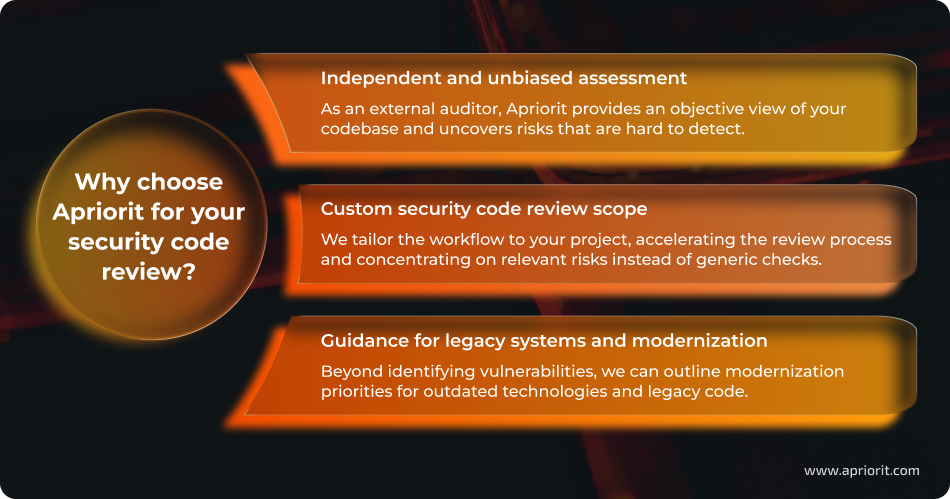
Once you delegate your product’s code security review to Apriorit, this is what we’ll do:
- Before starting the review, we’ll prepare a high‑level review plan aligned with your product type, architecture, and business goals.
- For comprehensive evaluation, we can add penetration testing activities (traffic analysis, port scanning, packet capture, etc.) to the overall security code review scope. This way, you can ensure an even deeper security assessment and verify how hard it would be for malicious actors to break your systems.
- Once you give us access to the source code, we’ll refine the scope and focus areas, selecting relevant vulnerability classes and security concerns (for example, OWASP categories or applicable CWEs).
- Throughout the engagement, we’ll maintain active communication and may share preliminary findings so your team can start addressing critical issues without waiting for the final report.
- At your request, we can create a proof of concept (PoC) program that demonstrates how a vulnerability could be exploited in practice, helping your teams better understand real‑world risk.
- We’ll send you a well‑structured report with a clearly defined scope, goals, results, and improvement options. Each identified vulnerability will be explained in detail, including its impact, affected functions or components, and actionable mitigation recommendations.
Upon our client’s request, the Apriorit team can run a follow‑up assessment after fixes are implemented. Most commonly, a client requests a focused recheck of remediated vulnerabilities, with the update reflected in the change history and an updated version of the report.
Victor, Engineering Director at Apriorit
If you need a clear, independent security code review — or a combination of audit services tailored to your product — Apriorit is ready to help you gain clarity, reduce risk, and move forward with confidence.
Looking to check where your product security stands?
Get an unbiased evaluation together with clear conclusions, prioritized risks, and practical next steps.
FAQ
What is the difference between a code audit, code review, and security code review?
<p>These terms refer to different types of code analysis with distinct goals:</p>
<ul class=apriorit-list-markers-green>
<li>Å code review focuses on code quality, readability, and correctness. It’s usually performed by developers to catch bugs and improve maintainability.</li>
<li>A code audit is a broader, often formal assessment of a codebase that evaluates overall quality, architecture, risks, and sometimes compliance, often for business or due diligence purposes.</li>
<li>A security code review specifically targets security vulnerabilities in the source code and assesses how the software could be exploited, often identifying underlying weaknesses that may be difficult to exploit in practice but still increase overall risk.</li>
</ul>
<p>While these activities can overlap, a security code review is the only one dedicated to identifying security risks and should not be conflated with general code quality checks.</p>
When should I carry out a security code audit?
<p>Consider running a security code analysis when:</p>
<ul class=apriorit-list-markers-green>
<li>Acquiring or inheriting a codebase</li>
<li>Preparing for a release, certification, or external audit</li>
<li>Developing security‑critical functionality for an existing product</li>
<li>Working on a cybersecurity solution</li>
<li>Creating an application that handles sensitive user data</li>
</ul>
How long does a security code audit take?
The duration depends on the scope, goals, codebase size, and product complexity. A focused security code review typically takes several weeks.
What does a security code review include?
Secure code review best practices that the Apriorit team follows include checking architecture and trust boundaries, entry points and data flows, access control logic, dependency risks, and security‑critical code paths. The outcome is a structured report with prioritized findings and actionable improvement recommendations.
Can a security code review help with legacy code issues?
Yes, but mostly in terms of the legacy code’s security. Security code audits can identify outdated libraries, risky assumptions, and implementation patterns that no longer meet modern security expectations.
Can automated tools (like SonarQube) replace a security code review?
<p>No. Automated tools are useful for detecting certain patterns and common issues, but they can’t fully assess architecture‑level risks, trust assumptions, or low‑level security‑critical logic.</p>
<p>A security code analysis complements automation with expert analysis and context‑aware judgment. For more details on automated tools, check out our article on improving code quality with A security code analysis complements automation with expert analysis and context‑aware judgment. For more details on automated tools, check out our article on improving code quality with <a href=/qa-blog/765-qa-improving-code-quality-using-sonarqube>static code analysis using SonarQube</a>.</p>
How does a security code review align with CIS and OWASP standards?
A security code analysis translates broad standards such as those put forward by OWASP or CIS into product‑specific checks. Instead of mechanically applying generic guidelines, reviewers adapt these frameworks to the architecture, threat model, and codebase to produce practical, relevant findings.
What is the difference between a security code review and security testing?
A security code review analyzes source code to identify vulnerabilities and risky implementation patterns that may not appear during runtime. Security testing focuses on observing system behavior during execution. They are complementary, but they usually take place at different project stages.
Have a question?
Ask our expert!

VP of Engineering