
 Skip to main content

Background
Integra Energy, a US-based company operating electric vehicle (EV) charging stations, was looking to improve the efficiency and quality of their customer support. As their nationwide network grew, the support team was increasingly flooded with similar customer questions on topics from electric vehicle charging issues to payment errors.
To provide timely support without overloading their agents, Integra decided to use AI technology. That’s why they searched for a development company to build an AI chatbot for customer support that could later be integrated into their mobile application.
Integra Energy wanted their chatbot to automate the processing of simple repetitive queries, thus freeing up their human customer support specialists to deal with more complex requests. The chatbot was expected to handle common customer questions and work with a private knowledge base while meeting strict data privacy and infrastructure requirements.

The client
Integra Energy is a US-based company operating a nationwide network of EV charging stations. They provide turnkey energy solutions, particularly for electric vehicle charging infrastructure and energy-efficient LED lighting.
| Our client: | Integra Energy |
|---|---|
| Location: | United States |
| Industry: | Electric vehicle infrastructure |
| Collaboration with Apriorit: | Short-term |
| Solution we delivered: | AI-powered customer support chatbot |
| Services we have provided: | Business analysis AI chatbot development DevOps QA |
The challenge
Integra Energy asked us to build an AI-powered customer support chatbot that their internal team could later integrate into the client’s mobile application.
Key requirements included:
- Building an AI chatbot for an electric vehicle charging network that relies on an internal knowledge base containing FAQs and troubleshooting guides
- Ensuring that all searches and data processing remain private and are not shared with third-party LLM providers
- Supporting scalable simultaneous conversations via the cloud
- Deploying the solution within the client’s existing cloud infrastructure
- Ensuring the chatbot can operate in multiple languages
The solution also needed to be technologically flexible, so we had to suggest a technology stack that would support features planned for future implementations.
Want to automate your business processes?
Our team of AI development experts helps build solutions that cut costs and increase efficiency without exposing your business to security risks.
Project details
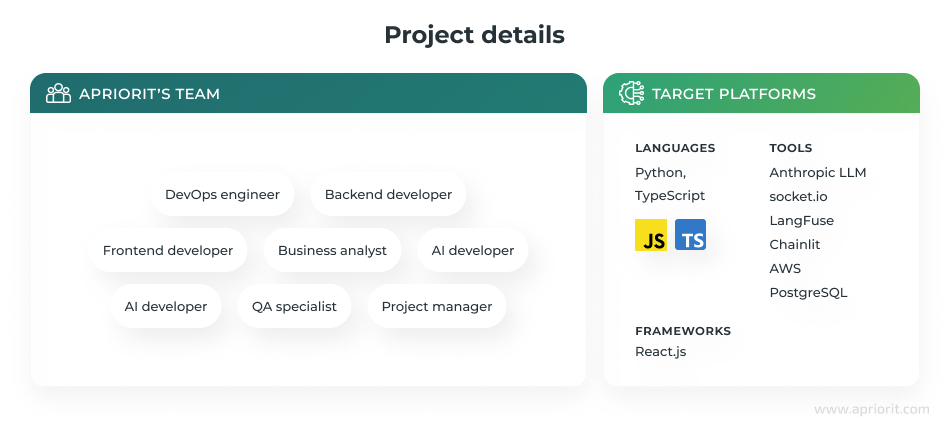
To deliver the required solution, we assembled a cross-functional team and proposed a two-milestone delivery plan with a total development timeline of 2.5 months.
The result
Our team delivered an AI-powered customer support chatbot and deployed it within the client’s cloud infrastructure. The solution supports voice-based and text interactions, relies on a private, customizable knowledge base for answering customer inquiries, and uses web search when internal information is unavailable.
The chatbot was delivered as a stable, production-ready system with an admin dashboard for monitoring performance and user interactions.
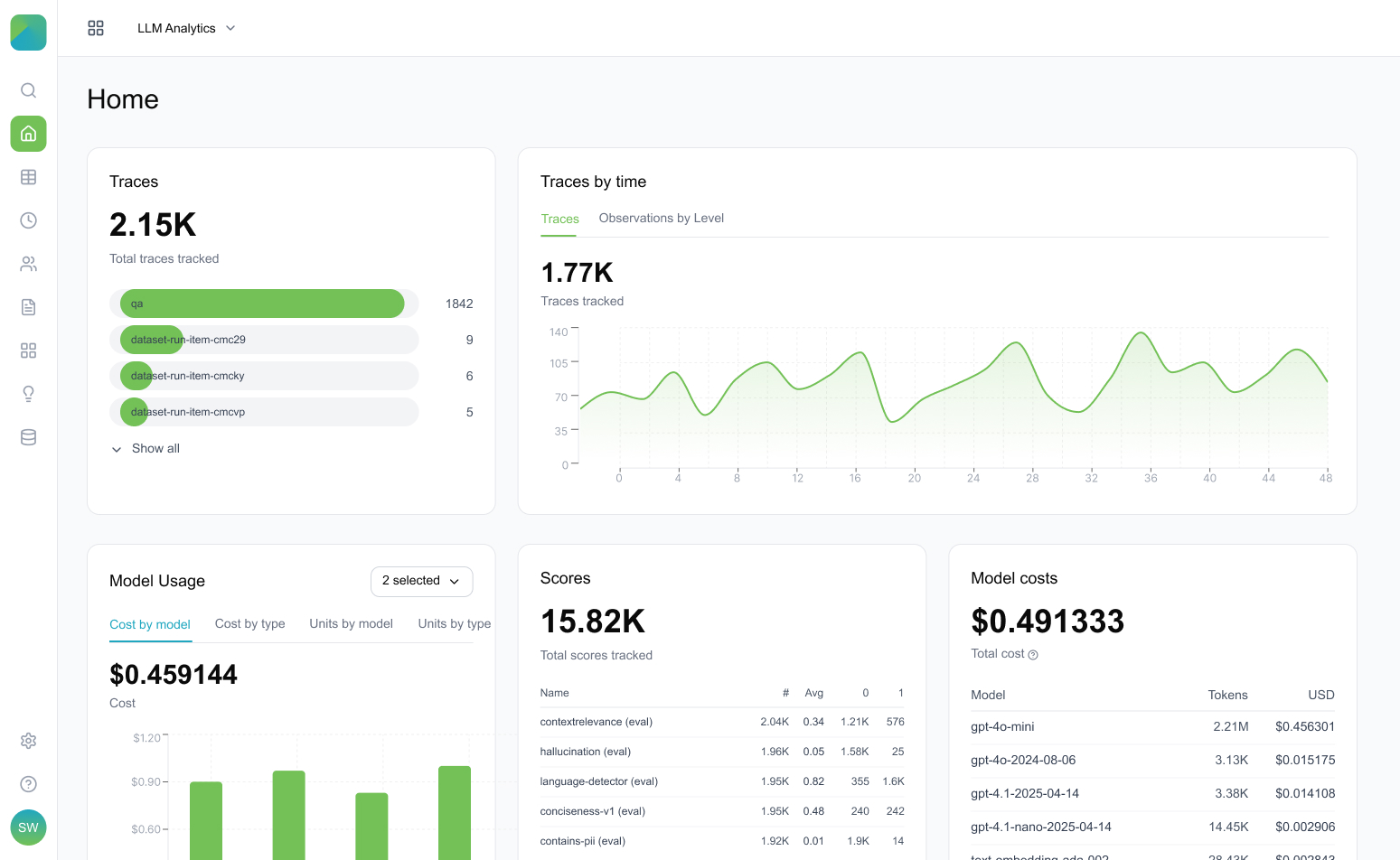
The chatbot supports hundreds of simultaneous users, and this capacity can easily be scaled through AWS. It operates in all languages that the LLM supports, and it enables the client to continuously refine response quality based on real usage data. All queries and responses remain within the client’s system: no data is shared with third-party AI services.
Our solution
After analyzing and discussing the client’s requirements, we proposed developing an AI-powered chatbot that the client’s internal team would then integrate with a mobile app through socket-based communication.
Our engineers designed the chatbot to:
- Answer customer questions based on a private, configurable knowledge base
- Support voice interaction through speech-to-text capabilities
- Handle multiple languages (tested in English and Spanish)
- Collect interaction data to further improve response quality
- Scale via the cloud to support a varying number of simultaneous users depending on demand
The system architecture was designed to be modular and scalable, allowing the client to adjust resources and extend functionality over time.
How we did it
We structured the project into six key stages:
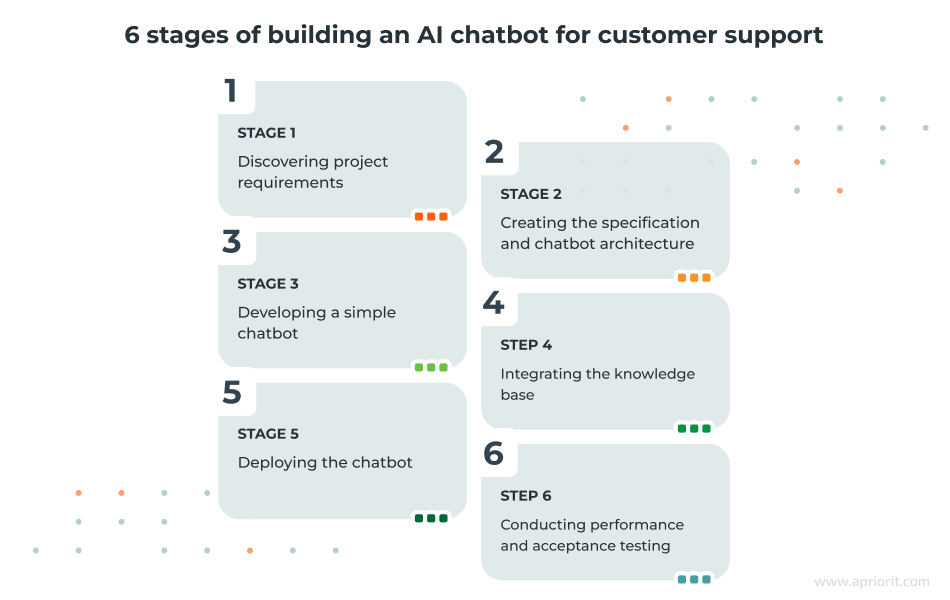
1. Discovering project requirements
The project began with a discovery phase focused on understanding the client’s business goals, customer support processes, and expectations for the chatbot. We held meetings with key stakeholders to clarify how the chatbot would be used within the mobile application, identify the most common customer inquiries, and define language and communication requirements.
2. Creating the specification and chatbot architecture
Based on the discovery phase findings, our business analyst prepared a detailed specification describing chatbot functionality, user interaction flows, and integrations. In parallel, we designed the overall system architecture, covering AI components, data storage, APIs, and cloud infrastructure.
After stakeholders reviewed and approved project documentation, we created a clear development roadmap.
3. Developing a simple chatbot
At the next stage, we implemented a functional chatbot with core conversational capabilities. Our engineers enabled voice interaction through speech-to-text functionality, improving accessibility and the user experience. We also added intent recognition through prompt engineering and retrieval-augmented generation (RAG), without additional model training.
Our engineers integrated the chatbot into a testing environment, presented a working prototype to stakeholders, and gathered feedback and answered technical questions during demo sessions. After our developers implemented all requested changes, we were ready for chatbot training.
4. Integrating the knowledge base
A significant part of our work focused on building and refining the chatbot’s knowledge base. We integrated FAQs, troubleshooting guides, and product-related information, and we tested the chatbot. Our engineers also performed prompt tuning to improve answer accuracy and control the number of follow-up questions.
Additionally, we prepared a web-based UI that allowed stakeholders to test the chatbot and edit knowledge base content. This helped us improve response quality and reduce reliance on human support agents for repetitive and simple queries.
While testing with a large EV-focused knowledge base, we found that a RAG-only approach was not effective for handling extensive vehicle-specific manuals. To solve this issue, we recommended leveraging web search for vehicle-specific questions.
Read also
Prompt Injection Protection for AI Chatbot LLM Models
Are your AI chatbots secure? Learn how to identify and address prompt injection threats with tested strategies from Apriorit experts.
5. Deploying the chatbot
Once development was complete, we deployed the solution to a live environment and configured the LangFuse admin dashboard to monitor chatbot performance and user interactions. At this stage, we ensured the system was stable, observable, and ready for real-world use.
The deployment relied on multiple interdependent services with separate resource allocation, making the infrastructure more complex than a standard containerized setup. To deal with this complexity, Apriorit’s experienced DevOps engineer designed a multi-service architecture with flexible resource configuration.
6. Conducting performance and acceptance testing
After cloud deployment, we conducted comprehensive QA acceptance and performance testing. This included functional, usability, and security testing, as well as load testing to validate performance under peak use.
Our engineers ensured the chatbot met the agreed acceptance criteria and delivered reliable performance.
The impact
As a result of our partnership, Integra Energy received a production-ready AI-powered customer support chatbot with voice recognition that was fully prepared for integration into their mobile application.
By using AI in EV charging customer support, our client reduced response times for customer inquiries and significantly decreased the workload on human support agents by automating responses to common questions and troubleshooting scenarios.
Thanks to the Apriorit team, customers of Integra Energy now receive fast answers to routine questions, while human support agents have the capacity to focus on cases that truly require their involvement.
With the addition of targeted internet search, customer support agents can also provide more accurate and personalized assistance when handling complex requests.
Customize AI to boost your customer support
Reach out to us for expert assistance in building smart and secure AI chatbots that provide accurate answers to your customers while cutting support costs.
Have a question?
Ask our expert!

R&D Delivery Manager