
 Skip to main content
Key takeaways:
- Integrating GenAI into education solutions improves learner engagement, supports ongoing platform enhancement, and enables personalized learning.
- GenAI is expected to offer exceptional ROI in areas such as adaptive content and automated assessments.
- Implementation comes with challenges, including a shortage of skilled specialists, complex regulatory compliance requirements, and the need for ongoing model updates.
- Apriorit experts recommend starting with a PoC to validate business value.
- Partnering with an experienced vendor streamlines the journey from proof of concept to full deployment, reducing risks and shortening time to value.
GenAI is already transforming education. By enabling real-time tutoring, adaptive quizzes, and immersive simulations, it delivers tailored experiences that drive learner engagement and retention.
However, successfully integrating GenAI into your learning product can be tricky. This process requires careful preparation to ensure data quality, eliminate biases, and be ready to continuously fine-tune models to prevent their drift.
In this article, we share actionable strategies and expert insights to help you overcome implementation challenges and integrate GenAI smoothly into your eLearning platform.
This article is tailored for business and technical leaders who want to know how to use generative AI in education (for learning and training innovation), including:
- CTOs and Heads of Product at EdTech companies aiming to enhance existing learning solutions with AI or build AI-powered eLearning platforms from scratch
- Large enterprises looking to streamline onboarding and employee training processes
- Educational organizations planning to adopt GenAI for internal learning solutions
Contents:
- Why integrate GenAI into eLearning platforms: business and user benefits
- Use cases of GenAI in education
- Challenges of integrating GenAI into eLearning and how to handle them
- Apriorit’s recommendations for integrating GenAI into educational platforms
- How Apriorit can help you plan, implement, and scale GenAI integration
Why integrate GenAI into eLearning platforms: business and user benefits
The primary reason for implementing generative AI (GenAI) in education is to deliver personalized, inclusive, and scalable learning experiences. It also enhances efficiency, quality, and measurable outcomes of the learning process for both students and educators.
For example, GenAI can rapidly generate diverse materials for both educators and students: lesson plans, tests, quizzes, summaries, and learning guides. In corporate training, GenAI can create role-specific content that supports employee upskilling, reskilling, and performance improvement.
GenAI provides three dimensions of value for digital learning platforms. For product teams, it offers faster innovation cycles and lower content ops costs. For educators and businesses, it brings scalable personalization and efficiency. And for learners, it moves from static consumption to adaptive, responsive skill‑building.
With the right data, guardrails, and measurable ROI frameworks, GenAI evolves from a feature into the entire learning ecosystem.
Olya Kolomoets, VP of AI Engineering and Integration
Let’s break down the benefits of generative AI in education for different groups of users:
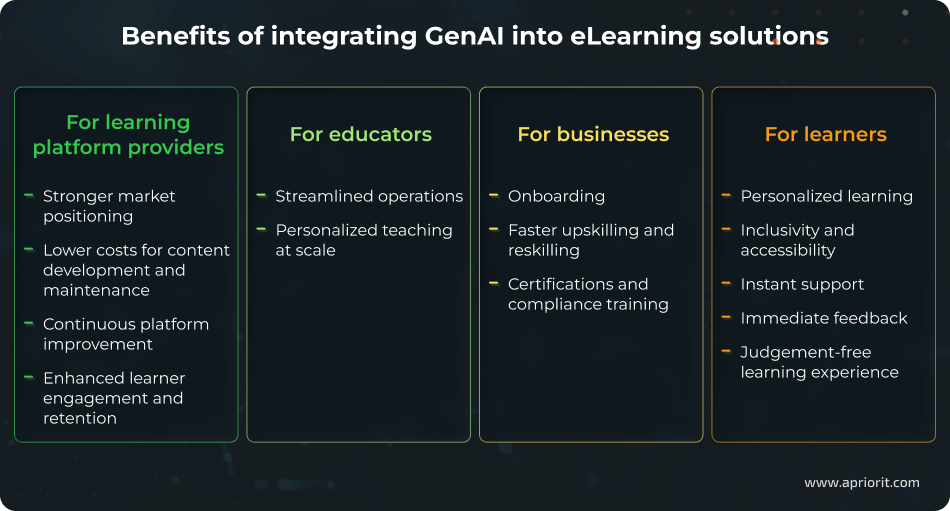
For learning platform providers:
- Stronger market positioning. Integrating unique AI-powered learning features (like AI tutors or code explainers), a user-focused approach, and faster content innovation cycles can help your platform stand out, improve user adoption, and strengthen your market position.
- Lower costs for creating and maintaining content. Adopting GenAI allows you to cut resource demands and operational costs through automating the generation of content (such as tests, code, or images) and implementing regular updates to keep that content relevant. This approach not only streamlines content creation but also accelerates content maintenance, freeing teams to focus on innovation.
- Continuous platform improvement. AI-driven insights from learners on content effectiveness, curriculum gaps, and misconceptions help you continuously enhance your product. By acting on this feedback, your team can deliver targeted improvements that raise user engagement and learning outcomes.
- Enhanced learner engagement and retention. AI algorithms adjust learning content in real time based on learner behavior. For example, GenAI can generate customized problems based on previous responses or adjust modules based on pre-assessments and ongoing test results. This approach builds dynamic learning paths tailored to each learner’s pace, preferences, and skill level, enhancing engagement and reducing dropout rates.
For educators:
- Streamlined operations. Adopting GenAI can help streamline operations by automating routine educator tasks, from generating lesson plans, quizzes, and teaching materials to grading assignments. GenAI can also deliver consistent, real‑time feedback to learners, helping to reduce manual workloads and minimize human error.
- Personalized teaching at scale. Integrating GenAI into learning platforms enables scalable, personalized teaching by adapting content and instructions in real time without adding staff. For example, GenAI can generate explanations based on a learner’s level or minimize and skip content that a learner has already mastered.
For businesses:
- Onboarding. Businesses can use GenAI to customize onboarding content based on an individual employee’s role and profile. They can also integrate AI-powered chatbots that guide employees through policies, tools, and workflows.
- Faster upskilling and reskilling. GenAI creates personalized training paths that are adapted to each employee’s skill gaps and career goals. It supports rapid mastery of new competencies (whether gaining new management skills, learning new software, or mastering advanced sales tactics) through bite-sized, context-aware modules, accelerating upskilling and reskilling with minimal workflow disruption.
- Certification and compliance training. GenAI features let you instantly generate role-specific compliance courses, certifications, quizzes, and case studies aligned with internal policies as well as the GDPR, HIPAA, ISO standards, and other compliance requirements. Outdated training content can be automatically updated, helping you speed up certification cycles, improve employee comprehension, and reduce enterprise-level regulatory risk.
For learners:
- Personalized learning. GenAI allows for adapting content to an individual’s skill level, pace, and goals, dynamically adjusting it as the learner progresses. For example, an AI math tutor can detect repeated mistakes in solving quadratic equations. Instead of sticking to abstract formulas, it can adapt by offering step-by-step examples or introducing visual aids, turning the user’s frustration into learning progress.
- Inclusivity and accessibility. GenAI enhances accessibility and inclusion by adapting learning content for diverse needs, from disabilities to language differences and learning styles. For example, it can generate alt text for images or transcripts for audio/video, and it can simplify complex content for users with visual, hearing, or cognitive challenges.
- Instant support. Developers can use GenAI to build always‑on virtual tutors, adaptive feedback systems, and 24/7 support chatbots that respond instantly to learner questions. This removes wait times for those studying outside business hours or on holidays, enabling non-stop learning.
- Immediate feedback. GenAI-driven platforms analyze learner responses in real time and deliver contextual corrections, explanations, and improvement tips. This helps to close knowledge gaps, promoting continuous progress.
- Judgement-free learning experience. GenAI helps to create a safe, judgment-free environment in which learners can ask basic questions and experiment without fear of failure. This increases learners’ confidence throughout the learning process.
To gain real business benefits from investing in GenAI, you need a clear understanding of how and why to integrate this technology into real-world educational platforms. In the next section, we explore key use cases of generative AI in education that are worth your attention.
Looking to integrate generative AI into your product?
Leverage Apriorit’s experience in building secure, high‑performance generative AI solutions that scale with your business.
Use cases of GenAI in education
Generative AI in education aims to cover different needs for various participants in the learning process:
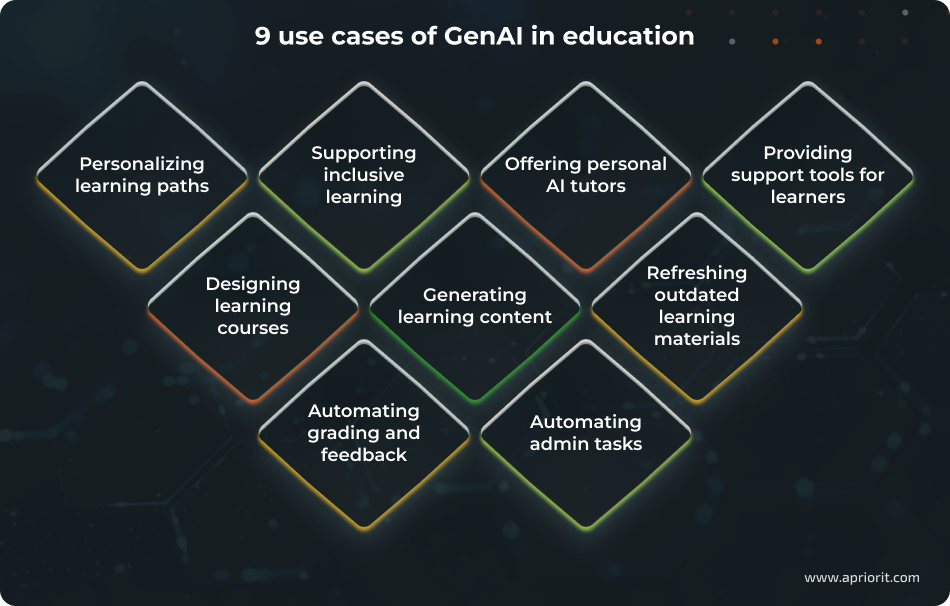
GenAI can be used in education to:
- Personalize learning paths based on learners’ prior knowledge, learning goals, and assessment results
- Support inclusive learning through multi-language explanations, reading level adaptation, and alternative learning formats
- Simulate one-to-one tutoring, providing individual guidance, explanations, and feedback
- Support learners with tools such as chatbots, helping students better adapt to academic life, explore possible career paths, write cover letters, and simulate interviews
- Design learning courses, including generating course outlines aligned to learning objectives, planning lessons, and updating content when standards or knowledge change
- Generate learning content, which includes rapidly drafting exercises and examples, reusing core lessons for multiple levels, ensuring consistent tone and terminology, translating for global reach, and converting materials into diverse formats such as slides, quizzes, and text
- Update learning materials by remaking legacy content (such as scanned PDFs, handwritten notes, or slides) into clear digital text, reorganizing unstructured content into lessons and modules, replacing obsolete terminology or examples, and adding missing context or examples
- Automate grading and feedback, including providing rubric-aligned assessments, applying the same evaluation logic across learners, ensuring assistive grading with human-in-the-loop control, and tailoring feedback based on a learner’s skill level and learning history
- Automate admin tasks, which includes automating reporting and documentation such as progress reports and accreditation paperwork, tracking learner performance across assessments, drafting emails and announcements, planning academic calendars, and optimizing teacher workload distribution
Integrating GenAI into education can deliver the strongest ROI when labor costs are high, tasks are repetitive yet knowledge-driven, and personalized learning significantly improves engagement and retention.
When not to choose GenAI
While GenAI offers significant potential for transforming education, it’s not practical to use it in every scenario. GenAI may not be practical when:
- Performing high-stakes grading without human review (such as certification decisions or final exams)
- Learning objectives require original thinking (for example, activities related to creativity, art, and critical thinking)
- Data privacy is crucial, such as in mental health training scenarios
These tasks are better handled with a traditional approach, which remains more reliable and secure.
Adopting GenAI in learning systems, in any implementation scenario, demands a clear understanding of potential obstacles and effective strategies to overcome them. In the following section, we explore common challenges of generative AI in education and practical ways to address them.
Read also
AI-powered Text Analysis: Benefits, Techniques, and Development Nuances
Discover proven AI techniques for text analysis that empower businesses to streamline processes and uncover hidden opportunities.

Challenges of integrating GenAI into eLearning and how to handle them
These are some of the business and technical challenges you can face when integrating GenAI into your learning product:
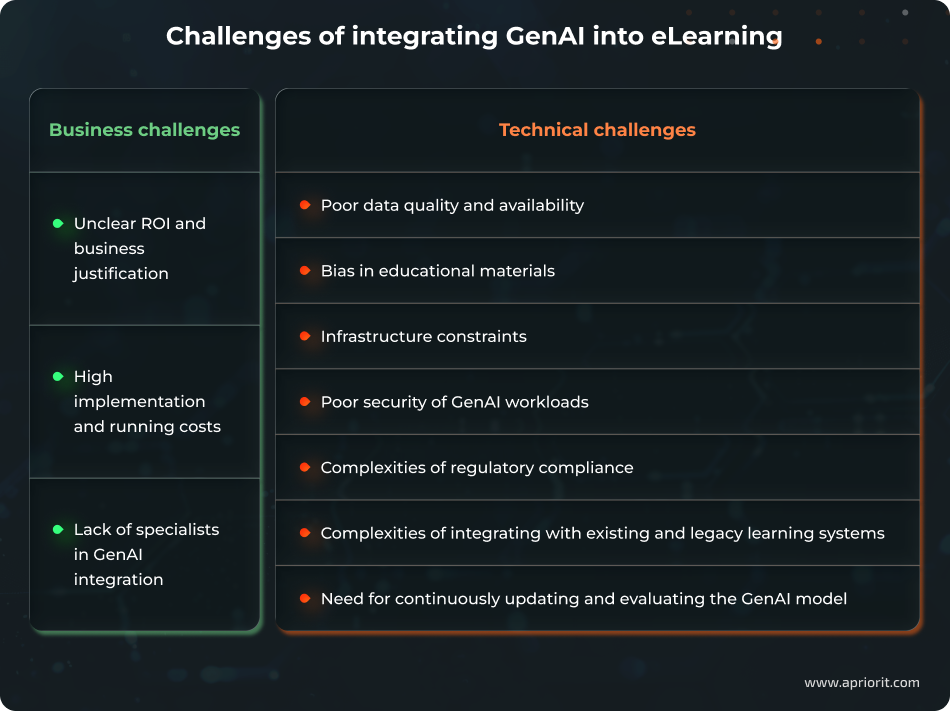
1. Unclear ROI and business justification
Many GenAI initiatives fail to deliver expected results because ROI isn’t clearly understood before implementation. This happens because GenAI implementation projects often lack robust, agreed-upon metrics, making it challenging to demonstrate value later.
While benefits such as improved learner satisfaction, higher engagement, and better long-term retention are real, they remain challenging to quantify financially. This creates a gap between perceived and actual success.
To make GenAI’s value measurable, we recommend breaking ROI into five key buckets:
- Learner engagement and retention to measure how GenAI keeps learners active and motivated. Metrics include course completion rates and monthly active users (MAU) before vs. after GenAI implementation.
- Conversion to assess how GenAI drives new enrollments or upsells existing learners. Metrics include enrollment rates for new courses and average revenue per learner.
- Content operations cost to track cost savings and speed improvements from AI-assisted content creation. Metrics include time-to-launch for new courses and content production costs.
- Support cost to evaluate operational savings from automating learner support. Metrics include number of tickets resolved by AI vs. humans and average resolution time.
- Risk reduction to measure how AI minimizes potential risks. Metrics include learner satisfaction scores and avoidance of compliance or regulatory penalties.
Defining these buckets up front ensures ROI is transparent and actionable.
2. High implementation and running costs
Implementing GenAI often demands substantial computing power, especially for training and running advanced models. This typically requires cloud-based GPU or TPU instances, which can be expensive. In addition, upgrading existing infrastructure (such as storage, networking, and security systems) to support GenAI introduces further budget considerations.
To reduce such costs, Apriorit recommends the following:
- Start implementation from use cases with clear ROI
- Restrict token use: for example, limit response length and use structured prompts
- Combine GenAI with cheaper technologies (for example, NLP modules or lighter machine learning models) where possible
- Implement retrieval-augmented generation (RAG) that can help optimize token use when combined with efficient chunking and retrieval strategies
- Cache answers to common queries
- Track cost per feature, per user, and per task and optimize usage continuously
3. Lack of specialists in GenAI integration
A lack of relevant expertise is one of the biggest obstacles to adopting and scaling GenAI. This talent shortage makes it difficult to recruit professionals who can design, build, tune, evaluate, and maintain GenAI systems. It’s especially challenging for learning platforms that require combining data integration, security, pedagogy, and personalization logic.
To overcome this challenge, you should consider upskilling existing engineering teams or engaging external specialists with expertise in AI/ML, security, and compliance requirements. Building a cross-functional team that understands both technology and educational context is critical for successful GenAI implementation.
Looking for a reliable partner to integrate generative AI safely and effectively into your eLearning product?
Work with the Apriorit team to architect, develop, and deploy secure, high‑performing AI solutions.
4. Poor data quality and availability
GenAI generates responses based on patterns learned from both its pretrained model and the custom data you provide during integration. If this data is incomplete, inconsistent, inaccessible, or inappropriate, the result is inaccurate or misleading answers, confusion in automated tutoring or feedback, and flawed insights in learner analytics.
Many high-value GenAI features also depend on structured learner data, such as progress reports, performance assessments, and rubrics. Without this information, GenAI can’t meaningfully personalize instructions or deliver accurate support.
To ensure data quality and availability, Apriorit experts suggest:
- Explicitly defining which data GenAI is allowed to use
- Standardizing data schemas across the learning system: use consistent naming, IDs, formats, etc.
- Cleaning and normalizing content before AI use: remove duplicates and normalize terminology and metadata
- Tagging content by topic, difficulty, and audience
- Breaking content into token chunks for RAG and keeping them semantically complete
- Constantly monitoring data quality to track missing values, conflicting records, and so on
- Educating teams on data literacy
5. Bias in educational materials
AI bias occurs when AI systems produce outputs that systematically favor certain groups, viewpoints, or stereotypes. This often stems from imbalanced training data, which can underrepresent specific cultures or demographics. As a result, AI may unintentionally marginalize these groups, reinforce stereotypes (e.g., depicting professionals as predominantly male), or limit exposure to diverse perspectives.
Such biases can make learners feel excluded, reduce engagement, and even lead to misleading outcomes in tutoring or assessment scenarios.
To minimize biases in learning materials:
- Clearly define what fair, inclusive, and neutral means for your platform
- Document examples of acceptable and unacceptable content
- Ensure diverse representation across genders, cultures, and regions
- Provide explicit AI instructions to avoid stereotypes and biased language
- Diversify examples and scenarios to include varied contexts and professions
- Apply human review for high-impact or sensitive content
- Engage diverse reviewers and stakeholders for broader perspectives
- Conduct regular audits using bias detection prompts and tools
- Avoid over-personalization based on sensitive attributes (e.g., ethnicity, religion)
Actively monitor feedback from learners and educators to catch bias early. In AI-driven learning systems, real-world feedback is a critical signal for detecting and correcting skewed outputs before they scale, ensuring fairness and trust.
Vadim Nevidomy, Head of AI
6. Infrastructure constraints
Integrating GenAI requires significant infrastructure resources to ensure the smooth operation of your learning platform. LLMs and multimedia deliberation consume high GPU memory and computer power per request. Usage spikes during exams or deadlines may cause a decrease in performance, while scaling often requires cloud instances or even custom software.
To cope with possible infrastructure constraints, we recommend that you:
- Use RAG to reduce the compute and memory load to retrieve only relevant chunks at runtime
- Plan for peak usage periods to scale up
- Separate AI services from the core learning platform using microservices
- Invest early in prompt and token optimization
- Monitor AI load separately to track latency per AI workflow or tokens per feature and prevent outages
- Design for graceful degradation to protect the learner experience and avoid infrastructure overload cascades
7. Poor security of GenAI workloads
Integrating GenAI into learning platforms — especially in the form of AI tutors, content generation tools, or automated feedback — can introduce new attack surfaces and vulnerabilities. This can lead to sensitive data leakage, prompt injection, and data poisoning. When you integrate GenAI, it becomes part of the platform’s trusted infrastructure and must be protected accordingly.
Here are a few practices from Apriorit developers to help your team safeguard GenAI workloads, thus fortifying your infrastructure as a whole:
- Enforce strict data access controls (for example, role-based access control, principle of least privilege, anonymizing and masking user data where possible)
- Secure RAG pipelines end to end, including validating retrieved documents before prompt injection and separating private and public knowledge stores
- Use system prompts that cannot be overridden
- Block instructions that attempt to bypass rules
- Run GenAI as an isolated microservice
- Log, monitor, and audit AI interactions
- Check and sanitize training and fine-tuning data, which involves reviewing data sources and removing untrusted inputs
- Prepare an incident response plan for AI-specific risks
Non-overridable system prompts act as the essential guardrails for GenAI in eLearning. They set strict operational boundaries, enforce safety and compliance policies, and shield your platform from prompt injection attacks that could undermine security.
Vadim Nevidomy, Head of AI
8. Complexities of regulatory compliance
Adopting generative AI in the education sector introduces complex regulatory compliance issues that span data protection (the GDPR, FERPA), children’s privacy (COPPA), intellectual property, fairness, and cross-border law. These complexities can be hard to navigate because AI-specific rules (such as the EU AI Act) are evolving and often intersect with existing regulations affecting educational platforms.
To effectively manage this regulatory burden, consider these best practices from Apriorit experts:
- Involve legal, privacy, and security teams early in the development process
- Explicitly document approved AI use cases
- Maintain detailed records of GenAI use, including data sources and output purposes, for compliance audits
- Establish clear AI governance and ownership for accountability
- Minimize the processing and use of personal data
- Use anonymized or pseudonymized learner data
- Avoid reusing learner data for model training by default
- Implement explicit consent, disclosure, and opt-out mechanisms (including non-AI alternatives where required)
- Avoid opaque AI decisions where possible
- Provide clear explanations for AI-driven outcomes
- Choose GenAI vendors with a strong compliance posture
- Train your team on AI compliance requirements
9. Complexities of integrating with existing and legacy learning systems
Legacy learning platforms (such as older LMSs or custom-built systems) were often designed long before modern AI workflows and typically rely on proprietary, inflexible architectures. As a result, GenAI rarely integrates out of the box and may require adapters, APIs, or even a redesign of core components. For example, platforms built on outdated tech stacks (like PHP or older .NET frameworks) often need custom integration layers to connect with AI services, making modernization a critical step for successful GenAI adoption.
To streamline the integration process, consider these Apriorit recommendations:
- Integrate GenAI via APIs or middleware instead of modifying core LMS logic
- Build a translation layer to normalize legacy data formats and manage calls to GenAI services
- Normalize data incrementally to lower compliance and data risk
- Use RAG instead of deep integration to avoid rewriting LMS data models
- Decouple identity and permissions from AI logic for better security and scalability
10. Need for continuously updating and evaluating the GenAI model
Since learning platforms operate in dynamic knowledge domains, ongoing GenAI model updates and evaluation are essential to keep AI outputs accurate and relevant. Otherwise, this may lead to GenAI model drift, the emergence of bias and fairness risks, and hallucinations.
To address these challenges effectively, we suggest the following:
- Prefer RAG and prompt updates over full model retraining for faster, cost-effective updates
- Monitor model drift, such as changes in response length, shifts in topic coverage, or an increase in clarification requests
- Check for bias and fairness continuously and evaluate outputs — for example, across demographics and skill levels
- Define clear AI quality KPIs like bias indicators, hallucination rate, and learner satisfaction
- Track learners’ and educators’ feedback to discover unseen issues and improve relevance
- Document evaluation results, such as test outcomes and review logs, for compliance audits and accountability
Addressing these business and technical challenges up front will set the foundation for successful GenAI integration. Now, let’s review Apriorit experts’ recommendations to help you plan GenAI integration thoroughly and effectively.
Related project
Developing an Advanced AI Language Tutor for an Educational Service
Discover the steps Apriorit took to deliver a smart AI-based chatbot that enhanced user engagement by 11%.

Apriorit’s recommendations for integrating GenAI into educational platforms
If you’re looking to enhance your eLearning product with GenAI or build an EdTech platform from scratch but aren’t sure where to start, we’ve got you covered.
Based on Apriorit’s hands-on experience, we outline key recommendations for integrating GenAI into your solution:

1. Perform competitor analysis
Start by researching similar projects to identify features that enhance adoption, uncover gaps in functionality, and understand common user complaints. Conducting a professional competitor analysis often requires engaging a business analyst who can benchmark competitors, interpret user feedback, and align findings with your product strategy.
2. Set clear business objectives
Successful AI integration must be driven by measurable business objectives. Before starting development, define clear outcomes in accordance with your business goals and project needs, such as:
- Reducing costs
- Improving learner engagement
- Increasing course completion rates
AI initiatives that are not aligned with business goals often fail to deliver meaningful value or ROI.
3. Define use cases and a list of features
Make sure you have a clear vision of how your learning platform should function after GenAI integration. For example, determine whether it will include personalization, automated grading, or inclusive learning features.
Explore potential GenAI use cases, choose the most suitable for your project, and prepare a detailed feature list for each. This approach helps you estimate the scope of work faster and more accurately, ensuring alignment between technical effort and business goals.
4. Check data readiness
Before implementation, assess the volume and types of learning materials (such as PDFs, videos, and text), along with their storage locations and organizational structure. This will let you identify integration points and ensure that GenAI features can access and process content effectively.
5. Start with a proof of concept (PoC)
Based on our experience, it’s best to start any GenAI initiative with a proof of concept. This approach helps your team validate business value, user acceptance, and technical feasibility before committing to full‑scale development. It also saves time and money if the idea turns out to be irrelevant for your customers.
At Apriorit, we have extensive experience creating PoCs across various domains, including eLearning platforms and EdTech solutions. From that experience, we know that building a PoC isn’t always as simple as it seems.
PoCs can fail due to an unclear scope, missing success metrics, or the absence of a user feedback loop. Therefore, make sure to engage professionals in your team who can:
- Quickly gather the right information
- Set up an efficient development process
- Validate the business idea as fast and as accurately as possible
6. Build a minimum viable product (MVP)
Once the PoC confirms viability, proceed to developing an MVP to test reliability and security, and to gather real user feedback. If the MVP receives positive feedback, scale the solution with a focus on performance optimization, robust security, and expanding functionality to meet diverse learning needs. This phased approach minimizes risks and ensures sustainable GenAI adoption.
7. Implement success metrics
Define clear success metrics for the MVP launch period to validate performance and user value. While different use cases may require specific KPIs, common indicators include:
- Performance: response time and system availability targets, or latency and scalability across regions (to measure infrastructure readiness for global users)
- User feedback: simple feedback mechanisms, such as like/dislike buttons for AI responses, session-end ratings, and detailed feedback requests during use
- Engagement: indirect indicators, such as changes in time spent on the platform before and after GenAI integration, or number of user queries to the new GenAI tool as a measure of adoption
- Quality: monitoring hallucination rates and relevance of responses
Tracking these metrics will help you validate MVP feasibility, uncover user satisfaction trends, and guide scaling decisions.
8. Ensure the solution’s scalability and performance
While you should begin with a small pilot, your solution may need to scale to hundreds or even thousands of users. That’s why it’s essential to ensure your platform can handle growing user volumes and data loads without failing or requiring a full redesign.
We recommend that you:
- Estimate and define the peak number of simultaneous users, as this is one of the most critical factors influencing performance and scalability in GenAI-powered learning platforms
- Design your architecture to handle peak concurrency (not just average use) to prevent downtime during traffic spikes
- Implement concurrency controls early, such as queuing for non-urgent tasks, to maintain system stability
- Use RAG for short user prompts and a shared knowledge base to reduce processing overhead
Implementing these recommendations requires careful planning and deep expertise in GenAI. If you’re seeking a reliable partner to integrate GenAI functionality into your learning platform, discover how Apriorit’s experts can guide you through a structured, risk-free integration process.
Read also
Developing an AI-based Learning Management System: Benefits, Limitations, and Best Practices to Follow
Unlock the potential of AI in your LMS to deliver personalized learning experiences and improve educational outcomes.

How Apriorit can help you plan, implement, and scale GenAI integration
To help you adopt GenAI in your learning platform with minimal risk and maximum value, Apriorit offers tailored engagement options:
- Discovery phase. Apriorit experts conduct in-depth research to analyze competitors, understand user expectations, and identify high-value features for your solution. You’ll receive a detailed scope of work, accurate resource estimates, and an early compliance and security risk assessment with a tailored mitigation plan, ensuring your eLearning product is secure, scalable, and aligned with your business goals.
- GenAI development. We follow secure SDLC principles at every stage and offer end-to-end services, from GenAI integration into existing eLearning platforms to model deployment across multiple products, fine-tuning, upgrades, and ongoing maintenance. As a result, you’ll get a secure and scalable GenAI-based solution that fits your unique business needs.
- Consulting on AI adoption. If you’re unsure where to start, Apriorit experts will help you build a solid foundation for GenAI integration. We assess your AI readiness, identify technical gaps, develop a tailored strategy aligned with your business goals, and define high-impact use cases to maximize ROI. If AI isn’t the right fit for your needs, we’ll recommend more cost-effective alternatives that can deliver meaningful business value.
- PoC and MVP delivery. If you need to validate your GenAI concept, Apriorit specialists can help you develop pilot features to confirm technical feasibility and user value. We also implement guardrails for security, privacy, and responsible AI use, test performance and reliability under real-world conditions, and gather user feedback to guide informed scaling decisions.
- Scaling and compliance. By hardening security measures to protect sensitive data and AI workflows and ensuring compliance with the GDPR, FERPA, COPPA, and other relevant laws and regulations, Apriorit can help you prepare your solution for global scaling. We can also set monitoring and governance frameworks for ongoing risk management and optimize your infrastructure for cost efficiency and high performance across regions.
Leveraging expertise across 20+ AI models, Apriorit’s team will help you with smooth GenAI integration, ensuring your solution aligns with your vision, performance requirements, and business goals.
Want to transform your eLearning platform with AI?
Partner with Apriorit to design and implement intelligent solutions that boost engagement, personalize learning, and streamline content delivery.
FAQ
What are the most valuable benefits of AI in education?
GenAI delivers the most value in two key areas:
<ul class=apriorit-list-markers-green>
<li>Personalized learning experiences: adaptive explanations, practice, and feedback that keep learners engaged and returning</li>
<li>Content and operational efficiency: automating tasks like drafting lessons, quizzes, summaries, reports, and support replies</li>
</ul>
<p>The biggest gains come when AI initiatives are tied to clear business goals, such as faster course creation or reduced support load, and measured from day one using product analytics and continuous user feedback loops.</p>
What factors influence ROI for GenAI in an EdTech platform?
ROI from GenAI depends less on simply using AI and more on strategic placement in the user journey and consistent performance. Key factors include:
<ul class=apriorit-list-markers-green>
<li>Business alignment: AI features should support measurable revenue or retention goals</li>
<li>Data readiness: Structured content and proper permissions enable accurate, secure outputs</li>
<li>Quality safeguards: Grounding and evaluation reduce hallucinations and build trust</li>
<li>Cost control: Monitor latency, inference efficiency, and cloud usage at scale</li>
</ul>
<p>A small, measurable MVP usually outperforms a broad launch because it reveals the real cost per active user early and validates ROI before scaling.</p>
Which GenAI features are currently the most popular with users of digital learning platforms?
<p>Learners adopt features that save time and reduce friction, such as AI explanations (“Why is this wrong?”), AI-generated quizzes or flashcards, study planning, and instant Q&A grounded in course materials.</p>
<p>For creators and instructors, the most valuable capabilities include drafting content, such as lesson outlines and question banks, and structuring feedback. To make GenAI easier to adopt for educators, make sure the outputs are editable and transparent.</p>
How is GenAI used in higher education?
The use of generative AI in higher education generally centers on three key areas:
<ul class=apriorit-list-markers-green>
<li>Student support: writing and research assistance aligned with academic integrity policies</li>
<li>Teaching: drafting course materials and providing feedback aids</li>
<li>Administration: automating summaries, reporting, and service desk responses</li>
</ul>
<p>The real challenge isn’t generating text but establishing governance, defining what data can be used, verifying outputs for accuracy, protecting academic integrity, and training staff and students to use AI responsibly.</p>
What is generative AI in education (in plain language)?
Generative AI is software that creates new content, such as explanations, quizzes, summaries, or messages, by learning patterns from large datasets. In learning platforms, AI works best when it’s based on reliable materials such as existing course content or policies and follows clear rules. This helps keep results accurate, consistent, and safe, reducing the risk of mistakes or biased answers.
What are some examples of AI in education products?
<p>Common examples of generative AI in education include AI tutors that explain mistakes and recommend practice tools that generate quizzes and flashcards from learning materials, assistants that answer questions about courses or internal policy libraries, and teacher or L&D tools that draft lesson plans, rubrics, and progress reports.</p>
<p>The most successful implementations pair AI with strong guardrails, such as citations to source materials, editable outputs, and human oversight for high-stakes decisions to ensure accuracy, transparency, and trust.</p>