
 Skip to main content

Key takeaways:
- Rust helps backend development teams deliver products with high performance, predictable behavior, strong security guarantees, and long‑term reliability.
- Rust brings benefits including reduced latency, improved stability under heavy load, safe integration with existing systems, and easy interoperability with other languages.
- Top backend scenarios for Rust are security‑sensitive architectures, data‑intensive services, IoT solutions, and microservices.
- Rust may not be the best option when you need rapid prototyping, minimal development complexity, and quick onboarding for large teams.
For many engineering leaders, Rust isn’t the first choice for backend services. Languages like Go, Java, and Python typically dominate that space.
But in some cases, Rust offers advantages that are difficult to match. It’s a great fit for projects that demand predictable performance, long‑term maintainability, and strong security guarantees, especially in high‑load back ends with strict safety requirements.
In this article, we discuss why and when you might want to consider using Rust for backend development from the business perspective. You’ll also find a list of cases when it’s best to choose another language.
This text will be helpful for CTOs and project or tech leaders who are building or modernizing backend systems and wondering whether Rust can bring the desired performance, safety, and predictability.
Contents:
- Why businesses should consider Rust for backend development
- Rust vs other backend languages
- Backend use cases where Rust excels
- 1. Performance‑critical systems
- 2. IoT back ends and embedded projects
- 3. Blockchain back ends
- 4. Telemetry and logging systems
- 5. Security‑critical backend infrastructure
- When Rust is not the best backend choice
- Architecture approaches for Rust back ends
- How Apriorit helps build secure, high-performance Rust back ends
Why businesses should consider Rust for backend development
Rust is known for its memory safety, low‑latency execution, and architectural clarity.
This combination makes Rust increasingly relevant for back ends powering:
- High‑throughput cloud services
- Data‑intensive applications
- Cybersecurity platforms
- Financial systems
- And other types of software products
Rust is worth considering when backend teams need both the efficiency of low‑level control and the long‑term predictability of a memory‑safe language.
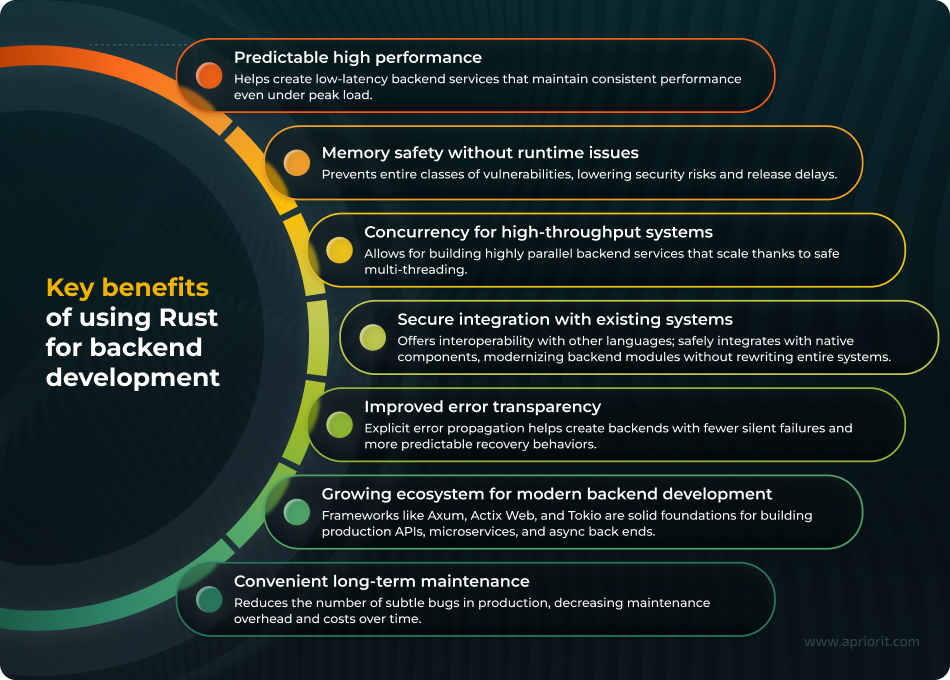
Many companies have already started using Rust in their backend systems. Let’s take a look at a few globally known organizations that have adopted Rust for backend development:
- Discord migrated key backend services, including parts of its real‑time infrastructure, to Rust for better performance and reliability. After doing so, they reported significantly reduced latency and far fewer runtime issues when handling millions of concurrent connections.
- Cloudflare uses Rust across multiple backend and networking components because of its memory safety and predictable performance. Rust enabled Cloudflare to build safer edge services without the risk of memory‑related security vulnerabilities common in C/C++.
- Dropbox adopted Rust for performance‑critical backend components of its file‑sync engine. This switch helped them improve efficiency, reduce resource use, and increase the reliability of operations running at massive scale.
- Meta uses Rust in backend infrastructure, including internal tools and performance‑critical systems, to ensure strong safety guarantees. They cite Rust’s combination of speed and safety as a strategic advantage in maintaining complex distributed backend architectures.
Need expert help with complex Rust projects?
Accelerate project workflows and ensure reliable backend development with Apriorit’s experience in Rust-based programming.
Rust vs other backend languages
All popular languages for backend development ー Golang (Go), C++, Python, Java ー have their own clear advantages.
For example, Go is known for its simplicity, fast onboarding, and quick development cycles. Java excels when used for multi-team backend platforms and complex enterprise workflows. C++ provides flexibility, a mature ecosystem, and deep control over hardware.
Here’s when you should choose languages other than Rust for backend development:
- Choose Go for faster time to market when working on typical backend services, cloud-native applications, APIs, and microservices.
- Choose Java for large enterprise platforms that depend on established ecosystems.
- Choose Node.js for prototyping and fast-moving product development.
- Choose Python for exploratory work and ML features.
- Choose C++ for performance‑critical back ends with established codebases, when you depend on existing ecosystems and toolchains.
Rust and C++ both target high-performance, low‑level systems, but they offer very different development experiences and risk profiles.
C++ is a strong choice for performance‑critical back ends with established codebases. However, it places more responsibility on developers to manage memory and avoid unsafe patterns, which can introduce long‑term maintenance and security risks.
Rust, on the contrary, delivers comparable performance while enforcing memory safety and concurrency guarantees at compile time. This way, Rust significantly reduces classes of bugs that often show up late in C++ projects.
Alexandr, Software Developer at Apriorit
Rust can’t replace these languages universally, but it may be a better choice in certain cases.
Consider Rust backend development for:
- Predictable high-level performance, strong safety guarantees, and easier long‑term maintainability
- Production back ends that require speed, reliability, concurrency, and consistent performance
- Protected backend services
- Backend components in demanding environments
- High‑load and security‑critical back ends
- Performance‑critical APIs and CPU‑bound tasks
You’ll see use cases where Rust shines in the next section.
Watch webinar
Rust in Cybersecurity: Capabilities and Prospects for System Programming
Strengthen your cybersecurity strategy with practical insights from experts on using Rust to build safer, more reliable system components.
Backend use cases where Rust excels
Rust is not always the simplest or fastest language to adopt, but it consistently outperforms alternatives in specific backend scenarios.
Let’s explore key backend use cases where Rust brings the most benefits:
Examples of using Rust for backend development
| Project type | Use cases |
|---|---|
| 1. Performance‑critical systems | 🟢 Storage engines 🟢 Schedulers 🟢 Protocol handlers 🟢 Custom networking layers |
| 2. IoT back ends and embedded projects | 🟢 IoT gateways 🟢 Device coordination services 🟢 Hardware processors |
| 3. Blockchain back ends | 🟢 Smart contract execution engines 🟢 Crypto wallet back ends 🟢 Consensus and networking layers |
| 4. Telemetry and logging systems | 🟢 High‑throughput log collectors 🟢 Observability platforms 🟢 Message brokers 🟢 Analytics pipelines 🟢 Distributed monitoring agents |
| 5. Security‑critical backend infrastructure | 🟢 Identity management services 🟢 Authentication gateways 🟢 Payment processing services 🟢 Zero‑trust network gateways 🟢 Cybersecurity platforms 🟢 Key management and signature services |
1. Performance‑critical systems
Rust is well-suited for backend components that operate close to the system level. It provides deep control over resources (almost like C++) and compilation safety. In this way, Rust reduces the risks associated with manual memory management and offers access to near‑hardware performance without security trade‑offs.
Real-life examples:
- Amazon’s Firecracker, a virtual machine monitor, is developed using Rust for micro‑VM to meet safety and speed requirements.
- Linkerd2-proxy, the most critical component of the Linkerd service mesh that handles sensitive data, is written entirely in Rust.
- TiKV, a distributed key–value store used in TiDB distributed databases, is built using Rust for predictable performance.
2. IoT back ends and embedded projects
IoT ecosystems often include devices with very limited CPU, RAM, and storage, and backend services must efficiently process telemetry, commands, and state updates. Rust’s efficient memory management and safety features help reduce the chance of runtime failures. This makes Rust an excellent choice for projects where devices must remain operational for long periods without human intervention.
Rust has an official Embedded devices Working Group that coordinates efforts towards successfully using Rust for embedded development. Their GitHub page lists a variety of helpful resources and instructions to help embedded teams get the most from the Rust language. Such extensive community support is another great reason to choose Rust as your backend choice for IoT or embedded projects.
Alexandr, Software Developer at Apriorit
Real-life examples:
- Azure IoT Edge uses Rust for its core security daemon to ensure secure interactions with hardware security modules.
- Microsoft Pluton, a hardware-based security processor, is built using Rust to reduce security vulnerabilities.
Read also
Using Rust for IoT Development: Everything You Need to Know to Start a Project
Advance your IoT projects with safer system code. Find out how Rust helps tackle common security, performance, and reliability issues in modern embedded environments.

3. Blockchain back ends
Rust’s compile‑time checks and explicit error management significantly reduce attack surfaces. For example, Rust can help eliminate classes of bugs like data races, null pointer dereferences, and inconsistent error handling. Such protection capabilities are crucial for blockchain, cryptographic, and other products that require reliability and security.
Real-life examples:
- Parity Ethereum client, a smart contract execution engine, is written in Rust for improved reliability and code clarity.
- Solana’s core infrastructure and on-chain programs (smart contracts) are developed using Rust.
- NEAR Protocol, a layer-one blockchain, is written primarily in Rust for parallelism.
4. Telemetry and logging systems
Rust is highly effective for backend services that ingest and process millions of events per second. It helps build back ends that scale horizontally without unexpected latency spikes or memory leaks. For data-intensive products, Rust can help achieve higher throughput and lower operational costs.
Real-life examples:
- Vector, a lightweight tool for building observability pipelines and managing logs, leverages Rust’s ability to handle the most demanding workloads.
- OpenObserve, a cloud-native observability tool for log management and analytics, also uses Rust.
5. Security‑critical backend infrastructure
Rust’s type system prevents many vulnerabilities at compile time, reducing the likelihood of memory‑related breaches. This language forces explicit handling of every possible error path, improving the reliability of mission‑critical backend flows. For products handling sensitive data, Rust offers a safer foundation with fewer failure modes.
Examples of projects with security‑critical backend infrastructure:
- Cloudflare uses Rust for its proxy framework Oxy that powers several major Cloudflare services, including their Zero Trust Gateway.
- HarfangLab adopted Rust to develop their endpoint detection and response solution.
When Rust is not the best backend choice
Rust is not a silver bullet, and for some projects, it may not be the most cost‑effective or efficient option. Specifically, if speed of delivery, flexibility, or team structure matter to you more than raw performance, Rust may not be the best choice.
Consider other backend languages as a better strategic choice when:
- You need rapid development and fast prototyping. Rust has strict compiler rules that slow down early stages of development, which is a disadvantage for MVPs and prototypes. If you work on a startup or project that’s aiming to get something functional into customers’ hands quickly, consider languages with simpler development workflows that support faster iteration. JavaScript and Go would be the most fitting choices here.
- Slow compilation impacts the engineering workflow. Compile times when developing with Rust are quite long, especially as codebases grow. This can slow down feedback loops and increase total engineering hours. If rapid build‑test‑deploy cycles are critical to your productivity, consider languages like Python and Go with shorter compile times or interpreted runtimes.
- Your project depends on dynamic typing and scripting. Rust is a statically typed, compiled language with strict rules. This is great for correctness but limiting for systems that rely on runtime flexibility. For scripting engines, automation layers, and configuration‑heavy systems with dynamic behavior, languages like Python and JavaScript usually allow for faster and more flexible development.
- Your team lacks Rust experience or has many junior developers. Rust has a steep learning curve. It’s easier to teach a team another language like Go than Rust. The reason is that Rust has many features that are implemented in a unique way, like borrowing rules, lifetimes, multithreading, and asynchronous programming. Gaining proficiency with these features requires time. If you don’t have the time to allocate, you might consider another language or outsource backend development to a third-party software development vendor.
- Your backend architecture heavily depends on existing vendor SDKs. Many enterprise systems rely on proprietary or vendor‑maintained SDKs for identity, payments, analytics, cloud services, and hardware integration. These SDKs are often offered first (and best) in widely adopted languages such as Java, Python, JavaScript/Node.js, and Go. Rust may either lack official SDK support or provide only minimal community-maintained packages.
To sum up, Rust is most likely to be your best backend choice when your project needs high performance, low latency, advanced cybersecurity, and predictable resource use. You’ll find out how this language fits into your project architecture in the next section.
Related project
Porting a Remote Connectivity Protocol from C to Rust for Web Use
See how our client managed to deliver a safer, more flexible, and more competitive cross-platform remote management solution. Explore how our team helped modernize a legacy component and secure remote access.

Architecture approaches for Rust back ends
What changes with Rust is how architectures behave: boundaries become clearer, performance becomes more predictable, and concurrency issues are caught at compile time rather than in production.
Yet, there are no Rust-specific architectural patterns for backend development. Your development team can use the same proven backend approaches like microservices, modular monoliths, hexagonal architecture, and event‑driven systems.
Let’s explore a few examples of Rust backend architectures:
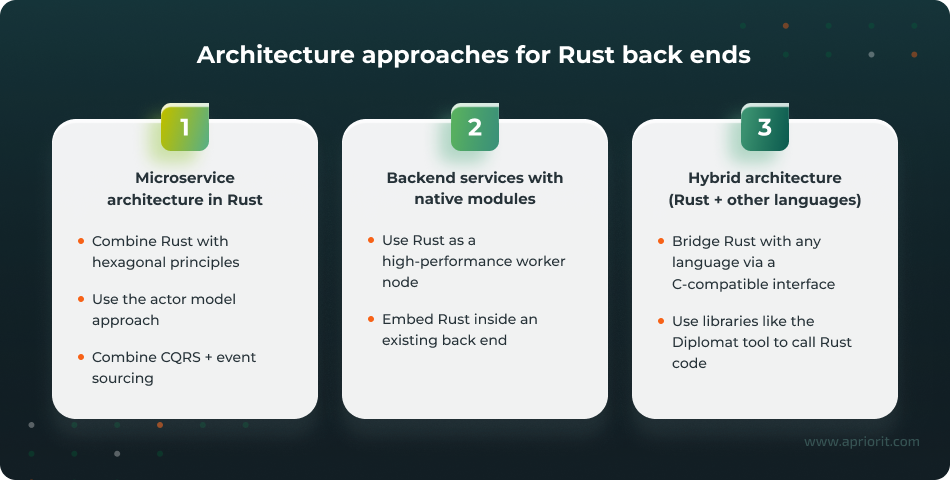
1. Microservice architectures in Rust
Rust fits naturally into microservice architectures due to its focus on performance, safety, and explicit boundaries. Most software products use Rust backend frameworks like Axum, Actix Web, and Warp, which encourage separation between domain logic, infrastructure, and transport layers.
Here are a few approaches to using Rust in microservice-driven back ends:
- Combine Rust with hexagonal or “clean” architecture principles. Here, Rust enforces strict module boundaries, enabling domain code to remain free of framework coupling or runtime dependencies.
- Use the actor model. This is a powerful pattern for building concurrent, resilient microservices in Rust. Libraries like Actix (in actor mode) and Riker enable isolated, message‑driven components that communicate without a shared state. While not as common as the hexagonal approach, actor systems can simplify the design of real‑time, multi-tenant, and streaming‑heavy workloads.
- Combine command query responsibility segregation (CQRS) and event sourcing. This is a robust approach built on Rust’s type system to enforce clear separation between commands, queries, and events. It helps to reduce the risk of malformed domain transitions and inconsistent states.
2. Backend services with native modules
One common pattern is using Rust as a high‑performance worker node to create:
- Cryptography handlers like TLS termination and digital signatures
- Risk scoring modules
- Ledger engines
- Fraud detection logic that must run with tight latency requirements
Such Rust modules typically communicate with other services via gRPC, Kafka, NATS, or RabbitMQ when integrated with native C/C++, Swift, or Kotlin modules.
Another pattern is embedding Rust inside an existing back end:
- Python services call Rust via PyO3
- Node.js services call Rust via napi‑rs or neon
- Java back ends call Rust via JNI or JNA
This approach can be useful when most of the application benefits from a dynamic language, but parts like hashing, compression, parsing, or numeric computation can benefit from Rust’s performance and predictability.
There is a growing trend of rewriting performance-critical parts of backend services in Rust. This way, you can keep the flexibility of GC languages where needed and have native performance where it matters. Although one needs to measure penalty data transfer between Rust and the other language, because it might be higher than the possible performance win.
Alexandr, Software Developer at Apriorit
3. Hybrid architectures (Rust + other languages)
Adopting a hybrid architecture allows organizations to maintain a single, high‑performance codebase across multiple runtimes.
However, there are nuances your team should be ready to deal with:
- Rust can be bridged with any language via a C-compatible interface. But this requires marking functions as extern “C” and using only C‑compatible types such as primitive values and raw pointers. Languages like Python, Java, Swift, or JavaScript cannot natively understand Rust-specific types. This is why if Rust allocates memory, it must deallocate it later; this memory cannot be deallocated in the language you’re bridging with. Otherwise, your systems may run into undefined behavior, which is one of the reasons cross-language bridges require careful engineering.
- Many Rust libraries simplify working with other languages. For example, the diplomat tool allows many other languages to call Rust code, significantly streamlining the development process. Still, hybrid architectures introduce additional build and deployment complexity, since systems must coordinate both Rust’s and the host language’s toolchains.
Without relying on garbage collection or runtime heuristics, Rust helps organizations build backend services that stay fast, stable, and secure. However, to get the most out of this language and overcome its pitfalls, make sure to delegate technical tasks to engineers with relevant expertise (such as our engineers at Apriorit).
Read also
Writing Windows Drivers in Rust: How Rust Is Changing Kernel-Level Development [+ Development Guide]
Enhance the stability of your driver projects by learning how Rust enables predictable, maintainable development for Windows kernel modules.

How Apriorit helps build secure, high-performance Rust back ends
With a strong background in cybersecurity, Apriorit helps clients develop backend services with advanced reliability and security.
Whatever project or task you have in mind, reach out to us to get expert assistance with professional backend development.
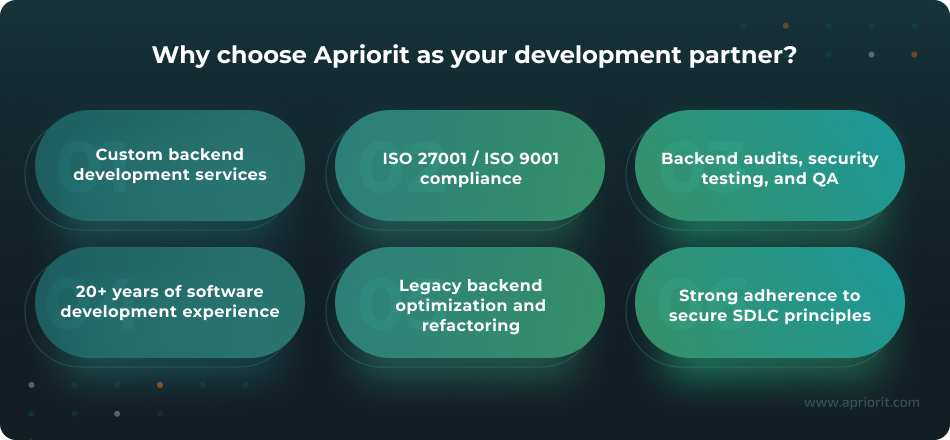
Our specialists will gladly help you:
- Evaluate whether Rust is the right backend choice for your project (if not, we’ll suggest the most fitting options)
- Pick the most suitable libraries, frameworks, and tools for your tasks
- Create resilient cloud and virtualization solutions
- Build high-performance backend services according to your latency and throughput requirements
- Integrate Rust with existing C/C++ backend components
- Organize and streamline essential DevOps workflows
- Deliver a truly protected back end by following secure SDLC principles during each step
Leverage our expertise in Rust development to bring memory safety, high performance, and protection to your project.
Ready to leverage Rust for your project?
Start writing new backend elements in Rust using Apriorit’s expertise!
FAQ
Is Rust a backend language?
<p>Yes. Over the years, Rust has become a strong choice for backend development thanks to its predictable performance, memory safety, and reliable concurrency model.</p>
<p>Companies adopt Rust for high‑load APIs, security‑critical services, data‑intensive systems, and microservices architectures. Its ability to deliver low latency, stable performance under pressure, and safe integration with native components makes it a compelling backend choice.</p>
Rust vs Go for backend development: Which should I choose?
<p>Choose Go (also called Golang) if your project requires simplicity, fast onboarding, and quick development cycles. Golang is ideal for typical backend services, cloud‑native apps, and teams prioritizing delivery speed.</p>
<p>Choose Rust if your project prioritizes latency, fine‑grained resource control, security guarantees, and consistent performance under heavy load. Rust is perfect for highly scalable and performant backend components.</p>
When should I choose Rust as a backend language?
<p>Rust is the right choice when your back end must handle high throughput, low latency, and strict security requirements. This language shines in:</p>
<ul class=apriorit-list-markers-green>
<li>Performance‑critical systems</li>
<li>Trust‑sensitive architectures</li>
<li>Logging and telemetry pipelines</li>
<li>IoT and embedded back ends</li>
<li>Systems that require stable long‑term operation</li>
</ul>
<p>Rust is also a good fit when you need safe concurrency or must integrate with existing C/C++ components. If predictable performance and reliability directly impact business outcomes, Rust provides significant advantages.</p>