
 Skip to main content


Key takeaways:
- Implementing a multi-cloud strategy is a proven way to mitigate cloud concentration, improve resilience, and reduce the risk of vendor lock-in for FinTech software.
- Data fragmentation, latency between clouds, and talent shortages are among the key challenges you need to be prepared for before adopting a multi-cloud strategy.
- If you’re a FinTech startup or can tolerate a bit of downtime, a multi-cloud strategy might not be the best option for you.
- Partner with a reliable vendor in cloud computing and FinTech software development to choose the cloud strategy that’s best suited to your FinTech solution.
Your FinTech platform isn’t required to adopt a multi‑cloud strategy for regulatory compliance. Yet this approach can help you align with compliance expectations — and provide other business benefits.
Multi‑cloud architectures support the resilience and risk management principles of modern financial regulations by:
- Enabling smoother exit strategies
- Minimizing single points of failure
- Reducing risks of vendor lock-in
This article explains when (and when not) to adopt a multi-cloud strategy for FinTech software. You’ll also find key benefits of such an architectural choice and practical tips for handling implementation challenges.
This article is useful for CTOs and project leaders who want to improve the resilience and compliance of their FinTech solutions, are considering multi-cloud as an option, and are searching for best practices for multi-cloud strategies.
Contents:
Why adopt multi-cloud in your FinTech solution?
Cloud concentration — when a large share of FinTech infrastructure relies on a single cloud service provider (CSP), typically a hyperscaler like AWS, Azure, or Google Cloud — has become a major concern for FinTech companies. Overreliance on a single cloud provider can mean that FinTech platforms can go offline entirely when the CSP experiences a service outage. As FinTech organizations often use cloud services for core banking APIs, payment processing, fraud detection systems, and KYC/AML pipelines, the risk of cloud concentration is especially critical for them.
To mitigate this risk, regulations such as the EU’s Digital Operational Resilience Act (DORA) require FinTech companies to implement comprehensive information and communication technology (ICT) risk management frameworks. In practice, these requirements encourage organizations to consider adopting a multi-vendor strategy.
One proven way to enhance the resilience of your FinTech product is to adopt a multi-cloud approach, which enables you to effectively distribute resources and reduce reliance on a single CSP.
But mitigating risks of cloud concentration is not the only reason you should consider implementing a multi-cloud strategy for your FinTech project. Let’s look at the key benefits this approach brings:
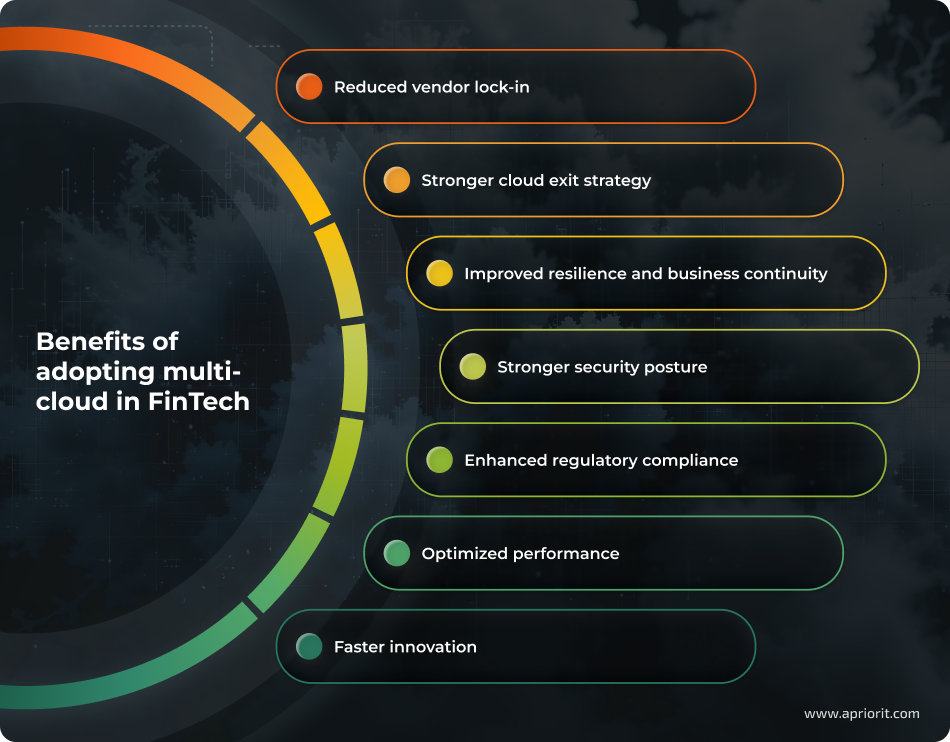
- Reduced vendor lock-in. When you build infrastructure on a single cloud platform, you become dependent on that provider, its proprietary services, APIs, and pricing model. A multi‑cloud strategy distributes workloads across several providers, reducing the impact of any single vendor’s outage, policy change, or cost increase on your business operations.
- Stronger cloud exit strategy. Exit planning is required by FinTech regulators. For example, EBA Guidelines on Outsourcing Arrangements (EBA/GL/2019/02) explicitly require documented and tested exit strategies. When relying on proprietary services in a single cloud setup, exiting becomes costly and slow because your FinTech system must be re-architected. A well‑designed multi‑cloud setup promotes portability and architectural abstraction, making it technically and operationally feasible to transition away from a single provider without major disruption or downtime.
- Improved resilience and business continuity. A multi-cloud environment reduces single points of failure, improves recovery capabilities, and aligns with regulatory expectations for operational resilience. By using services across multiple clouds, you can provide uninterrupted delivery of critical financial services, even during outages and cyber incidents.
- Stronger security posture. A single CSP can create a central point of compromise, whether through a security breach or misconfiguration. Multi-cloud financial strategies help to reduce this risk, limiting the impact of any single provider’s failure. You can also isolate high-risk or high-sensitivity workloads in separate clouds, strengthening overall security segmentation and control.
- Enhanced regulatory compliance. A multi-cloud approach can improve regulatory compliance for FinTech companies by giving them greater control over data residency (as required by the GDPR and local banking laws) and operational resilience (DORA). At the same time, a cross-cloud strategy helps to mitigate cloud concentration and third‑party risk (EBA and FCA).
- Optimized performance. By deploying workloads in regions closest to customers, your team can minimize latency. Distributing (or horizontally scaling) services across multiple cloud providers also allows you to improve scalability during demand spikes. Such capabilities are especially critical for real‑time financial services like payment processing, trading, fraud detection, and digital banking.
- Faster innovation. Different cloud providers offer unique cutting-edge capabilities, such as advanced data analytics platforms and AI/ML services, that you can adopt without being restricted to a single ecosystem. This flexibility significantly accelerates innovation in FinTech by giving your team access to diverse technologies, reducing experimentation constraints, and supporting faster deployment of new financial products.
Despite the obvious benefits of a multi-cloud strategy, its adoption should be justified. To say with certainty whether you actually need a multi‑cloud architecture, it’s essential to analyze your FinTech product in detail. In the next section, we provide you with a short checklist that will be a good starting point for evaluating your situation.
Ready to migrate workloads to multi-cloud confidently?
Let our experts plan and execute a seamless cloud transition with minimal disruption.
When (and when not) to adopt multi-cloud: A checklist
The decision to adopt a multi-cloud strategy has to start with a clear view of your business objectives, the current state of your project, existing resources, and your long‑term development plans.
Let’s explore several high‑level criteria that will help you form an initial picture:
Table 1. Criteria for multi-cloud adoption
Adopt multi-cloud when: | Stick to a single cloud provider when: |
|---|---|
| ✅ High availability is crucial This is the case for trading systems or core banking platforms | ❌ You are a FinTech startup You have a small engineering team and limited resources, or you prioritize speed over resilience |
| ✅ Multi-cloud is required for regulatory compliance Your FinTech product operates across multiple jurisdictions or needs to meet data residency requirements | ❌ You lack governance maturity You don’t have strong IAM practices or a clear cloud operating model |
| ✅ You risk vendor lock-in You can’t afford strategic dependence on one hyperscaler | ❌ Cost optimization is critical Multi-cloud can increase costs for tooling, monitoring, and staffing |
| ✅ You are able to manage multi-cloud complexities You have mature DevOps, advanced cloud security capabilities, or cloud-agnostic architecture | ❌ Your workloads don’t require cross-provider redundancy You can tolerate short periods of downtime, or you don’t operate globally |
| ✅ You are in the process of a merger or acquisition You need to reduce migration risk and ensure business continuity |
If your project meets most of the “yes” criteria, you can proceed with planning the implementation.
In the next section, we look at challenges in implementing multi-cloud strategies and provide you with expert insights on how to address them effectively.
Read also
Multi-Cloud Security: What Challenges to Consider and How to Secure Multi-Cloud Infrastructure
Improve your security posture by exploring proven approaches to managing threats, identities, and data protection in distributed cloud environments.

9 challenges of adopting multi-cloud in FinTech and ways to overcome them: Apriorit tips
Adopting a multi‑cloud strategy may seem risky or complex. And this concern is reasonable. At Apriorit, we know that to fully use the advantages of a multi‑cloud approach, you need a solid understanding of what challenges to expect and how to overcome them.
Based on our extensive experience, these are the most common issues you may encounter during multi‑cloud adoption and proven ways to address them:
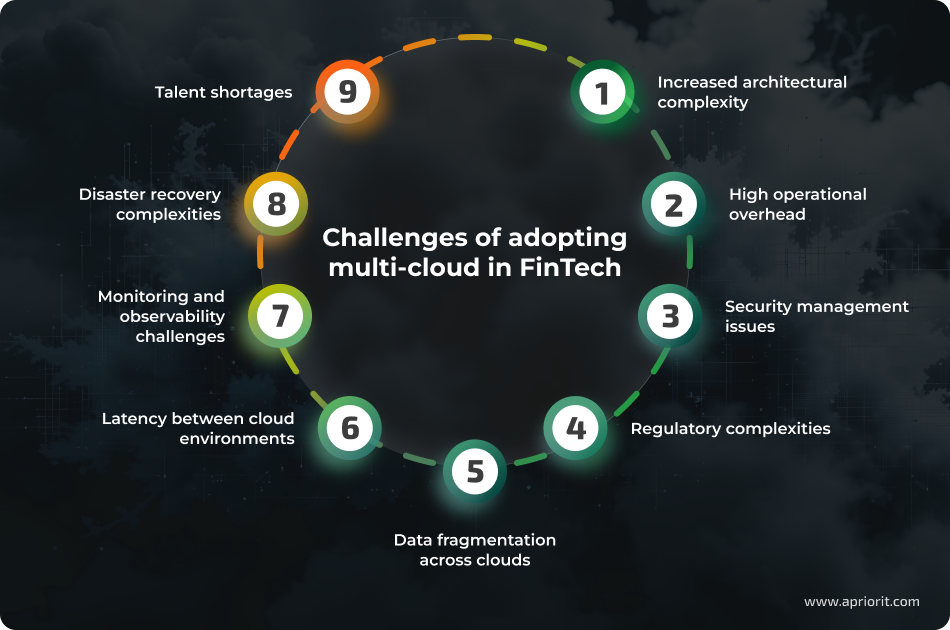
1. Increased architectural complexity
With a multi-cloud approach comes inevitable architectural complexity. The reason is that each cloud provider offers numerous components: distinct APIs, services, IAM models, networking architectures, and operational tooling that require custom integration logic or middleware. Your team must also manage configurations, governance, monitoring, and security policies separately for each platform.
To deal with all of this, your team needs to implement coordinated tools, processes, and integration standards tailored to each provider. Such a workload increases administrative overhead and overall design effort.
Apriorit expert tips:
- Use containerization (e.g., Docker and Kubernetes) to abstract infrastructure differences where possible.
- Adopt cloud‑agnostic frameworks such as Terraform to standardize provisioning.
- Avoid deep lock‑in to proprietary services unless the business case clearly outweighs portability concerns.
- Design for portability from day one, incorporating uniform CI/CD patterns, centralized observability, and policy as code.
2. High operational overhead
Multi‑cloud environments introduce significant operational complexity because each provider uses different billing models, pricing units, discount structures, resource naming rules, and cost visibility tools. As a result, your team must navigate multiple systems on an ongoing basis.
At the same time, maintaining a multi‑cloud setup requires your team to develop the relevant cross-cloud expertise, which increases both staffing expenses and ongoing training demands.
Apriorit expert tips:
- Use unified cost management tools to gain consistent, cross‑cloud cost visibility.
- Automate cost allocation by product, team, or service to simplify internal chargebacks and budgeting.
- Schedule automatic shutdown of non‑critical development and testing environments to avoid idle resource waste.
- Continuously optimize reserved instances, committed use discounts, and storage tiers to maintain cost efficiency across all platforms.
- Implement FinOps as Code to scale governance across clouds.
3. Security management issues
Multi‑cloud architectures significantly complicate security operations because each provider relies on their own IAM models, security controls, logging formats, and configuration standards.
These variations increase the likelihood of misconfigurations, inconsistent policy enforcement, and configuration drift. In addition, distributing workloads across multiple platforms expands the overall attack surface, introducing more APIs, endpoints, and network paths that must be protected and monitored.
Apriorit expert tips:
- Create and enforce centralized security policies to ensure consistent governance across all cloud environments.
- Regularly assess risks associated with each provider and each service to detect provider‑specific vulnerabilities.
- Implement strong, unified IAM practices, such as role-based access control (RBAC) or single sign-on (SSO) solutions, to reduce identity fragmentation.
- Standardize encryption requirements for data in transit and at rest to minimize inconsistent protection levels.
- Use a consolidated threat detection and response layer (SIEM, XDR) to maintain full visibility across environments.
- Deploy automated monitoring tools to identify configuration deviations, anomalies, and suspicious activity in real time.
- Provide continuous training for teams on best practices of multi‑cloud security for finance solutions, misconfiguration risks, and provider-specific features.
- Develop and communicate clear, cross‑cloud incident response plans outlining roles, escalation paths, and containment procedures.
4. Regulatory complexities
FinTech organizations often operate under a wide range of regulatory frameworks, including the GDPR, PCI DSS, DORA, and national banking laws. Managing compliance becomes significantly more challenging in a multi‑cloud architecture because each provider offers different security controls, audit mechanisms, reporting formats, and compliance certifications.
Data may be processed or stored in multiple regions, unintentionally violating data residency demands. In addition, cross-border data transfers may breach the GDPR or local banking regulations.
Apriorit expert tips:
- Embed regulatory controls directly into CI/CD pipelines to enforce compliance from the beginning of the development lifecycle.
- Continuously scan multi‑cloud environments for configuration or compliance drift to ensure policies remain consistently applied.
- Automate compliance reporting dashboards to provide auditors and stakeholders with up‑to‑date visibility.
- Conduct regular compliance reviews across all cloud environments to verify adherence to evolving regulatory requirements.
- Enforce geo‑fencing and region‑specific storage policies to maintain data residency compliance.
- Minimize unnecessary cross‑cloud data replication, especially for regulated or sensitive workloads.
- Design segregated environments for regulated workloads (e.g., isolated payment zones) to reduce scope and simplify audits.
- Ensure cloud providers (including the specific services and regions you plan to use) hold the certifications required to meet your FinTech compliance obligations.
- Use secure API gateways for open banking integrations to maintain strong authentication, authorization, and audit trails.
5. Data fragmentation across clouds
Multi‑cloud architectures often rely on heterogeneous storage systems and database technologies. When organizations distribute workloads strategically across different clouds (for example, running core banking functions in one provider while placing payment systems in region‑specific clouds), data is naturally partitioned across multiple environments. Legacy data sources further compound this issue by introducing incompatible formats and synchronization challenges.
As a result, your team may encounter inconsistent schemas, APIs, and data models across clouds, making seamless integration more difficult and increasing the risk of siloed data stores.
Apriorit expert tips:
- Implement a cross‑cloud data layer, such as a data fabric or data mesh, to abstract provider‑specific differences and ensure consistent access to distributed data.
- Standardize data governance policies across all clouds, including unified data classification and access control.
- Use cloud‑agnostic data management tools for orchestration, lineage tracking, and cross‑platform monitoring.
- Establish a comprehensive data catalog to maintain visibility into datasets, ownership, lineage, and quality across environments.
6. Latency between cloud environments
In a multi-cloud environment, latency can occur when services hosted in one cloud call APIs in another, databases are replicated across providers or regions, or data pipelines transfer financial datasets between clouds. Unlike single-cloud architectures, network paths between providers are longer and less optimized.
As a result, cross-cloud latency can cause slower transaction approvals and inconsistent payment states, degrade real-time risk scoring, and reduce pricing accuracy in trading systems.
Apriorit expert tips:
- Keep latency‑sensitive services, such as payment authorization, fraud detection, and real‑time scoring, within the same cloud and region.
- Place asynchronous or batch processing workloads in secondary clouds where latency is less impactful.
- Co‑locate databases with their primary compute workloads to minimize cross‑cloud data access.
- Use private interconnect services (e.g., dedicated cloud‑to‑cloud links) to reduce routing variability.
- Deploy edge nodes closer to users and transaction sources to improve round‑trip times.
- Adopt asynchronous and event‑driven architectures to reduce dependency on synchronous, latency‑sensitive calls.
- Optimize data replication strategies, such as selectively replicating only critical datasets instead of making full data copies.
- Use multi‑cloud load balancing to route requests to the lowest‑latency endpoints.
7. Monitoring and observability challenges
This challenge may arise as each provider relies on its own observability ecosystem (for example, AWS CloudWatch or Azure Monitor). Because these tools use different metric definitions, logging formats, and alerting models, your team can face inconsistent baselines and limited end‑to‑end visibility across distributed services.
This fragmentation complicates cross‑cloud incident correlation, slows down root cause analysis, and introduces blind spots in performance monitoring.
For FinTech organizations, inconsistent logging can also create compliance risks. If transaction‑level events, audit logs, or operational records are dispersed across cloud‑specific systems, maintaining a complete and regulator‑ready audit trail becomes significantly more difficult.
Apriorit expert tips:
- Adopt a centralized observability platform capable of aggregating metrics, logs, traces, and events from all cloud providers.
- Use vendor‑neutral telemetry frameworks (such as OpenTelemetry) to standardize data collection across environments.
- Implement end‑to‑end distributed tracing to track full transaction lifecycles, especially for cross‑cloud financial workflows.
- Aggregate logs into a centralized, tamper‑evident storage layer and enforce retention policies aligned with financial compliance requirements.
- Build consolidated dashboards to visualize cross‑cloud performance, availability, and incident patterns in one place.
8. Disaster recovery complexities
Although multi‑cloud architectures are often adopted to improve resilience and reduce reliance on a single vendor, they introduce significant complexity into disaster recovery (DR) planning.
Each cloud provider offers its own failover mechanisms, storage replication options, security policies, and regional availability models. Coordinating these differences makes DR design, testing, and execution considerably more complex.
Apriorit expert tips:
- Define a clear multi‑cloud DR architecture, choosing between active–active (both clouds run production workloads) or active–passive (a secondary cloud remains on standby).
- Implement automated failover scripts and orchestration workflows to reliably meet defined recovery time objectives (RTOs).
- Conduct regular disaster recovery tests to validate cross‑cloud failover under peak transaction loads and ensure full data integrity after recovery.
- Establish centralized backup governance and automate backup verification to maintain consistent protection across clouds.
- Optimize network and DNS failover mechanisms to reduce switchover delays and avoid traffic routing issues during recovery.
9. Talent shortages
Effectively building and managing a multi‑cloud FinTech environment requires deep expertise across several cloud platforms, security models, regulatory expectations, and distributed system architectures. This skill set is difficult to find because it demands both broad technical mastery and specialized understanding of financial domain requirements.
The intersection of cloud engineering and FinTech compliance is particularly niche, resulting in a limited talent pool and increased competition for qualified specialists.
Apriorit expert tip: One way to overcome talent constraints is by upskilling your existing engineering team. Or you can partner with an outsourcing vendor that has proven experience in deploying and managing secure multi‑cloud environments for the FinTech sector.
Given the wide range of factors that influence the successful deployment and management of multi‑cloud infrastructure, it’s sometimes essential to outsource non-trivial tasks to a reliable cloud engineering vendor.
Let’s see how Apriorit specialists can help you adopt a multi-cloud approach that aligns with your technical and business goals.
Read also
How to Develop DORA-compliant Software for Your Financial Project
Ensure your FinTech product meets regulatory expectations by getting practical guidance on building DORA-compliant software.

How Apriorit can boost your FinTech platform’s resilience
With extensive expertise in cloud computing and FinTech software development, Apriorit professionals know how to build high-performance, robust cloud solutions tailored to your needs.
Leverage our 20+ years of experience in software development to receive professional services in:
- Multi-cloud architecture design and migration. Be sure that your new multi-cloud strategy is tailored to your FinTech solution’s specific requirements and demands. Apriorit experts will design your architecture with scalability in mind and migrate your workloads with maximum efficiency. If a multi-cloud approach isn’t the best fit for your project, we’ll recommend a more suitable architecture from the start.
- Multi-cloud infrastructure security strengthening. Enhance protection of your multi-cloud environment through proven defensive strategies, secure SDLC practices, and advanced monitoring techniques that we apply to safeguard sensitive data across multi‑cloud and cross‑region environments. Our approach integrates threat modeling, secure code review, and continuous security testing while aligning with relevant compliance frameworks such as the GDPR, DORA, and other industry‑specific requirements.
- Multi-cloud infrastructure management. Optimize and modernize your cloud or multi‑cloud environments through automated infrastructure deployment, robust monitoring, and efficient container orchestration. Our DevOps specialists ensure consistent policy enforcement, unified configuration management, and full observability across environments. We also perform comprehensive vulnerability assessments and cloud penetration testing to identify risks early and strengthen overall system resilience.
Apirorit’s vast experience building compliant FinTech software solutions enables us to design and implement multi‑cloud infrastructures that meet the performance, reliability, and regulatory requirements of modern financial platforms.
Need a partner for complex cloud and virtualization projects?
Deliver a solution that meets your performance requirements, business goals, and security needs. Let Apriorit take care of all the tech work and challenges.
FAQ
Is multi-cloud always more expensive than a single cloud?
<p>No. Using multiple cloud service providers isn’t inherently more expensive than using a single provider. The total cost of your infrastructure depends on your strategy, scale, and how well the environment is managed. While multi‑cloud can introduce additional expenses due to duplicated services, data egress fees, and the need for cross‑platform expertise, it also creates opportunities for cost optimization by allowing you to select the most cost‑efficient services from different providers and reducing dependency on a single vendor.</p> <p>Single‑cloud environments usually offer simpler billing and volume discounts, but they can lead to higher long‑term costs if pricing changes or vendor lock‑in becomes restrictive.</p>
How can financial institutions control and optimize multi-cloud costs?
<p>Financial institutions can effectively manage multi‑cloud spending by combining FinOps practices with centralized governance and automation tailored to regulatory requirements. Implementing a FinOps framework aligns finance, engineering, and business teams around consistent tagging, unified KPIs, and standardized governance across all cloud providers.</p> <p>Centralized management platforms also help normalize billing formats, provide unified visibility into cloud expenditures, enforce budgets, and allocate costs accurately across business units or regulated workloads, improving both financial transparency and compliance.</p>
What is the minimum skill set needed to operate a multi-cloud environment?
<p>Operating a multi‑cloud environment requires a foundational skill set that combines cloud architecture knowledge, automation proficiency, and strong security practices.</p>Essential competencies include:<ul class=apriorit-list-markers-green>
<li>Core cloud platform expertise across AWS, Azure, and GCP, covering compute, storage, networking (VPCs/VNets), and IAM</li>
<li>Infrastructure as Code proficiency, primarily with Terraform, for consistent cross‑cloud provisioning</li>
<li>Containerization and orchestration skills, including Docker and Kubernetes, to standardize application deployment across providers</li>
<li>CI/CD pipeline management to automate builds, testing, and releases in a unified multi‑cloud workflow</li>
<li>Security and compliance fundamentals, including zero‑trust principles, CSPM practices, encryption, and regulatory frameworks such as the GDPR and PCI DSS</li>
</ul>
How can you keep observability consistent across clouds?
<p>Consistent multi-cloud observability requires standardization, centralization, and automation to overcome tool silos and data inconsistencies.</p> <p>For standardization, you can adopt open standards such as OpenTelemetry to uniformly collect metrics, logs, traces, and events across AWS, Azure, and GCP, minimizing vendor-specific dependencies. For centralization, deploy unified platforms or pipelines that aggregate data into a single back end, such as a data lake or SIEM, for holistic views, anomaly detection, and cross-cloud querying.</p> <p>You can also automate deployment of observability agents with IaC (Terraform/Helm) and orchestration (Kubernetes), using AI/ML for predictive alerting, root cause analysis, and drift detection.</p>
How can financial institutions ensure data sovereignty across different cloud providers?
<p>Financial institutions can maintain data sovereignty in multi‑cloud environments by enforcing geo‑specific data residency and automated compliance controls aligned with regulations such as the GDPR, DORA, and PCI DSS.</p>This includes:<ul class=apriorit-list-markers-green>
<li>Storing and processing data only within approved jurisdictions: for example, restricting workloads to EU‑based regions like AWS Frankfurt or Azure West Europe</li>
<li>Preventing cross‑border transfers through network policies, encryption keys managed in‑region, and legally binding data processing agreements</li>
</ul>
Does DORA require multi-cloud?
<p>No. DORA doesn’t require financial institutions to adopt multi‑cloud architectures. Instead, it mandates strong ICT risk management, incident reporting, resilience testing, and oversight of third‑party ICT providers. The regulation focuses on ensuring operational resilience and managing concentration risk, not prescribing specific technical architectures.</p> <p>DORA encourages a holistic ICT multi‑vendor strategy, including mapping dependencies, performing due diligence, and identifying critical third‑party providers (such as major cloud platforms like AWS or Azure), but leaves architectural choices (single‑cloud or multi‑cloud) to each institution.</p>
What’s the difference between cloud concentration risk and vendor lock-in?
<p>Cloud concentration risk is the systemic exposure that comes from relying heavily on one cloud provider or a small group of dominant providers. When many business‑critical workloads share the same underlying platform, an outage, cyber incident, or regional disruption can impact multiple functions at once, even if they span multiple availability zones.</p> <p>Vendor lock‑in, on the other hand, refers to the technical or financial barriers that make switching cloud providers difficult. Proprietary APIs, data egress fees, provider‑specific services, or tightly coupled application dependencies can all limit portability and raise the cost of switching.</p>
Have a question?
Ask our expert!

Director of Global Markets Development