
 Skip to main content


Key takeaways:
- Rust eliminates entire classes of security vulnerabilities before your wallet ever reaches production.
- A cryptographic core written in Rust stays consistent across desktop, mobile, and web without rewriting it for each platform.
- Rust has a smaller talent pool, a steeper learning curve, and a younger ecosystem — but for crypto wallets that need security, it’s worth it.
- Frameworks like Tauri let you ship a Rust wallet to Windows, macOS, Linux, and iOS from a single codebase, without sacrificing the security properties Rust provides at the core.
- To successfully build a crypto wallet in Rust, you need an experienced team that can match your technical requirements against what the current Rust ecosystem actually supports.
If you’re building a crypto wallet, security is probably your main concern. One vulnerability in your signing logic or key handling can mean irreversible asset loss, a failed audit, or regulatory intervention.
Most teams address security through strategy, protective mechanisms, and testing — and those matter. But Rust lets you start earlier, at the language level. Its ownership model eliminates entire classes of memory vulnerabilities before your wallet logic is ever written.
In this guide, you’ll learn why Rust is worth considering for your next crypto wallet. We’ll cover its specific security benefits, walk you through its real tradeoffs, and show you how to build a wallet with the Tauri Rust framework and deploy it on both desktop and mobile platforms.
If your goal is to ship a wallet that passes regulatory scrutiny, handles growth without expensive rewrites, and gives your stakeholders confidence in the security of your infrastructure, this is the guide for you.
Contents:
- How a programming language affects crypto wallet security
- Why use Rust for building crypto wallets?
- Rust GUI frameworks for crypto wallet development: Tauri
- Building a Bitcoin crypto wallet with Tauri: A practical example for tech teams
- Things to know before building your crypto wallet with Rust
- Build a reliable and secure crypto wallet with Apriorit
How a programming language affects crypto wallet security
Choosing a programming language is the first step that will determine the security of your product. Some languages are more inherently secure than others, and for crypto wallets, language properties are important, as the number of hacks is constantly increasing.
According to Chainalysis, there were a total of 158,000 incidents of theft from personal wallets in 2025, nearly triple the 54,000 recorded in 2022. The number of unique victims reached 80,000 in 2025, compared to 40,000 in 2022, and they collectively lost $713 million to hackers.
Interestingly, the blockchain itself isn’t what gets compromised. What fails is the application layer: the software that sits between the user and the chain.
Wallet applications handle private key storage, transaction signing, and network interaction — and any weakness in that layer is a direct path to asset loss.
This means crypto wallets have stricter security requirements than typical applications. These requirements include:
- Cross-platform delivery without introducing platform-specific vulnerabilities in each build
- Secure key management, including safe handling of public and private keys, and a storage resistant to extraction, injection, and side-channel attacks
- Consistent performance under load, since degraded performance can itself become an attack surface through timing vulnerabilities or denial-of-service attacks
Consistently meeting all three requirements is hard. Most languages provide you with separate tools to achieve these goals, but Rust is one of the few languages that is inherently good at helping developers deliver them.
Looking to build a secure crypto wallet for your product?
Explore how Apriorit’s blockchain development team can help you deliver faster without cutting corners on security.
Why use Rust for building crypto wallets?
Rust is quite popular in the blockchain industry. It powers core components of platforms like Solana, Polkadot, Zcash, Sui, and Aleo. The typical languages used for developing crypto wallets are JavaScript, Swift, and Kotlin because of their mature ecosystems and large talent pools.
So, what makes companies choose Rust? Let’s look at its properties to answer that question.
Strong static typing
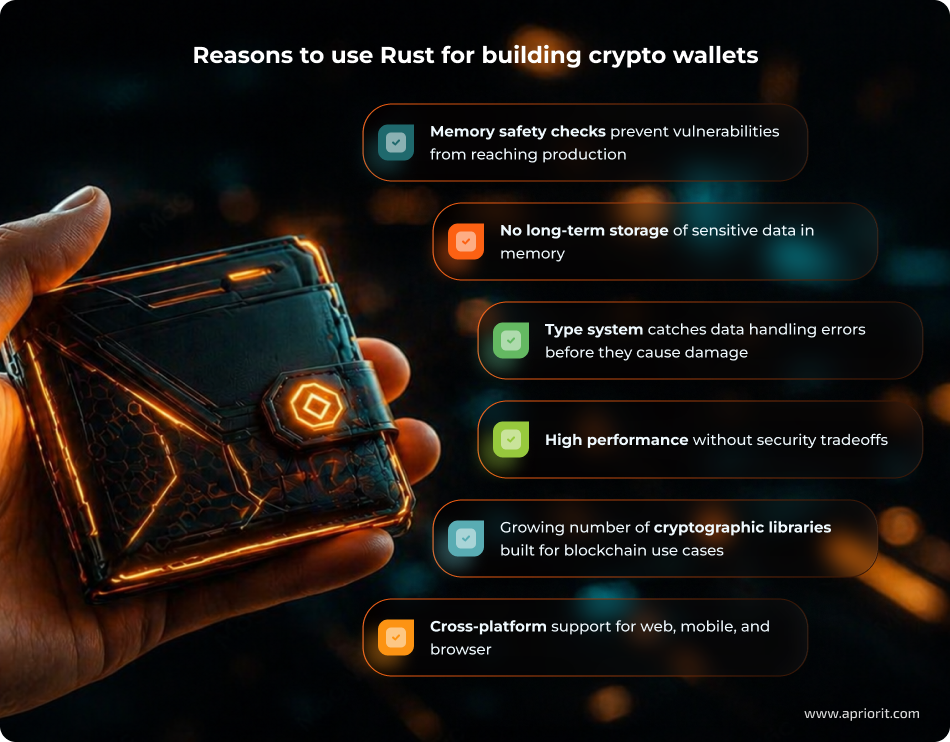
Rust’s strict type system doesn’t let a developer pass the wrong type of data to a function without explicitly handling the conversion. This protects the wallet from logical errors when handling cryptographic data: addresses, key material, transaction fields. Type mismatches that would silently corrupt data or cause unexpected behavior in loosely typed languages are caught at compile time in Rust.
Compile-time safety
Rust won’t compile if your code has memory-safety errors. Use-after-free bugs, null pointer dereferences, data races — the compiler catches these before your application ever runs. In other languages like C and C++, finding these issues requires runtime checks, external tooling, or hoping your tests cover the right cases.
For wallet software, where a memory corruption bug can expose private keys, catching these at compile time rather than in production is a clear advantage.
No memory leaks, by design
Rust tracks memory allocation and deallocation automatically, without a garbage collector. When a variable goes out of scope, Rust cleans it up. For wallet software, this matters because memory that isn’t properly freed can hold onto sensitive data like private keys or seed phrases. This gives hackers an opportunity to extract that data.
Performance
Rust compiles to native machine code that runs directly on the processor — the same as C and C++. Compared to languages like JavaScript or Python, which add a runtime layer between your code and the hardware, the performance difference is substantial.
For wallet development specifically, this matters for backend operations like high-frequency transaction signing, bulk key derivation, or running on constrained hardware such as security modules. That’s where its performance becomes a real architectural advantage.
Rich cryptographic library ecosystem
Rust has strong library support for the cryptographic primitives that wallet development requires. Its package ecosystem includes well-maintained libraries for TLS, digital signatures, and Bitcoin-specific functionality.
Additionally, a growing number of chain-specific SDKs are available, meaning your team can compose audited, maintained building blocks rather than implement cryptography from scratch.
Cross-platform deployment
Rust supports desktop and mobile platforms through frameworks like Tauri, Dioxus, and Iced, covering Windows, Linux, macOS, iOS, and Android from a single codebase. WebAssembly also makes it possible to run Rust in the browser using frameworks like Leptos or Yew instead of JavaScript-based alternatives like React, Angular, or Vue.
This gives teams the option to keep their core wallet logic in Rust across every platform — back end, desktop, mobile, and web.
Rust works well for integrations too. If your wallet needs Solana or Polkadot integration, Rust is a natural fit — both blockchains are built in Rust, and their developer tooling is Rust-native. Working in the same language means less friction when integrating deeply with either protocol.
These benefits are even more evident when you test them in practice.
Read also
How to Protect Your Assets: Crypto Wallet Security Best Practices
Discover how to safeguard wallets, prevent attacks, and build user trust through better protection.

Rust GUI frameworks for crypto wallet development: Tauri
Rust doesn’t include a built-in UI layer — for a wallet application, you’ll need a dedicated GUI framework to handle the interface. The main options available today are Tauri, Dioxus, and Iced, each with different tradeoffs in maturity, mobile support, and frontend flexibility. In this guide, we’ll be working with Tauri.
Tauri is an open-source framework for building desktop and mobile applications with a Rust back end and a web-based front end. It uses the operating system’s native WebView, which keeps binaries small and reduces the attack surface.
Its architecture fits crypto wallets: security-critical code lives in the Rust layer, isolated from the front end and exposed to it only through explicitly defined commands. This allows for clear boundaries between your cryptographic core and your UI.
To make Tauri’s specific advantages concrete, let’s compare it against Electron — the most widely used JavaScript framework for cross-platform crypto wallet applications.
Table 1. Comparison of Tauri (Rust) and Electron (JavaScript)
| Criterion | Tauri | Electron |
|---|---|---|
| Security | Very high. Rust back end minimizes the attack surface. | Good, but Node.js and a bundled Chromium increase exposure. |
| Performance | Higher. Uses the system’s native browser engine; low memory and CPU footprint. | Lower. Ships its own Chromium instance and Node.js runtime; significant resource overhead. |
| App size | Small. Typically 3–10 MB. | Large. 50 MB and above due to bundled Chromium. |
| Cross-platform | Windows, macOS, Linux, iOS, Android | Windows, macOS, Linux |
| Cryptographic libraries | Native Rust crates are fast and auditable, with no runtime overhead. | JS/Node solutions are functional but slower, with more overhead. |
| Blockchain integration | Via third-party Rust crates. Some native integrations require more setup. | Easier out of the box. Most chains publish JavaScript SDKs. |
| Entry barrier | Medium. Requires Rust knowledge alongside frontend skills. | Low. JavaScript/TypeScript and basic Node.js is sufficient. |
| Development speed | Slower, especially without prior Rust experience. | Faster. Has a large ecosystem and abundant ready-made modules. |
| Testability | More complex. Requires configuring testing for both Rust and web layers. | More convenient. Has rich JS/TS tooling and end-to-end test frameworks. |
| Community | Growing and active, but smaller. | Large and mature, with extensive documentation and solutions. |
While developing with Electron may seem more convenient for developers, Tauri offers superior performance, security, and cryptographic integrity, which is much more important when building crypto wallets.
Tauri also supports iOS and Android, using Rust for native API access and WebView for the UI layer. This means that your wallet can target mobile from the same codebase. Mobile support is still maturing, however. Build compilation on iOS can be unreliable for complex applications, so it’s best suited to simpler wallet interfaces for now.
In the next section, we put Tauri to work, building a functional desktop app for a Rust Bitcoin wallet from the ground up and then expanding its support to the iOS platform.
Read also
How Much Does Blockchain App Development Cost? A Detailed Overview
Accurately estimate your blockchain project budget and avoid hidden costs. Discover key factors that influence development expenses.

Building a Bitcoin crypto wallet with Tauri: A practical example for tech teams
Let’s see how you can build a simple Bitcoin wallet in Rust. The full source code is available here.
Dependencies
In this example, we’ll use four crates:
- bitcoin — core Bitcoin primitives: keys, addresses, transactions
- bip39 — mnemonic seed phrase generation and parsing
- rand — random number generation
- rand_core — core traits for random number generators
Now, we can get to developing the crypto wallet.
- Set up the project
First, we create a new Rust project:
cargo new rust-bitcoin-wallet
Then we create a wallet.rs module to contain the wallet logic.
- Generating a seed phrase
The first function generates a 12-word BIP39 mnemonic from cryptographically secure random entropy:
pub fn generate_seed_phrase() -> String {
    // create a new randomly generated mnemonic phrase
    let mut entropy: [u8; 32] = [0; 32];
    OsRng.fill_bytes(&mut entropy);
    let phrase = Mnemonic::from_entropy_in(Language::English, &entropy).unwrap();
    format!("{}", phrase)
}- Creating a wallet from a seed phrase
Next, we define the create_wallet_from_seed_phrase function, which takes a seed phrase and derives a Bitcoin testnet wallet from it, returning the secret key, public key, and a P2WPKH address.
pub fn create_wallet_from_seed_phrase(seed_phrase: &str) -> Wallet {
let network = Network::Testnet;
let mnemonic = Mnemonic::from_str(&seed_phrase).unwrap();
let entropy = mnemonic.to_entropy();

let secp: Secp256k1<bitcoin::secp256k1::All> = Secp256k1::new();

let secret_key = SecretKey::from_slice(&entropy).expect("32 bytes, within curve order");
let public_key = PublicKey::from_secret_key(&secp, &secret_key);

let private_key = PrivateKey::new(secret_key, network);
let public_key = CompressedPublicKey(public_key);

let address = Address::p2wpkh(&public_key, network);

let wallet: Wallet = { Wallet {
public_key: public_key.to_string(),
private_key: private_key.to_string(),
address: address.to_string(),
} };

wallet
}Now, we connect the entry point in main.rs:
fn main() {
let seed_phrase = find_or_create_seed_phrase();
let wallet = wallet::create_wallet_from_seed_phrase(&seed_phrase);

save_wallet_private_key(&wallet.private_key);

println!("{}", seed_phrase);
println!("{:#?}", wallet);

}On startup, the application will ask the user to enter an existing seed phrase or generate a new one. It will then derive the wallet from that phrase and save the private key to the device.
We’ll use a find_or_create_seed_phrase function to prompt our user to input the seed phrase or create a new one.
fn find_or_create_seed_phrase() -> String {
let mut buffer = String::new();

println!("Enter seed phrase or enter 1 to create new");
io::stdin().read_line(&mut buffer).expect("Failed");
let input: String = buffer.trim().parse().unwrap();

let mut seed_phrase: String = "".to_string();
if input == "1" {
seed_phrase = wallet::generate_seed_phrase();
} else {
seed_phrase = input;
}

seed_phrase
}If the user enters 1, a new seed phrase is generated. Any other input is treated as an existing phrase. Either way, the result is passed to create_wallet_from_seed_phrase to produce a usable wallet.
As you can see, Rust handles the cryptographic heavy lifting cleanly and with minimal boilerplate. But this example has only covered the wallet core — a command-line application. The real goal of this article is to show what Rust looks like as the foundation of a cross-platform wallet application. In the next section, we take this same logic and run it on iOS using Tauri.
Porting a Rust crypto wallet to iOS
With the core wallet logic working, let’s wrap it in a Tauri application and run it on iOS.
- Create a new Tauri project
First, we’ll install the Tauri app scaffolding tool and create a new project:
cargo install create-tauri-app --locked
cargo create-tauri-app
During setup, we need to select Yew as our frontend framework. Some Rust frontend frameworks have stability issues in Tauri’s mobile environment. Yew is the most straightforward choice for reliably getting a working build.
Before proceeding, make sure you have the prerequisites for your OS installed: tauri.app/start/prerequisites
- Initialize and run the app
Now we navigate to the project folder to initialize the mobile targets:
cd wallet-ios
cargo tauri android init
cargo tauri ios init
From there, we use appropriate commands for each of our target platforms:
- Desktop:
cargo tauri dev - Android:
cargo tauri android dev - iOS:
cargo tauri ios dev
For iOS frontend builds, we’ll also need Trunk — the Wasm build tool for Yew:
cargo install --locked trunk
Then, we run the following commands:
сd wallet-ios
cargo tauri ios init
cargo tauri ios dev
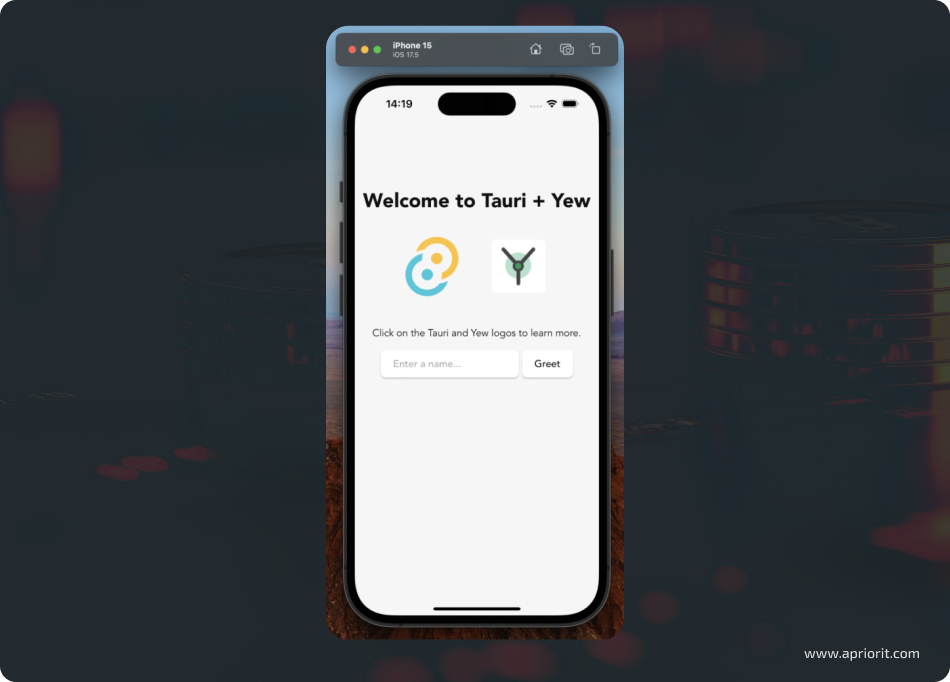
At this point, we see the app running in the iOS simulator.
- Adding wallet functionality
To add our wallet functionality, we copy wallet.rs from the previous project into our Tauri project and add the same dependencies — bitcoin, bip39, and rand — to Cargo.toml.
Next, we replace the default greet button handler with a create_wallet command. In Tauri, backend functions exposed to the front end are defined with the #[tauri::command] attribute:
#[tauri::command]
fn create_wallet() -> String {
let seed_phrase = wallet::generate_seed_phrase();
let wallet = wallet::create_wallet_from_seed_phrase(&seed_phrase);

println!("{}", seed_phrase);
println!("{:#?}", wallet);
seed_phrase
}This function generates a seed phrase, derives a wallet from it, and returns the seed phrase to the front end.
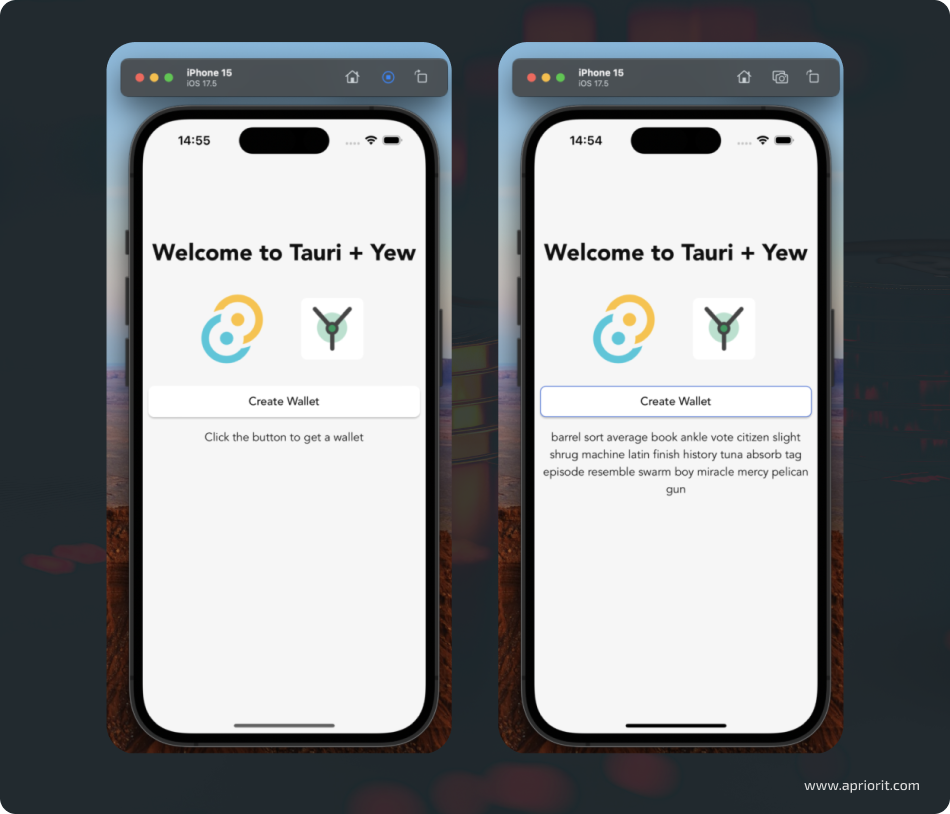
Note: This example uses Yew for the front end, but Tauri works equally well with standard JavaScript frameworks. If your team is more comfortable with JavaScript, or if your UI requirements are complex, JavaScript may be the better option. The wallet core in Rust remains the same either way — only the frontend layer changes.
The full source code for the Tauri iOS application is available here.
That’s it!
The examples in this guide are a starting point. Your production wallet will need more: proper key storage, transaction broadcasting, error handling, and rigorous testing of your cryptographic logic.
Things to know before building your crypto wallet with Rust
Before choosing Rust for your crypto wallet project, there are several practical constraints worth knowing about.
Mobile support is WebView-based, not native
Rust frameworks like Tauri and Dioxus support iOS and Android, but they render the UI through a WebView — the platform’s built-in browser engine — rather than native UI components. Application logic runs on-device, but the user experience may differ from fully native Swift or Kotlin apps in terms of performance and platform consistency.
The ecosystem is still young
Rust’s library ecosystem is growing, but it’s smaller than JavaScript, Python, or Java. Some functionality you’d find as a mature, well-maintained library in those ecosystems doesn’t yet have a Rust equivalent — or exists only as an early-stage crate with limited maintenance.
In some cases, teams end up writing their own implementations. That adds development time, cost, and surface area to audit.
At Apriorit, we always verify what specific chains, signing schemes, or integrations are already covered by existing crates and adjust our estimates accordingly if we need to build one from scratch.
Rust doesn’t handle UI on its own
Rust doesn’t have a built-in UI layer. For wallet applications, you’ll need a framework like:
- Tauri — pairs Rust backend logic with a web-based front end
- Dioxus — a React-like framework that lets you write UIs in Rust
- Iced — a native-feeling widget toolkit in pure Rust
In this article, we’ll demonstrate building a crypto wallet with Tauri, as it’s the most suitable framework for this type of software thanks to its maturity.
Rust developers are harder to hire
The Rust talent pool is smaller than for mainstream languages, and Rust engineers with blockchain experience are even rarer. This affects both hiring timelines and development costs. Rust specialists typically command higher rates than equivalent JavaScript, Kotlin, or Swift developers.
At Apriorit, we grow and train our Rust developers in-house, making them available for our clients whether they need just one Rust developer or a whole team with supporting specialists like QA engineers, project managers, and business analysts.
Related project
Enhancing Financial Data and Operational Security with a Tezos Wallet and dApp Audit
Discover how our team identified critical vulnerabilities in a Tezos wallet and dApp, helping the client strengthen security and prevent potential exploits before product release.

Build a reliable and secure crypto wallet with Apriorit
Whether you plan to build your crypto wallet with Rust or any other technology, Apriorit is ready to help. Our 20+ years of experience in cybersecurity allow us to build truly secure and compliant blockchain solutions.
By hiring our blockchain experts, you can get:
- A custom wallet that doesn’t let users, stakeholders, or regulators down. We build software that lasts using a set of technologies, methods, and tools that guarantee your wallet is error-free, highly performant, and easy to use.
- Smart contracts that are seamlessly integrated into whatever dApp or blockchain service you need.
- Expert answers to your questions, which we offer through consultations. Whether you have questions about your blockchain strategy, wallet security, compliance, or specific technical issues, our experts are always here to help.
Already have a wallet in production? We can work with your existing codebase to:
- Audit it for security vulnerabilities and performance bottlenecks
- Extend it with new functionality as your business requirements evolve
- Keep it up to date as the underlying platforms and protocols change
Ready to build or strengthen your crypto wallet? Contact Apriorit and talk to our blockchain experts.
Work with experts who get it right
Reach out to our blockchain development team and build a crypto wallet that serves your business and your customers.
FAQ
Why should I consider using Rust in my blockchain project?
<p>Rust eliminates entire classes of security vulnerabilities at the compiler level — before your code even runs.</p>
<p>Beyond security, Rust delivers native performance comparable to C and C++, a growing ecosystem of cryptographic libraries, and cross-platform deployment through frameworks like Tauri.</p>
<p>If security and performance are non-negotiable in your project, we’d recommend considering Rust.</p>
What should I know before choosing Rust for crypto wallet development?
<p>Rust does come with tradeoffs. For starters, the talent pool is smaller than for JavaScript or Python, which affects both hiring timelines and development cost.</p>
<p>Additionally, while the ecosystem is growing, it is relatively young — some chain-specific SDKs and integrations that you would readily find in JavaScript don’t yet have mature Rust equivalents. Mobile support through Tauri is still maturing as well.</p>
<p>And for developers coming from other languages, Rust’s ownership model has a steep learning curve. However, you can avoid this challenge by simply hiring Rust developers who have enough experience to deliver your crypto wallet without having to spend time familiarizing themselves with the language.</p>
Can I build a cross-platform crypto wallet with Rust?
<p>Yes. Tauri, the leading Rust application framework, supports Windows, macOS, Linux, iOS, and Android from a single codebase. This means that your wallet’s cryptographic core that includes key management, transaction signing, and address derivation stays in Rust across all platforms.</p>
<p>This allows you to preserve Rust crypto wallet security everywhere your application runs. For web delivery, WebAssembly makes it possible to run Rust in the browser as well, using frameworks like Leptos or Yew instead of JavaScript.</p>
What is Tauri, and why use it for crypto wallet development?
<p>Tauri is an open-source framework for building desktop and mobile applications with a Rust back end. Unlike Electron, which bundles its own Chromium instance and Node.js runtime, Tauri uses the operating system’s native browser engine. This results in smaller binaries, lower resource consumption, and a significantly reduced attack surface.</p>
<p>It also means that Tauri lets you keep your signing logic and key management in Rust while delivering a polished cross-platform interface.</p>
Is Rust suitable for mobile crypto wallet development?
<p>Rust is viable for mobile wallet development, but with caveats.</p>
<p>Tauri supports iOS and Android using Rust for native API access and a WebView for the UI layer. The approach is lightweight and performant, but mobile support is still maturing — build compilation on iOS can be unreliable for complex applications.</p>
<p>If you have a simple wallet interface, Tauri will work well. However, for feature-heavy mobile wallets, we’d recommend other frameworks like React Native, Flutter, or Swift and Kotlin.</p>
Have a question?
Ask our expert!

VP of Engineering