
 Skip to main content


Key takeaways:
- Decision intelligence (DI) and agentic AI complement each other: DI is the framework for decision-making, and AI agents are tools to optimize it.
- You can use AI agents at any stage of the decision loop, but they require different levels of autonomy based on the tasks they handle.
- When implemented poorly or without a clear vision, AI agents can introduce security issues, slow down integrations in data pipelines, and make wrong decisions.
- You can prevent these and other issues by preparing for AI agent adoption with an experienced partner and conducting regular testing to fine-tune AI models.
Agentic AI and decision intelligence are commonly seen as the future of business decision-making. But these concepts can be both beneficial or risky for a business.
For midsize companies that already have dashboards, analytics tools, and a few AI pilots running, additional agents can create a real risk. Investing in technology that sounds promising could in fact result in cybersecurity incidents, wasted budgets, and AI tools that nobody trusts or uses.
In this article, you’ll learn:
- What decision intelligence and AI agents actually mean — and how they work together
- How AI agents work within a structured decision loop
- Risks of adopting AI agents for decision-making — and how to manage them
Contents:
- DI & agentic AI: Key definitions
- How AI agents improve decision intelligence
- Where AI agents fit into the DI workflow
- Risks of using AI agents for DI and how to overcome them
- 1. Decision bias and fairness
- 2. Cybersecurity incidents and data leaks
- 3. Long-term scalability limitations
- 4. Slow integrations and compromised data security in transit
- 5. Decision quality drift
- 6. Lack of transparency and accountability
- Build reliable agentic DI systems with Apriorit
DI & agentic AI: Key definitions
Many enterprises shift from business intelligence to decision intelligence in an effort to keep up with the mountains of data they generate and the growing number of choices they face. But despite aggressive market growth (from $17.41 billion in 2025 to $20.73 billion in 2026), decision intelligence continues to be misunderstood (or implemented incorrectly) due to the hype around it. It gets even more complicated when AI agents are added to the mix.
So, let’s start with definitions: what is decision intelligence?
Decision intelligence is a discipline that connects data, analytics, AI tools, and outcome tracking into a single process. It identifies a decision, models options, acts, and then feeds the results back into the system to improve future decisions.
DI was built to handle the speed at which organizations need to turn information into action. Even skilled analysts can’t reliably process all incoming data fast enough — not because they lack expertise, but because the volume and pace of inputs exceed what any person can consistently handle. This is where AI agents come in.
Then, what is agentic AI?
AI agents are software systems that can:
- Take in information from their environment
- Assess what needs to happen based on a set of goals and rules
- Carry out actions across digital systems
Where AI algorithms can automate processes according to the initial prompt, AI agents can adjust their approach as conditions change, work across multiple tools at once, and handle workflows that involve several steps and decision points.
How AI agents improve decision intelligence
Implementing AI agents isn’t without risks — which we’ll cover later.
But when built with the right safeguards and embedded into a company’s decision workflows, using agentic AI in decision intelligence provides:
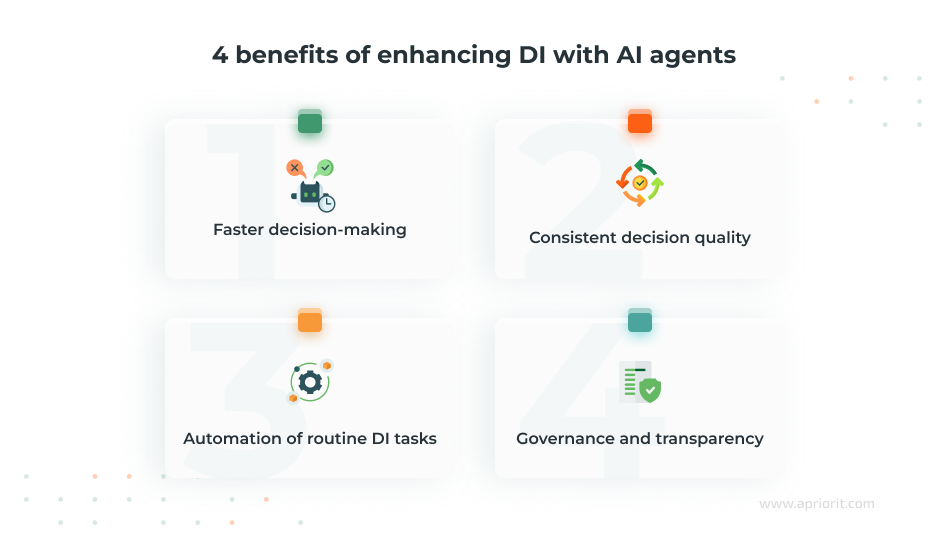
Faster decision-making. Agents can monitor data feeds nonstop, flag meaningful changes, and generate recommendations before a human would notice the shift. This turns decision-making from a scheduled activity into a continuous one, giving leaders relevant inputs as soon as possible.
Consistent decision quality. AI agents apply the same criteria to every decision, reducing the risk of biased results or human error. They don’t falter under pressure or cut corners because of tight deadlines. And while they also don’t bring unexpected results or have a hunch about decisions, consistency is exactly what some tasks need.
Automation of routine DI tasks. A significant share of business decisions — think risk assessments, compliance checks, and inventory adjustments — are repetitive and data-heavy. Offloading those tasks to agents means experts can focus on complex, high-stakes problems where human judgment matters.
Governance and transparency. Properly designed agents log every step. This kind of traceability is increasingly important for regulatory compliance and internal accountability, and it’s far more reliable than depending on meeting notes or institutional memory.
Looking for a team with real-life AI development experience?
Apriorit’s team has delivered AI algorithms, chatbots, and agents for various industries and tasks. We’ll help you define use cases for AI in your business and prepare you for efficient implementation.
Where AI agents fit into the DI workflow
The business decision-making process generally follows an OODA loop: Observe, Orient, Decide, Act. In a DI system, agents can participate at every stage of this loop. They also have a fifth stage for learning and improving AI output quality.
Here’s how AI agents participate at every stage of the DI loop:
Table 1. Tasks for AI agents along the DI loop
| Loop stage | Tasks for AI |
|---|---|
| Observe | – Pull data from enterprise software systems – Monitor data streams and capture events and signals in real time – Aggregate relevant inputs for a specific decision context |
| Orient | – Detect patterns that signal a decision is needed – Run predictive and analytical models on the collected data – Define trade-offs and risks for a specific decision point |
| Decide | – Make decisions within predefined policies – Generate recommendations with supporting evidence – Escalate exceptions to decision-makers |
| Act | – Follow decision playbooks and escalation rules – Update records and trigger workflows across connected systems – Send notifications and issue tasks |
| Learn | – Log decisions, actions, and outcomes – Provide data for model refinement and retraining |
At different stages, AI agents have different levels of autonomy that depend on their impact and the stakes involved. Those levels are defined in AI agent rules and scenarios for each stage.
For example, in low-risk high-volume scenarios (routing a support ticket, flagging a suspicious transaction), agents can make decisions on their own as long as they operate within rules the organization has set. These types of repetitive tasks take a lot of time from analyst teams but don’t require in-depth investigation.
In high-impact scenarios, such as handling a client’s complaint or updating an internal policy, the agent should shift into copilot mode: gather relevant data, run simulations or models, and present a set of options with supporting evidence. But company experts have to make the decision.
This distinction between autonomous and advisory modes is the cornerstone of an efficient and reliable combination of decision intelligence with AI. Organizations that skip this step often end up either over-automating sensitive decisions or under-utilizing agents for the routine tasks they’ve built to handle.
Related project
Building an AI-powered Customer Support Chatbot for an EV Charging Network
Discover how integrating an AI chatbot helped our client optimize support operations and reduce pressure on their service team.

Risks of using AI agents for DI and how to overcome them
Understanding what typically goes wrong and where to place safeguards is what separates successful decision intelligence AI implementations from expensive experiments.
Gartner predicts that over 40% of agentic AI projects will be canceled by the end of 2027 because of escalating costs, unfulfilled goals, and unmanaged risks. That’s not a reason to avoid this technology, but it is a warning to implement it carefully.
Here are the key risks of adopting AI agents and steps we recommend taking to mitigate them:
1. Decision bias and fairness
Agents learn from historical data and the specialists who configure them, and both sources are unavoidably biased. A lead scoring agent trained on past sales outcomes may systematically deprioritize prospects from certain industries or regions because they are underrepresented in the training data.
Biased AI decisions can damage a business or even pose legal risks in regulated areas like lending or hiring.
How to manage bias and fairness:
- Balance training datasets, focusing on representativeness.
- Run regular bias testing for high-risk decisions.
- Include fairness criteria to assess decision quality along the DI framework.
- Make sure that all high-risk issues are reviewed by experts.
2. Cybersecurity incidents and data leaks
As agents gain access to more systems and data along DI pipelines, they expand the organization’s attack surface. Prompt injection, data exfiltration, and unauthorized actions are already common risk vectors for agentic AI. An agent with broad permissions and poor guardrails can become a vulnerability rather than an asset.
How to manage security risks:
- Enforce strict authentication and access management rules for agents.
- Log access events.
- Design escalation paths so agents cannot take high-impact actions without human approval.
- Plan regular security audits and penetration testing for your agentic AI solution.
3. Long-term scalability limitations
Scaling AI use and DI frameworks introduces problems that don’t exist at the pilot stage or with a one-team deployment.
As multiple agents are deployed across departments, their decisions can start conflicting. Also, decision-making agents require real-time access to reliable data. As the number of agents and data sources grows, so does latency and the risk of agents acting on stale or incomplete information.
There’s also the challenge of allocating specialists to oversee agent deployment and maintenance. This consistently takes up the time of your tech team, and the more agents you have, the more support efforts they require. Without planning for this, teams quickly lose control over what their agents are actually deciding.
How to manage scalability:
- Start agent implementation with clearly scoped decision areas and expand incrementally.
- Add an orchestration layer to your DI framework that coordinates agents, resolves conflicting outputs, and maintains a shared context across the system.
- Plan supervision resources from the start.
4. Slow integrations and compromised data security in transit
AI agents typically need access to multiple enterprise systems to gather the inputs needed for decision-making. Each integration with CRMs, ERPs, databases, third-party APIs, etc. creates a potential performance bottleneck and increases the risk of data exposure. Poorly secured connections between an agent and a source system can leak sensitive information or slow down the entire decision loop.
How to manage integrations and data security:
- Enforce encrypted communication protocols for all agent-to-system connections.
- Apply the principle of least privilege for integrations.
- Add integration health checks into your monitoring and observability pipeline.
Read also
Third-Party API Integrations for Your Software: Benefits, Challenges, and Best Practices
Explore how to evaluate providers, structure integrations, and plan fallback logic so your product stays resilient even when external services fail.

5. Decision quality drift
Model drift is a common issue for any AI-based solution. For decision-making AI agents, this results in misrepresentation of data and incorrect recommendations. Researchers at Stanford and Carnegie Mellon demonstrated this risk by tasking an AI agent to compile expense receipts into an Excel file. When the agent couldn’t process data, it fabricated plausible records, complete with invented restaurant names.
In a business environment, such errors can lead not only to suboptimal decisions but to legal consequences.
How to maintain decision quality:
- Continuously monitor agent outputs against expected baselines.
- Define performance thresholds that trigger automatic alerts and call for specialist oversight.
- Run regular model reviews and retraining cycles.
6. Lack of transparency and accountability
When an agent makes or recommends a decision, the organization must be able to explain why. This is a requirement of the EU AI Act and the NIST AI Risk Management Framework, and it’s a common request among businesses adopting AI. Black-box decision-making systems are no longer sufficient.
On top of that, teams that can’t see how an agent reached a conclusion can’t catch errors in its logic, improve performance, or trust the system enough to act on its recommendations. And the more autonomous the agent, the more damage an unexplainable error can do before anyone notices it.
How to ensure transparency and accountability:
- Research and plan to meet transparency requirements that apply to your business.
- Require every agent to log the data it uses, the rules it applies, and the alternatives it considers.
- Assign clear ownership for each agent’s decisions.
These risks are serious, but none of them are reasons to avoid AI agents altogether. Instead, they are reasons to build and deploy agents carefully — with a reliable tech partner that has practical experience with AI.
Build reliable agentic DI systems with Apriorit
Designing trustworthy AI agents and uniting them in a DI pipeline requires more than just AI development skills. It takes a deep understanding of system architecture, data infrastructure, cybersecurity, and how all of these layers connect to business processes. Apriorit combines these capabilities under one roof.
We’ll help you with end-to-end software development or specific tasks along your AI journey. Here’s what we can do for you:
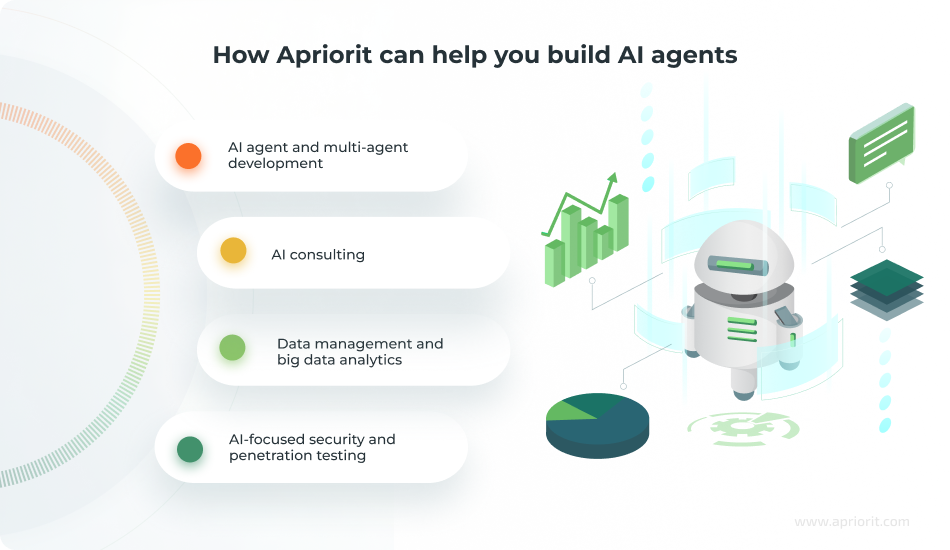
- AI agent and multi-agent development. We design, build, and deploy AI solutions tailored to your decision workflows, from single-task agents to multi-agent systems that coordinate across business functions.
- AI consulting. Not every decision requires an AI agent, and not every agent needs full autonomy. Apriorit experts can help you map decision workflows, identify where agents create the most value, and design an AI solution architecture based on your real-life tasks.
- Data management and big data analytics. Decision intelligence requires efficient data pipelines and well-designed data processing workflows. Apriorit will create storage architectures, data infrastructure, and analytics solutions that give your AI agents the foundation they need.
- Cybersecurity-focused development. Requirements for AI security get stricter every year. To accommodate, we build every AI system following secure SDLC principles, with protection mechanisms embedded at every stage of development. Our practices also align with ISO 27001 and ISO 9001 standards.
- AI-focused security and penetration testing. Regular testing should be a part of AI agent maintenance to help you detect security issues and model drift. Apriorit has dedicated QA teams that test AI-specific system threats and requirements.
Feel like we can help with your AI development tasks?
Challenge us with your project. We’ll get it done with the precision and attention it deserves.
FAQ
How can I ensure reliability and guardrails for agentic systems in DI?
<p>Start by defining the boundaries within which an AI agent is allowed to operate. Clear decision scopes help prevent unintended actions.</p>
<p>You can strengthen AI reliability through a mix of deterministic rules, human‑in‑the‑loop checkpoints for high‑impact decisions, and continuous monitoring that can detect model drift or unusual behavior. Most teams also enforce role‑based permissions, input validation, and explainability layers so engineers and stakeholders can see why a recommendation was made.</p>
<p>Detailed activity logs and audit trails make it easier for risk and compliance teams to understand how an agent behaves over time.</p>
What are common failure modes of agentic AI in decision processes?
<p>Agentic AI tends to fail when it makes assumptions outside the available data or when objectives are poorly defined. Many failures stem from missing guardrails or unclear process definitions, leading to actions that don’t align with business rules. Another common issue is drift in reasoning, where an agent’s internal policy changes as upstream data shifts.</p>
<p>These issues reinforce the need for clear goals, strong validation, and ongoing supervision.</p>
Where should I start on introducing AI agents to DI?
<p>Most organizations begin by selecting a single, well‑defined decision process with clear rules, consistent data, and enough volume to show measurable results. A pilot agent should have a limited role, like supporting data processing or automating a narrow part of the workflow.</p>
<p>This allows the team to validate assumptions, tune guardrails, and understand integration requirements before scaling. Once the initial pilot performs reliably, the agent’s responsibilities can expand, supported by governance, monitoring, and cross‑system alignment.</p>
How does decision intelligence support risk management?
<p>Decision intelligence helps risk teams understand how decisions are made, how they interact, and how they impact the business.</p>
<p>Key benefits of decision intelligence include:</p>
<ul class=apriorit-list-markers-green>
<li>Earlier visibility into potential issues by simulating scenarios before they reach production.</li>
<li>Clear decision boundaries that help ensure AI agents and automated workflows stay within approved constraints.</li>
<li>Continuous feedback loops that compare expected vs. actual outcomes and flag anomalies or drift.</li>
<li>Shared understanding between technical and business teams, reducing blind spots and improving governance.</li>
</ul>
Can I use AI agents to automate only some decision-making processes?
<p>Yes, partial automation is often the most effective starting point. You can let agents handle predictable, data‑heavy, or repetitive segments of a workflow while keeping ambiguous or high‑risk tasks under the control of your experts.</p>
<p>This hybrid approach delivers early gains in speed and consistency without forcing a complete redesign of governance or risk frameworks.</p>
Have a question?
Ask our expert!

R&D Delivery Manager