
 Skip to main content


Key takeaways:
- Rust shines where performance, security, and reliability really matter thanks to its intrinsic qualities like memory safety and safe concurrency.
- For some products or teams, Rust can be overkill and create more constraints than solutions.
- The biggest gains from Rust come in high-risk, long-term systems, especially in industries like cybersecurity, cloud infrastructure, FinTech, automotive, and AI.
- To get the most out of Rust, use it for the right components, migrate gradually, and combine it with other languages as needed.
- With the right guidance and experienced Rust engineers, you can get Rust’s benefits without sacrificing time to market or over-engineering your product.
Rust is gaining momentum across industries, and some of the largest tech players are adopting it for higher flexibility, security, and performance. Should you follow them and build your product with Rust, or is it the wrong tool for the job?
If you’re a CTO in need of a high-performance system or a product leader deciding whether Rust is worth the investment, this article is for you. By the end, you’ll understand when Rust delivers measurable business and engineering value, when it introduces unnecessary complexity, and how to decide whether Rust is the right fit for your product, industry, and team.
Contents:
Rust today: Popularity and enterprise adoption
Developers love Rust. Year after year, it tops surveys as the most admired language, being praised for its safety, performance, and modern tooling.
But developer enthusiasm is only one piece of the story. For business and technical leaders, the more pressing questions are these: Are real companies using Rust in production today, and Is it delivering measurable value? The answers increasingly appear to be yes and yes.
According to the 2024 State of Rust Survey, 45% of organizations now make significant, non-trivial use of Rust in production, up seven percentage points from the previous year. Everyday use within companies is also rising, with 53% of developers reporting they use Rust on a daily or near-daily basis at work.
Growth in commercial use has been dramatic as well: A recent analysis by JetBrains found 68.75% growth in commercial Rust adoption over the last three years. Even traditional enterprise domains like cloud infrastructure and systems programming are increasingly turning to Rust.
Here are some examples of major companies that use Rust in their products:
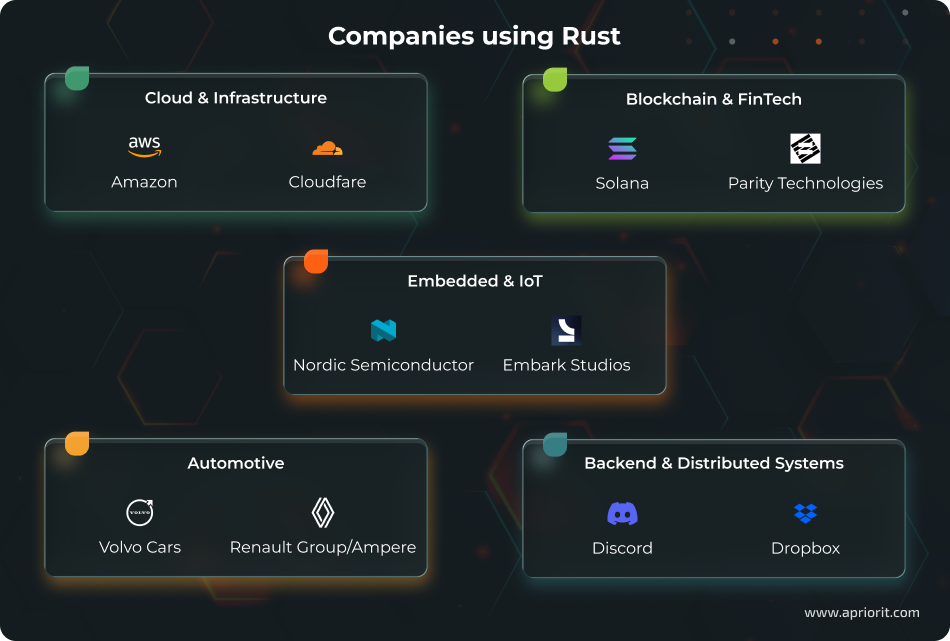
As you can see, Rust is already used in real-world enterprises. However, its adoption is not universal. In the next sections, we unpack why you might use Rust for your product — and when it might not make sense.
Considering Rust for your software?
You’re not alone! Explore whether adopting Rust is the right move for your business.
Why businesses choose Rust: Technical features with business impact
Developers love and choose Rust for its technical features, but how do they translate to business advantages like lower costs, reduced risk, and more predictable system behavior? Let’s look at the most important benefits of using Rust.
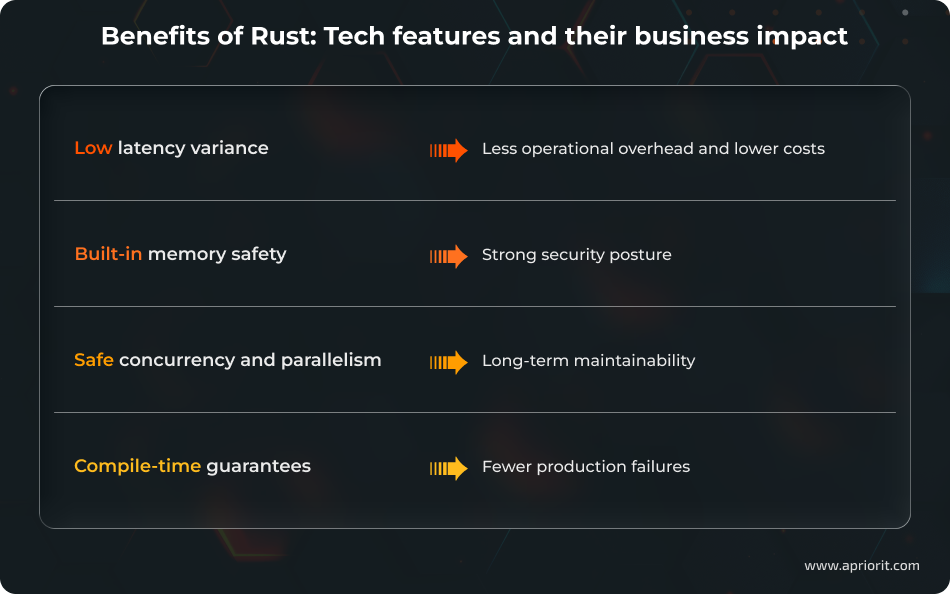
Reduced operational overhead and costs through predictable performance
Rust is consistently recognized for its high and stable performance under real-world workloads. In practice, Rust-based backend systems can significantly outperform dynamic languages such as Python and often match or exceed the efficiency of Go and even C/C++ in production environments.
But what matters for businesses isn’t just speed but predictability under load. Rust maintains low latency variance and stable throughput even as traffic increases, allowing systems to handle high request volumes without sudden performance degradation.
This predictability reduces the need for reactive over-provisioning — a common source of unnecessary infrastructure spending.
Rust’s efficiency also translates into lower CPU use and reduced energy consumption, which directly affects cloud and data center costs. For organizations running large-scale or always-on services, this can amount to meaningful savings over time.
In addition, Rust does not rely on a garbage collector, eliminating pause-related performance spikes and enabling more consistent system behavior — an important factor for customer-facing services.
Strong security posture through built-in memory safety
One of Rust’s most well-known strengths is memory safety enforced at compile time. This eliminates entire classes of vulnerabilities that frequently affect systems written in C or C++, such as buffer overflows, use-after-free errors, and data races.
For businesses, this means fewer security incidents, less emergency patching, and lower incident response costs. Memory safety is particularly valuable in security-critical domains, which is why organizations like the Internet Security Research Group (ISRG) are rewriting foundational components such as TLS libraries in Rust to reduce systemic risk.
Instead of relying solely on audits and runtime protections, Rust shifts a large portion of security assurance earlier in the development lifecycle. This approach helps enterprises build more resilient systems while reducing long-term security maintenance overhead.
Long-term maintainability through safe concurrency and parallelism
Modern software systems increasingly rely on parallelism to scale — but concurrency is also a major source of complexity and bugs. Rust addresses this by enforcing safe access to shared data, enabling developers to build concurrent systems with fewer hidden failure modes.
For a business, this means systems that scale without accumulating excessive technical debt. Rust supports both multithreading for CPU-intensive workloads and asynchronous programming for I/O-bound services, allowing your team to choose the right execution model without compromising safety.
As systems evolve and traffic grows, this flexibility helps organizations extend the lifespan of their software, improve hardware utilization, and avoid costly rewrites to overcome architectural limitations.
Fewer costly production failures through compile-time guarantees
Rust’s strict compilation model catches many classes of errors before code ever reaches production. Unlike languages where certain failures only surface under real workloads, Rust enforces well-defined behavior and prevents entire categories of undefined behavior at compile time.
For enterprises, this results in greater confidence during releases, fewer unexpected production outages, and lower costs associated with post-release fixes. While no language can eliminate all bugs, Rust significantly shifts risk left — from production incidents to development-time feedback — where issues are far cheaper to resolve.
Watch webinar
Rust in Cybersecurity: Capabilities and Prospects for System Programming
Join our experts as they discuss how Rust’s design principles help developers build secure, high-performance system software. Learn how Rust reshapes cybersecurity by preventing common vulnerabilities.
Domains that benefit the most from Rust
Certain industries benefit from Rust more than others. Let’s look at some examples of what Rust can be used for depending on the industry.
Table 1. Rust use cases across domains
| Domain | Typical use cases | Real-world examples |
|---|---|---|
| Cybersecurity | – Security products – Monitoring tools – Cryptographic components – Network proxies | Cloudflare (Pingora proxy), ISRG (TLS libraries), Microsoft (Windows security components) |
| Automotive | – In-vehicle software – Embedded controllers – Middleware – Safety-critical systems | Google (Android Automotive), Bosch |
| FinTech and payments | – Transaction processing – Cryptographic services – Blockchain platforms | Solana, Polkadot |
| Cloud providers | – Virtualization – Networking – Observability – Internal infrastructure | AWS (Firecracker), Cloudflare, Dropbox, Meta |
| AI and data platforms | – Inference engines – Data processing pipelines – Scalable backend services | Meta (Mononoke), Figma (multiplayer backend) |
Cybersecurity
In cybersecurity, memory safety is not just a nice-to-have feature — it directly impacts breach risk, regulatory exposure, and incident response costs. Rust’s compile-time guarantees eliminate entire classes of vulnerabilities that commonly affect C and C++ systems.
Here’s how some companies use these Rust properties for cybersecurity goals:
- Cloudflare replaced NGINX with a Rust-based proxy infrastructure (Pingora) to handle millions of concurrent connections with lower latency and stronger safety guarantees.
- Microsoft rewrote parts of Windows kernel components in Rust to reduce memory-related vulnerabilities.
Rust is a strong fit for security-critical systems where preventing vulnerabilities is more cost-effective than mitigating them later.
Automotive
Automotive software teams are increasingly adopting Rust for development of safety-critical and embedded components, with companies such as Google (Android Automotive), Bosch, and multiple AUTOSAR ecosystem vendors using Rust to reduce memory-safety risks in in-vehicle systems.
In practice, they are using Rust in:
- In-vehicle software and middleware
- Embedded controllers
- Safety-critical automotive components
The appeal lies in combining near-C++ performance with strong safety guarantees, without sacrificing deterministic behavior — a key requirement in automotive environments.
FinTech and blockchain
FinTech systems operate under strict correctness, compliance, and performance requirements. Errors are costly, and latency directly affects user experience and revenue.
That’s why more and more FinTech companies are using Rust as a foundation for their high-profile blockchain platforms:
- Solana uses Rust to power one of the fastest blockchain platforms, optimizing for throughput and low latency.
- Polkadot relies on Rust for secure and scalable blockchain interoperability.
Cloud providers
Cloud providers rarely replace their entire stack with Rust. Instead, they use it in components like proxies, infrastructure services, and internal tooling to reduce latency and security risk.
Here are some examples:
- AWS has used Rust across Firecracker, AWS Lambda, and Fargate to enable secure, lightweight virtualization.
- Dropbox has integrated Rust into performance-critical backend components, reducing CPU use by 25% and significantly improving file indexing latency.
Cloud providers usually start implementing Rust within infrastructure components where performance bottlenecks or infrastructure costs are most visible.
AI and data platforms
Rust plays an important role in AI infrastructure and data-intensive back ends.
Notable examples:
- Meta’s Mononoke back end was written in Rust to handle thousands of commits per hour across millions of files.
- Figma rewrote its multiplayer server from TypeScript to Rust to overcome scalability limits, achieving up to 10× faster serialization and stable low latency under load.
Note that Rust usually isn’t the best fit for training AI models. Most teams still rely on Python for that because of its mature tools and faster experimentation.
Michael Teslia, Program Manager at Apriorit
Let’s now take some practical steps to evaluate whether Rust fits your product and organization.
Read also
All You Need to Know About Rust for Automotive: Benefits, Limitations, and Compliance Requirements
Explore why the biggest automotive companies are using Rust, and how using this language for your automotive software translates to security, compliance, and performance.

When to go with Rust
Rust is an especially good choice for certain types of software.
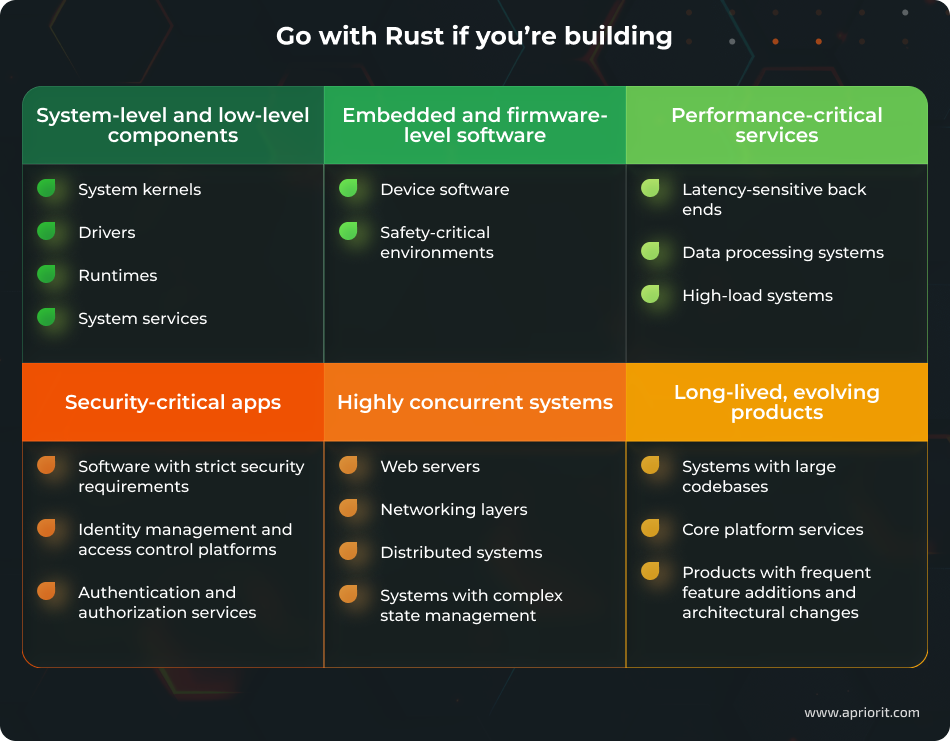
You should seriously consider Rust if you are building:
- System-level and low-level components. This includes operating system kernels, drivers, runtimes, and system services that require near-native performance.
- Embedded and firmware-level software. If you build device software for resource-constrained or safety-critical environments, use Rust to combat crashes, undefined behavior, and inefficiencies.
- Performance-critical services. These include latency-sensitive back ends, high-throughput data processing systems, or services that must maintain predictable performance under sustained load.
- Security-critical applications. Rust shines in software where vulnerabilities have direct legal, financial, or regulatory consequences, and where eliminating entire classes of memory-related bugs reduces long-term risk.
- Highly concurrent systems. Rust is great for web servers, networking layers, distributed systems, or other applications that rely on parallelism and complex state management.
- Long-lived, evolving products. Rust makes it easier to maintain codebases that grow and change over many years. You’re less likely to run into integration limitations thanks to Rust’s strict but expressive type system, clear ownership model, and strong backward-compatibility guarantees.
But when isn’t Rust that good of a choice? Let’s take a look at cases where choosing this language may be going overboard.
Related project
Porting a Remote Connectivity Protocol from C to Rust for Web Use
Learn how Apriorit modernized a VNC protocol with Rust and expanded its feature set, making our client’s product more secure, flexible, and competitive.

When using Rust may be over-engineering
Rust is a powerful tool, but it isn’t universal. In some scenarios, adopting it can introduce unnecessary complexity without delivering proportional business value.
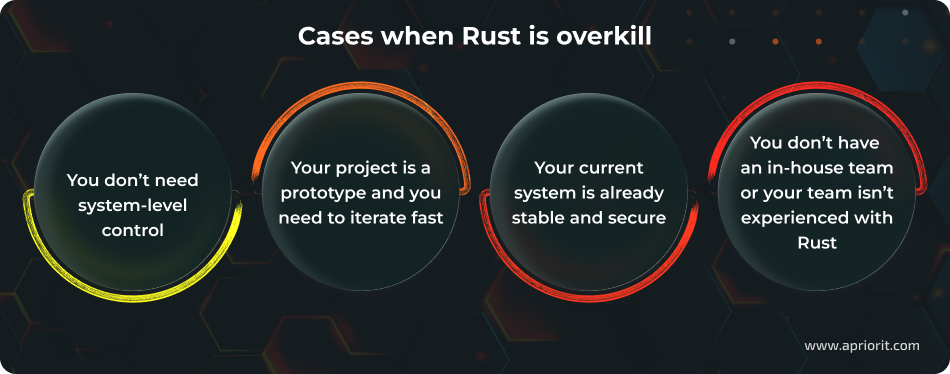
You may want to reconsider using Rust if:
- You don’t need system-level control. Your project is primarily driven by business logic, such as a CRUD-heavy application with standard data flows, and you don’t need systems-level control, low-level optimization, or fine-grained memory management. In such cases, instead of Rust, we recommend using higher-level frameworks like Django or Ruby on Rails to accelerate development and reduce complexity.
- Your project will be short-lived. Your product is built mainly for rapid prototyping, where speed of iteration matters more than long-term correctness and maintainability. In such cases, we typically recommend Python instead of Rust.
- Your current system is enough. Your existing codebase is already stable and secure, it meets current performance and scalability requirements, and you have no strong technical or commercial pressure to justify a rewrite or migration. In this case, we recommend sticking with your existing technology stack.
- You lack in-house expertise. You want your product to be released fast, and you either don’t have an in-house team or your tech team doesn’t have enough time to learn Rust and gain experience using it. If this is your challenge, you can either choose a simpler technology, or hire an outsourcing team that already has experience with Rust.
In practice, the last two challenges are often not technical blockers but resourcing decisions. Teams that want long-term benefits of Rust without slowing down delivery frequently work with partners who already have production experience in the language and established development practices.
Rust is challenging to learn. If your team doesn’t have enough experience with it, you can still release your product fast by working with a team that already knows how to develop with Rust.
Michael Teslia, Program Manager at Apriorit
For example, at Apriorit, we regularly provide companies with experienced Rust developers to help them migrate entire systems (or parts thereof) to Rust, or to start Rust software development projects from scratch without spending time on hiring.
How Apriorit builds your product with the right tech
At Apriorit, we treat Rust as one of many tools in a broad engineering strategy. We recommend it only when it delivers clear technical and business value.
By partnering with us, you get:
- Clear guidance on choosing a technology stack. Before starting development, we carefully assess your business needs, domain, current system, and constraints. Then, we offer you the technology stack that suits your project best, whether it includes Rust or another programming language.
- Modernization without disruption. You don’t have to shut down your operations just to migrate to Rust. Our specialists can gradually design components in Rust that will coexist with your current system, migrating it gradually instead of risking it all with a total rewrite.
- Production-ready systems. We support you all the way, from assessing if Rust makes sense to discovering where it’s most suitable, carrying out the actual implementation, testing, deploying, and providing long-term maintenance.
Table 2. What Apriorit brings beyond Rust expertise
| Our benefit | What it means |
|---|---|
| Security-first engineering | We follow secure SDLC practices and build systems with regulated and high-risk environments in mind. |
| Quality and compliance by design | Our company is aligned with ISO 27001 and ISO 9001 practices, suitable for enterprise and compliance-driven products. |
| Deep systems expertise | We have over 20 years of experience in low-level software, including kernel modules, drivers, system services, and performance-critical back ends. |
The Apriorit team can help you make a sound technology decision depending on your needs, constraints, and long-term plans.
With our deep system-level experience, we help you implement the right solution for your business — whether that means building your entire product with Rust, integrating Rust into separate parts where it makes sense, or choosing alternative technologies to meet your goals.
Need a second opinion on Rust adoption?
Reach out to our development experts and find out if Rust will bring real value to your business.
FAQ
Why should my company choose Rust over C or C++?
<p>Rust delivers C/C++-level performance while offering stronger guarantees around memory safety and concurrency. You still get low-level control, but with fewer risks from common memory-related and multithreading issues.</p>
<p>For your business, this often means fewer security incidents, less time spent debugging, and lower long-term maintenance costs.</p>
<p>When Rust and C/C++ are both viable options, the right choice depends on your performance requirements, existing codebase, and team expertise. In this case, we can help you evaluate the trade-offs and implement the best-fit solution.</p>
Is Rust suitable for enterprise-grade products?
<p>Absolutely — and it already powers many. Rust is used in production by companies including AWS, Google, Microsoft, Meta, and Cloudflare for security- and performance-critical systems. It has a mature tooling ecosystem, strong community support, and clear backward-compatibility guarantees.</p>
<p>For enterprises, Rust works particularly well when reliability, scalability, and security are core product requirements.</p>
How hard is it to migrate from C/C++ to Rust?
<p>Whether the migration is challenging depends on the strategy. We usually recommend migrating gradually, starting with the most performance-sensitive components, as this allows us to reduce technical and operational risks.</p>
<p>Rust pairs well with existing C/C++ code, which makes gradual adoption realistic. There is a learning curve, especially around ownership and borrowing, but from our experience, the upfront effort pays off in more predictable and safer systems.</p>
Does Rust impact development speed?
<p>It depends on your team’s experience. If your team has little experience, Rust can feel slower at first while everyone is getting used to its ownership model and stricter compiler rules.
<p>However, with an experienced team, Rust software development is often faster in the long run. Many issues are caught at compile time rather than in testing or production, which means fewer bugs, less rework, and more predictable releases. Over time, this usually translates into higher delivery velocity and lower maintenance effort.</p>
How well does Rust hold up in long-lived systems?
<p>This is one of Rust’s greatest strengths. Its strict safety and concurrency guarantees make large, evolving codebases easier to maintain over time. Rust helps prevent the kind of subtle bugs that usually accumulate as systems grow, especially in multithreaded environments.
<p>For long-lived products, Rust allows for fewer rewrites, easier onboarding for new engineers, and a codebase that stays stable as requirements change.</p>