
 Skip to main content

Key takeaways:
- Rust offers strong safety, predictable performance, and modern tooling, which makes it a good fit for security-critical and high-performance applications.
- The Rust ecosystem is growing quickly, aiming to cover embedded, kernel, cloud-native, and security use cases, though it’s still not as broad as C/C++ or Go in some areas.
- Rust may be less practical for simple business applications or internal tools where performance and memory safety are not critical.
- Sufficient expertise is a must to benefit from Rust’s promised reliability and maintainability.
Rust is a systems programming language that is no longer niche and used only by enthusiasts — it’s a solid choice for companies that build secure, reliable, and predictable software. Today, Rust often powers environments where memory integrity can’t be compromised: cybersecurity platforms, automotive systems, FinTech infrastructure.
As adoption grows, engineering leaders often start with a simple question: Is Rust worth considering for our current project or the next major update? Once that question comes up, more practical considerations follow:
- How smoothly can Rust integrate with existing architectures?
- Does the ecosystem provide the tooling, maturity, and compliance-ready solutions that the industry requires?
- Where does Rust genuinely outperform other languages, and where might it introduce unnecessary complexity?
Our experts answer these questions as they offer a practical overview of the strongest real-world Rust use cases. They also provide insights into when Rust may not be the right choice. This guide will be especially useful for CTOs and product owners evaluating Rust for safety-critical, performance-sensitive, and large-scale systems.
Contents:
- Why choose Rust for your project?
- Key use cases for Rust
- 1. System programming
- 2. Embedded & IoT development
- 3. Cybersecurity tools and secure-by-design applications
- 4. Cloud-native and serverless development
- 5. Blockchain and decentralized systems
- 6. Backend development and high-performance APIs
- 7. WebAssembly for browser and edge computing
- When Rust is not the right choice
- How Apriorit helps you build performant and secure systems with Rust
Why choose Rust for your project?
Modern software teams building safety-critical, performance-intensive, and security-sensitive systems increasingly adopt Rust. What began as an experiment among open-source enthusiasts has become a strategic option for enterprises across various industries.
Rust adoption continues to grow fastest in:
- Systems programming (OS components, drivers, low-level services)
- Cloud and backend engineering
- Embedded and IoT development
- Cybersecurity and blockchain solutions
Why use Rust? Across industries, various organizations already rely on Rust for components where memory safety, reliability, and high performance directly impact the user experience and reduce business risk. Businesses actively use Rust for automotive, FinTech, embedded, and cloud development.
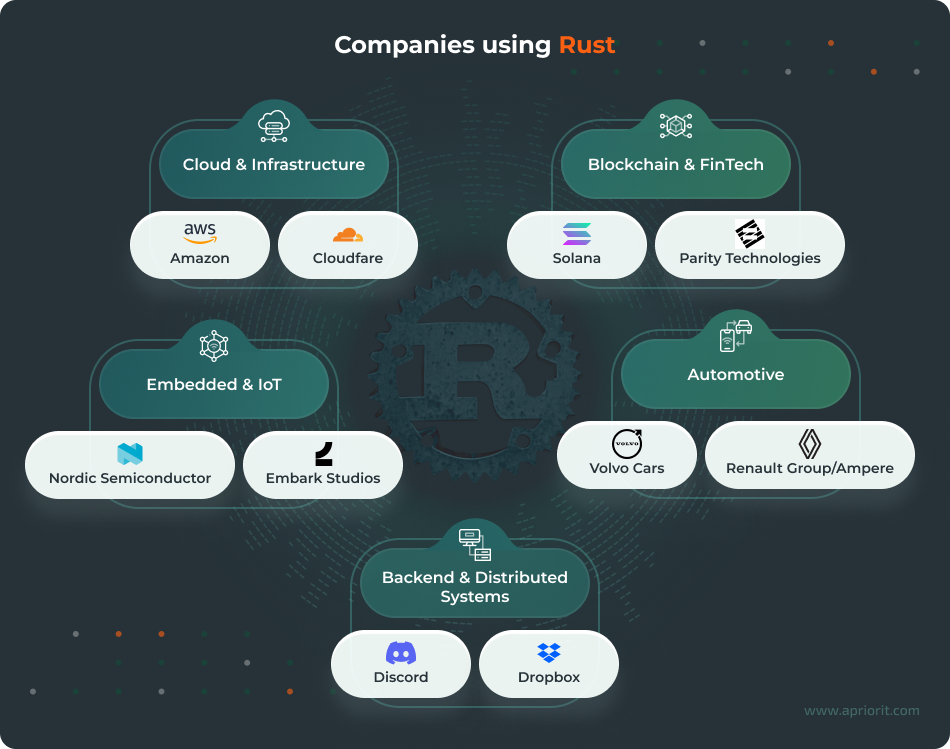
This shift is driven not by hype but by real business needs: predictable performance, stronger memory safety, fewer critical vulnerabilities, and lower long-term maintenance risks, according to the 2024 State of Rust Survey. Rust lets engineering leaders build critical components without sacrificing control over performance, hardware, or existing C/C++ codebases.
What makes Rust a strong fit for your projects?
Let’s see the overall benefits you can leverage from adopting Rust in your projects.
- Built-in protection against critical failures → fewer common memory-safety issues, production outages, and security risks
- Highly efficient execution → stable and predictable performance suitable for both resource-constrained devices and high-load services
- Smooth integration into existing systems → working alongside C/C++ through the Foreign Function Interface (FFI), enabling incremental modernization instead of full rewrites
- Expanding support across platforms and domains → improved tooling, growing libraries, better cross-compilation, stronger async support, and new Rust-first workflows
- Lower long-term maintenance cost → safe code and predictable resource use translate into fewer regressions, simpler maintenance, and more stable release cycles compared to other languages like C/C++
Whether you’re adding Rust to an existing system or using it to build something new, there are several areas where the language can deliver real, measurable value. Let’s take a closer look.
Need a high-performance system with zero compromise?
Partner with our Rust developers to eliminate memory issues, boost software speed, and achieve long-term reliability for your product architecture.
Key use cases for Rust
Rust is no longer tied to a single niche. It has grown into a flexible, production-ready choice for many applications, from low-level infrastructure to high-performance cloud services. Let’s break down the domains where Rust consistently proves its strengths.
1. System programming
Rust gives engineering teams an uncommon mix of memory safety, performance, and fine-grained control that low-level work demands. With the help of its ownership model, developers can eliminate entire classes of bugs, such as data races and use-after-free. At the same time, Rust gives developers direct access to hardware, system calls, and memory layouts.
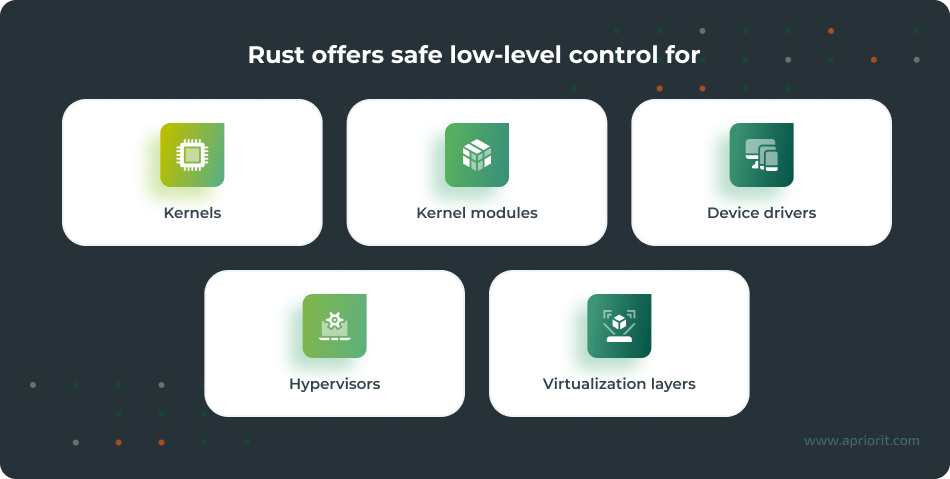
Key benefits of Rust for system programming include:
- Memory safety without a garbage collector. Rust eliminates common memory pitfalls, such as invalid pointers and accidental leaks, while keeping runtime behavior fully predictable.
- Сlose-to-metal performance. Zero-cost abstractions and compile-time checks let teams achieve a level of performance comparable to C/C++ without trade-offs.
- Fine-grained control over hardware and resources. Rust allows precise management of memory, concurrency, and system resources, which is critical for kernels and drivers.
As a result, Rust is well-suited for developing drivers, embedded solutions, and system-critical components where you can’t afford unpredictable behavior.
Apriorit experience: In our work with Linux kernel projects, we’ve seen that Rust can be especially effective for kernel modules that need strict control over low-level behavior without inheriting many of the common limitations of C. At the same time, using Rust in the kernel comes with its own constraints that teams need to account for early. We cover these considerations and share practical guidance in our article on Linux kernel and driver development with Rust.
2. Embedded & IoT development
Rust is a strong fit for embedded and IoT systems, where you operate within tight resource budgets, deterministic timing, and strict safety requirements. It has a no-runtime model and predictable memory use, which allows developers to target microcontrollers, bare-metal devices, and deeply constrained platforms.
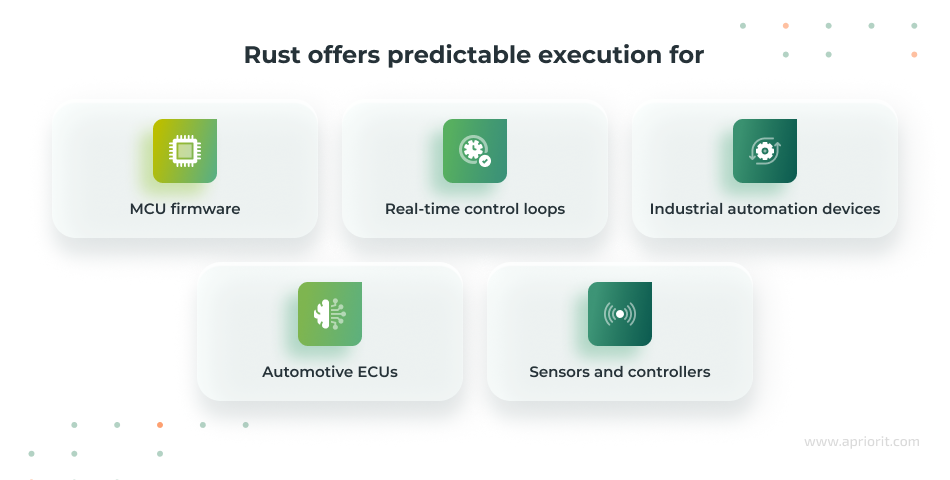
So, how can Rust be used for embedded systems? Let’s see:
- No runtime and deterministic behavior. Rust runs without a garbage collector, enabling precise timing and predictable memory access patterns.
- Safe concurrency for real-time workloads. Rust’s ownership system ensures data-race-free concurrency even on small devices with limited execution threads.
- no-std support for microcontrollers. Developers can build firmware for ARM Cortex-M, RISC-V, and other MCUs without relying on an operating system, which keeps binaries lightweight and ensures full control over memory and runtime behavior.
- Low memory footprint. Rust’s zero-cost abstractions minimize overhead, making it suitable for small RAM/flash configurations typical in embedded systems.
So, can Rust be used for embedded systems? Absolutely! Rust is highly effective for firmware, real-time systems, and embedded products in which reliability and deterministic performance are top priorities.
Apriorit experience: Our engineers used Rust to develop a minimal OS for Raspberry Pi 3. Through this work, we learned that adapting the kernel for embedded use often comes down to aligning it with very specific hardware limits and performance targets. In practice, this means tightening memory use, removing nonessential components, and carefully managing the boot process to get predictable behavior on resource-constrained devices.
3. Cybersecurity tools and secure-by-design applications
Rust has become a go-to language for building high-assurance security tools and applications that require reliability, memory safety, and predictable behavior. Rust’s strong guarantees also make it a powerful choice for cryptographic components, isolation layers, secure agents, and sandboxed execution environments.
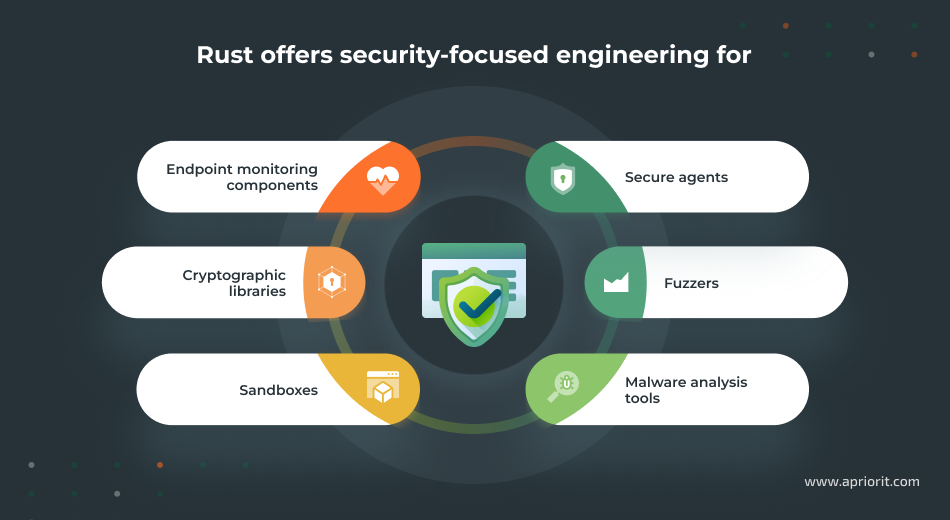
The main advantages of using Rust for security-focused tasks include:
- Elimination of memory corruption vulnerabilities. Rust prevents buffer overflows, dangling pointers, and other unsafe behaviors at compile time, which in turn reduces the exploit surface dramatically.
- Strong type guarantees. The compiler enforces strict type correctness, making it harder to introduce logic errors or unsafe state transitions.
- Safer cryptographic implementations. Rust offers a rich ecosystem of reliable cryptography crates (for example, the RustCrypto collection), making it easier to implement modern encryption, hashing, and signature algorithms without building everything from scratch.
- Built-in support for isolation and sandboxing. Rust’s ownership and borrowing rules naturally support separation of privileges and enforce safe boundaries.
Rust can be your choice when you need to create systems and tools with trust, safety, and exploit resistance in mind.
Apriorit experience: When building telemetry collection mechanisms for security monitoring, we’ve found Rust to be a strong fit thanks to its strict memory safety and support for well-structured data pipelines. In practice, designing such systems is not just about efficient data capture but about preserving data integrity and avoiding leaks throughout processing. Rust’s ownership model helps reduce common memory-related risks that can otherwise undermine telemetry in security-critical environments.
4. Cloud-native and serverless development
Rust is gaining traction in cloud development communities because it offers a blend of performance, reliability, and efficiency that modern distributed systems demand. Its lightweight runtime model and strong compile-time guarantees will help you deliver scalable services without overhead.
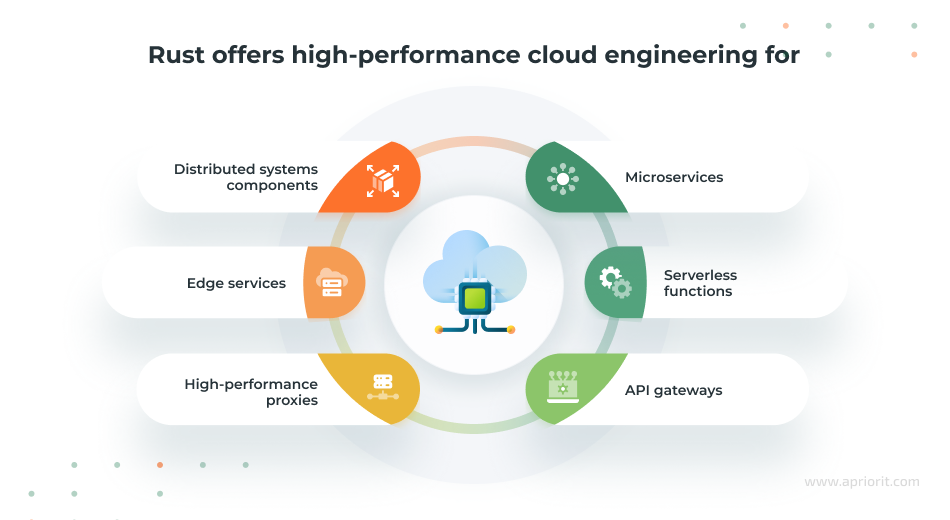
Here are some of the benefits of using Rust for cloud-native and serverless development:
- High throughput with minimal resource consumption. Rust services can handle more traffic while using fewer CPU and memory resources, which directly lowers cloud spending and helps teams scale applications more efficiently.
- Low-latency async execution. Modern async runtimes allow highly concurrent operations without the overhead of traditional threading models.
- Predictable performance at scale. Since Rust has no garbage collector, it avoids sudden latency spikes, which helps keep cloud services stable under load and makes it easier to meet strict SLAs and autoscaling rules.
- Efficient containerization and cold starts. Small binary sizes and fast startup times make Rust ideal for serverless workloads and edge deployments.
- Safe integration with existing cloud stacks. Rust fits smoothly into Kubernetes, Wasm runtimes, and polyglot microservice setups thanks to its small and efficient binaries, strong type safety, and predictable runtime behavior.
Rust is a strong fit for cloud-first and performance-sensitive workloads where reliability, speed, and efficiency must be balanced without compromise.
Read also
The Ultimate Guide to Cloud-based Application Development
Improve your cloud development decisions with practical recommendations on architecture, scalability, and security. Explore proven techniques that help you build stable and future-ready cloud applications.

5. Blockchain and decentralized systems
Thanks to its focus on safety, correctness, and efficiency, Rust is very useful in the blockchain ecosystem. Its compile-time guarantees help prevent subtle logic and memory issues that could compromise consensus or network integrity. Rust is also good for building components that operate under constant load.
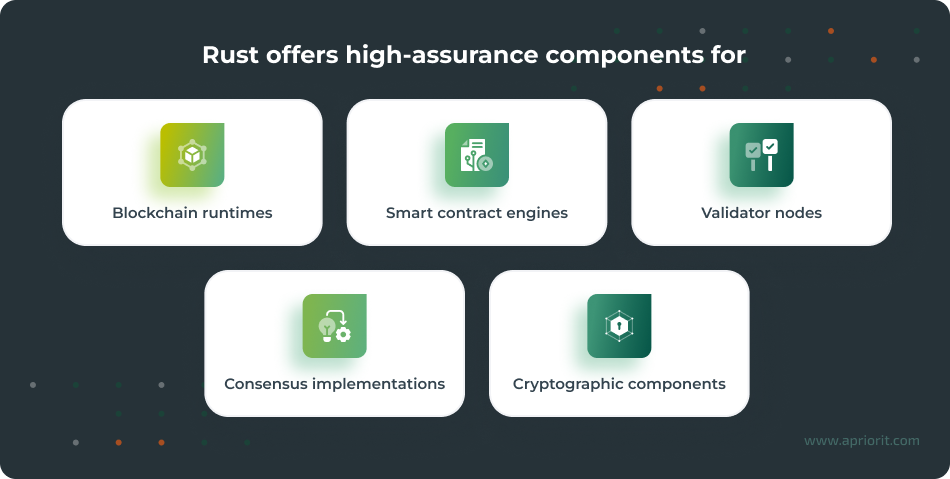
Let’s see why Rust is a good choice for blockchain and decentralized systems development:
- Strong safety guarantees. Rust’s ownership and borrowing system reduces the risk of critical failures or exploitable bugs in consensus-critical code.
- Reliable cryptographic execution. Deterministic behavior and memory safety help avoid side-channel vulnerabilities and undefined states in crypto routines.
- Performance suitable for decentralized networks. Efficient concurrency and low overhead allow nodes and runtimes to process large volumes of transactions with minimal latency.
- Predictable resource use. Without garbage collection, block times are consistent and performance is stable during network load spikes.
- Flexible integration with existing ecosystems. Rust powers frameworks like Substrate and integrates well with multi-language blockchain stacks.
As Rust prioritizes trust and accuracy, you can use it to efficiently build secure, performant, and resilient decentralized platforms.
Read also
How to Build a Secure Crypto Wallet with Rust: A Practical Guide from Blockchain Experts
Rethink how you design crypto wallets by learning why experienced teams choose Rust to reduce memory risks and long‑term maintenance costs.

6. Backend development and high-performance APIs
Rust is quickly becoming a solid choice for backend systems that need to deliver reliable performance under heavy load. Beyond speed, Rust helps teams avoid common backend issues like latency spikes from garbage collection, unpredictable memory growth, and concurrency bugs that surface under real traffic. This makes it especially valuable for APIs and services where stability under stress directly affects user experience and SLAs. That’s why more teams are starting to see Rust as a strong alternative to traditional high-performance stacks.

Key benefits of using Rust for backend development and APIs include:
- Low-latency request handling. Rust’s async runtimes allow highly concurrent workloads without the overhead of heavy threading models, helping APIs stay responsive even during traffic spikes.
- Efficient concurrency and safe parallelism. The ownership model prevents data races, which reduces hard-to-debug production issues in systems that rely heavily on parallel request processing.
- Reliable performance under load. Deterministic memory use avoids unpredictable pauses, helping backend teams maintain stable response times and meet strict SLAs during peak demand.
- Mature ecosystem for production services. Frameworks like Axum, Actix Web, and Tonic give developers reliable tools for REST, gRPC, and streaming back ends.
With these advantages, Rust gives you a reliable foundation for building back ends that stay fast and scalable even under heavy load.
7. WebAssembly for browser and edge computing
Rust has become one of the most reliable languages for compiling to WebAssembly (Wasm) because it provides fast and secure execution without relying on heavyweight runtimes. Its build process also produces small binaries with predictable behavior.
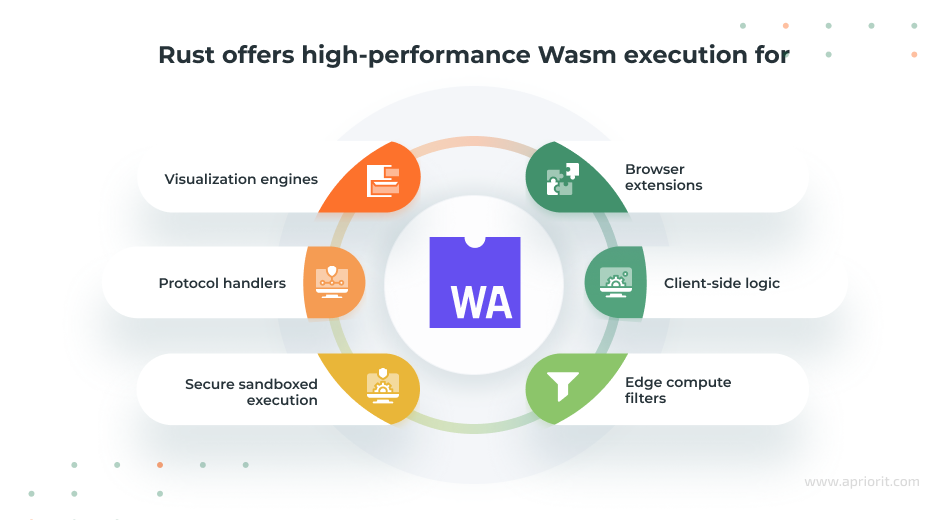
Rust can help your teams develop a Wasm product through:
- Predictable performance in the browser and at the edge. Rust-to-Wasm builds deliver near-native execution without pausing for garbage collection.
- Small and efficient binaries. Rust’s compilation pipeline is well-optimized for Wasm, reducing load times and resource use.
- Strong memory safety guarantees. The ownership model prevents vulnerabilities that could break sandbox isolation.
- Robust tooling for Wasm. Tools like wasm-bindgen, wasm-pack, and wit-bindgen streamline bindings, packaging, and cross-language interop.
This makes Rust a great fit for workloads that need to run safely in tight or sandboxed environments like browsers and edge platforms.
Apriorit experience: Our engineers used Rust to efficiently replace legacy C components when bringing system-level code to the browser via WebAssembly. In practice, this reduced memory-related defects and simplified long-term maintenance. It also allowed the client to deliver secure, low-latency remote connectivity directly in the browser without relying on heavyweight runtimes or plugins.
Read also
How to Develop a Back End for a Food Delivery App
Improve your backend development approach with guidance on managing orders, user data, couriers, and payments in food delivery apps. Our experts share methods that support performance, security, and rapid scaling.

When Rust is not the right choice
Even though Rust offers strong guarantees and long-term reliability, it won’t always give you the best return on effort. Before investing in Rust, ask yourself a few practical questions to see whether it truly fits your product’s priorities.
- Is performance or safety integrity truly a business-critical requirement?
If occasional slowdowns or memory-related issues won’t meaningfully impact your users or your SLA, Rust’s strengths may not justify the extra work.
- Will low-level control actually improve your solution or just add unnecessary complexity?
Rust excels when you need precise control over memory, hardware, or concurrency. However, if these are not your main concerns, the extra complexity might not pay off.
- Can your team realistically handle Rust’s learning curve right now?
Moving to Rust requires learning new mental models and patterns. If you prioritize fast delivery or don’t have resources to invest in team education, sticking to a familiar language or hiring a skilled outsourcing team may be more productive.
- Will Rust integrate smoothly into your existing architecture?
Even with FFI support, adding Rust to a large C/C++ or high-level codebase can complicate builds, tooling, and architectural decisions. You’ll also need someone on your team to maintain and monitor the Rust components over time.
- Does the Rust ecosystem fully support your domain, tooling needs, and compliance requirements?
Some regulated or highly specialized fields still rely on tooling that isn’t mature or is not yet certified in the Rust ecosystem. Rust can still be used in these cases, but development will take longer since your team may need to build custom solutions from scratch.
Rust is excellent when you need safety and performance above all else. But when your project prioritizes development speed, team familiarity, or integration simplicity, another technology may offer a better balance.
Michael Teslia, Program Manager at Apriorit
How Apriorit helps you build performant and secure systems with Rust
Apriorit helps companies build reliable, secure, and high-performance software with Rust, from embedded devices to large-scale cloud platforms. Our team combines years of system engineering expertise with hands-on Rust skills to reduce adoption risks, speed up delivery, and achieve predictable and safe code performance.
Here’s what you get when you partner with Apriorit:
- Experienced Rust engineering team
Using Rust, we’ve helped clients build solutions that meet strict safety, security, and compliance requirements. Our team brings hands-on experience across low-level, embedded, and cybersecurity projects, ensuring high performance and reliability where it matters most.
- Security-first development approach
We apply a secure SDLC for every Rust project and comply with ISO 27001/9001 standards, as well as niche or industry-specific regulations that apply to your product. This helps us achieve reliability, data protection, and compliance at every stage of development.
- 23+ years of low-level and system-level engineering experience
Our background in C, C++, OS internals, and virtualization allows us to solve complex Rust integration challenges and build solutions that are both high-performing and maintainable over the long term.
With us, you will gain a Rust engineering team that not only delivers secure, high-performance solutions but also helps you overcome adoption challenges. From getting your team up to speed to integrating Rust into existing systems and writing safe, maintainable code, we support your project every step of the way.
Accelerate your next project with a dedicated Rust development team
Let us help you adopt Rust smoothly and build systems that are faster, safer, and easier to maintain.
FAQ
What is Rust used for, and how can I integrate it into an existing C/C++ codebase?
You can add Rust gradually using its FFI (Foreign Function Interface). By letting C/C++ and Rust code work together, you can modernize parts of your system without rewriting everything. Careful planning helps to achieve smooth integration with existing build systems and tooling.
What is the best way to migrate a performance-critical module to Rust?
Your team needs to focus on modules where safety or speed really matter. Rewrite them step by step and benchmark to make sure the Rust version meets or exceeds the original performance. Rust’s safe concurrency and zero-cost abstractions help prevent regressions.
How does Rust improve memory safety compared to C/C++ in real systems?
Rust’s ownership and borrowing rules catch memory bugs like data races or use-after-free at compile time. It does this without a garbage collector, which reduces runtime errors and vulnerabilities. This, in turn, leads to more predictable and secure behavior in production.
Can Rust be reliably used for kernel modules and driver development?
Yes. Rust gives low-level control over hardware while preventing common C bugs. This makes kernel and driver code safer, easier to maintain, and more reliable.
Can Rust help reduce vulnerabilities in security-sensitive applications?
Yes. Rust eliminates many memory-related vulnerabilities at compile time and enforces strong type safety. It’s a great choice for building secure tools, cryptography, and sandboxed components.
Have a question?
Ask our expert!

Program Manager