
 Skip to main content


A microservice architecture ensures flexibility and resilience, making it a great choice for any software project — and especially for complex and highly distributed software systems. It allows your team to scale services independently and optimize performance of high-traffic components.
However, developing reliable microservices requires establishing effective inter-service communication without compromising overall performance. Leveraging built-in Golang capabilities can help you with this task.
In this article, we explore what challenges your team can face when implementing microservices and how Golang (or Go) can help you overcome them. You’ll also find practical examples of how to establish robust communication between microservices with Go.
If you are a technical leader considering building microservices or enhancing your microservice solutions, you will benefit from our experts’ implementation tips.
Contents:
Why use Golang for microservices?
Golang is a statically typed, compiled language known for its minimalist syntax and emphasis on maintainable code. Golang provides significant advantages for developing modern solutions, especially for scalable, concurrent, high-performance software systems with complex architectures.
Adding Golang to your technology stack will let you handle a range of limitations inherent to microservice architectures, such as:
- Architectural complexity. Handling numerous APIs, databases, and independent services increases the burden on deployment, monitoring, logging, scaling, and security. Go’s built-in concurrency allows for developing services that can process thousands of requests in parallel without the overhead of traditional threads.
- Network latency. Microservices often require multiple synchronous calls to other services to fulfill a single request, and every additional call may cause network latency. As Go is a compiled language with fast execution, it’s suitable for high-performance and low-latency services. Its concurrency model enables services to process multiple incoming and outgoing calls simultaneously without blocking. This allows for reducing wait times and improving responsiveness.
- Security vulnerabilities. An increased attack surface and the difficulty of monitoring different security protocols within multiple services lead to additional security risks. Go’s type safety, memory safety, and built-in security features help developers write secure code, reducing vulnerabilities related to memory management and type errors.
Ensuring effective inter-service communication is a crucial part of microservice development, as it directly affects the scalability and reliability of the whole solution. If microservices can’t exchange information smoothly, a system’s parts may wait for responses, causing delays and poor performance. Using Go for microservices can help you ensure reliable communication with its built-in support for modern protocols like gRPC and protocol buffers.
In the next section, we explore several ways of making communication between services efficient and straightforward with Go.
Want to level up your software resilience?
Apriorit experts will help you develop a reliable and secure microservice-based solution with Go.
How to implement effective communication between microservices with Golang: practical examples
From our experience, establishing smooth communication between microservices is often a primary challenge when developing a microservice architecture. It’s essential to choose the right communication pattern(s) based on your goals and task requirements.
In this article, we’ll walk you through three typical ways that we establish inter-service communication in our microservice-based projects:
- REST APIs
- gRPC
- Event-driven approach (message brokers)
REST APIs
Using REST APIs is a popular method of establishing communication, where one service exposes endpoints for specific functionality and another service makes an HTTP request (GET, POST, PUT, etc.) to that endpoint. This method balances good performance and development speed.
REST APIs use JSON to send data over the network. Since many testing tools also support JSON, you won’t have problems testing REST APIs.
Here’s an example of implementing a REST API in Go using the net/http standard package:
package main

import (
	"fmt"
	"log"
	"net/http"
)

func main() {
	http.HandleFunc("/hello", logicHandler)
	err := http.ListenAndServe(":8080", nil)
	if err != nil {
   	log.Fatal(err)
	}
}
func logicHandler(w http.ResponseWriter, r *http.Request) {
	fmt.Fprintf(w, "Hello from RESTAPI")
}gRPC
gRPC is a modern remote procedure call framework by Google that works over HTTP. Due to its low-latency characteristic, gRPC is suitable for high-performance tasks.
gRPC uses HTTP/2, which is faster than the common HTTP/1.1 standard because of reusable connections. Protobuf is used as a standard format to transfer data. To use gRPC properly, you need to use a proto schema to generate method code.
The following example shows how you can implement gRPC with a defined proto file.
syntax = "proto3";

package greeting;

option go_package = "./proto";

service GreetingService {
  rpc Hello(HelloRequest) returns (HelloResponse);
}

message HelloRequest {
  string name = 1;
}

message HelloResponse {
  string message = 1;
} Next, you can create autogenerated Go code using the protoc gRPC server:
package main

import (
	"context"
	"fmt"
	"log"
	"net"

	"google.golang.org/grpc"
	pb "snippets/proto"
)

type server struct {
	pb.UnimplementedGreetingServiceServer
}

func (s *server) Hello(ctx context.Context, req *pb.HelloRequest) (*pb.HelloResponse, error) {
	return &pb.HelloResponse{
   	Message: fmt.Sprintf("Hello from grpc, %s!", req.Name),
	}, nil
}

func main() {
	lis, err := net.Listen("tcp", ":50051")
	if err != nil {
   	log.Fatalf("failed to listen: %v", err)
	}

	s := grpc.NewServer()
	pb.RegisterGreetingServiceServer(s, &server{})

	log.Printf("server listening at %v", lis.Addr())
	if err := s.Serve(lis); err != nil {
   	log.Fatalf("failed to serve: %v", err)
	}
} Message brokers
If you need to transfer messages asynchronously, you can apply an event-driven approach. The main idea of this approach is to make a stream of events using message brokers, where one service produces messages and another service consumes them.
This approach allows for building a scalable architecture, as the number of consumers and producers can change dynamically. It also prevents message loss when one service shuts down, since all messages are saved in the broker.
To implement this approach, you can use standard message brokers like Kafka and RabbitMQ.
Let’s look at an example where a simple consumer uses the rabbitmq/amqp091-go library for RabbitMQ:
package main

import (
	"github.com/rabbitmq/amqp091-go"
	"log"
)

func main() {
	conn, err := amqp091.Dial("amqp://user:password@localhost:5672/")
	if err != nil {
   	log.Fatalf("Failed to connect to RabbitMQ: %v", err)
	}
	defer conn.Close()

	// Create a channel
	ch, err := conn.Channel()
	if err != nil {
   	log.Fatalf("Failed to open a channel: %v", err)
	}
	defer ch.Close()

	// Declare a queue
	q, err := ch.QueueDeclare(
   	"test_queue",
   	true,

	)
	if err != nil {
   	log.Fatalf("Failed to declare a queue: %v", err)
	}

	// Consume messages
	msgs, err := ch.Consume(
   	q.Name, // queue
   	"", 	// consumer
   	true,   // auto-ack

	)
	if err != nil {
   	log.Fatalf("Failed to register a consumer: %v", err)
	}

	go func() {
   	for d := range msgs {
      	log.Printf("Received a message: %s", d.Body)
  }
	}()
} These simple examples demonstrate how you can leverage Go to ensure smooth communication between microservices.
In the next section, we provide tips from Apriorit experts that you can use when implementing microservices in Go.
Read also
Golang, C#, or Java: Which Language Is Best for Building Microservices?
Explore the pros and cons of three languages for developing microservices to choose the best one for your project.

What to consider when implementing microservices: Apriorit’s tips
Based on their vast experience building scalable and reliable microservices with Go, Apriorit experts would like to share a few pro tips you can use when developing your own solution:
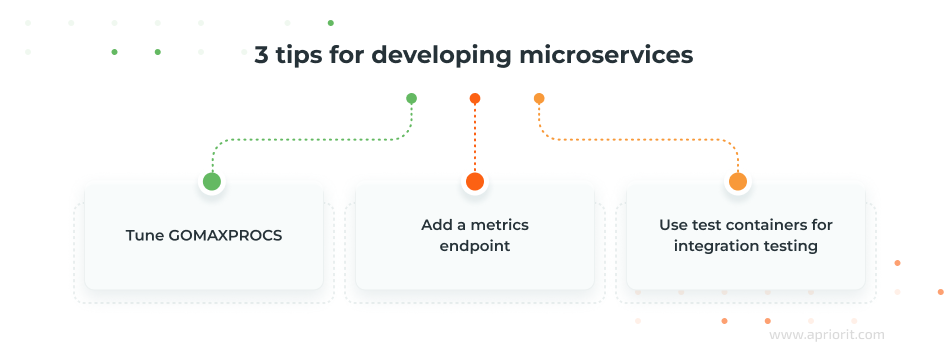
1. Tune GOMAXPROCS
GOMAXPROCS is an environment variable that controls the number of operating system threads that the Go scheduler can use. When a Go application runs inside a Docker container in Kubernetes with a CPU limit, you can face an issue when GOMAXPROCS is incorrectly adjusted. This happens because the Go runtime determines the number of available CPU cores, ignores all Kubernetes limits, and sets GOMAXPROCS to equal all available cores.
Apriorit tip: The uber-go/automaxprocs library dynamically sets GOMAXPROCS to match the container’s CPU quota, preventing CPU throttling issues in containerized environments. To use this library, you just need to import its main file.
_ "go.uber.org/automaxprocs" 2. Add a metrics endpoint
Adding metrics is a big task that includes deploying monitoring tools, setting up dashboards for visualization, and more. Incorporating metrics into your solution provides insights into software health, enabling your team to promptly identify and resolve performance and network issues.
Apriorit tip: The most common way to collect metrics from a Go solution is to use the Prometheus/client_golang library. To expose metrics, you need to create a metrics endpoint that will help you improve microservice observability.
http.Handle("/metrics", promhttp.Handler())
http.ListenAndServe(":8080", nil)3. Use test containers for integration testing
To guarantee your microservices work together as a reliable system, it’s important to perform integration testing that validates communication and data exchange between microservices as they interact. Moreover, integration testing allows you to validate APIs, message queues, databases, and other integration layers.
Apriorit tip: To test the integration of Go solutions, you can use the Testcontainers library. You need to define your test dependencies as code and then run your tests.
Here’s a simple example of creating a Redis container for testing in Golang:
container, err := testcontainers.GenericContainer(ctx, testcontainers.GenericContainerRequest{
	ContainerRequest: testcontainers.ContainerRequest{
   	Image:    	"redis:5.0.3-alpine",
   	ExposedPorts: []string{"6379/tcp"},
   	WaitingFor:   wait.ForLog("Ready to accept connections"),
    },
	Started: true,
})Knowing the nuances of microservice development is essential to implementing a reliable solution. Proper testing activities are also crucial. For example, understanding how to conduct load testing for Golang microservices will help your team improve your microservice-based applications’ resilience, scalability, and efficiency.
However, not all companies that want to develop a microservice solution or migrate to a microservice architecture have the in-house development expertise. If you find yourself in this position, you can outsource tasks to experts in microservice development like Apriorit.
How Apriorit can help you build efficient microservices with Golang
With extensive expertise in developing microservice architectures and a team of Go specialists, we can provide you with a full scope of services that include:
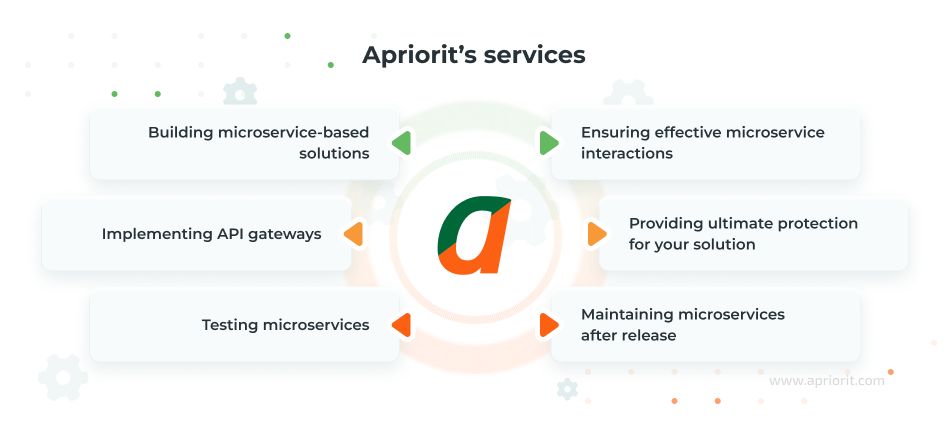
- Building microservice-based solutions. The Apriorit team is ready to help you design and implement a robust microservice architecture in different languages.
- Ensuring effective microservice interactions. Our DevOps experts will help you optimize Go microservice communication and enhance the solution’s performance and scalability.
- Implementing API gateways. To ensure software security and load balancing, our experts will develop reliable and protected API gateways as an entry point for your microservices.
- Providing ultimate protection for your solution. By following the main principles of a secure SDLC, we take advanced security measures throughout the development process, ensuring enhanced protection of sensitive data and the whole solution at every stage of development.
- Testing microservices. To check that microservices operate effectively, our QAs will prepare a testing strategy and conduct different types of testing, including integration testing.
- Maintaining microservices after release. Our experts are ready to provide you with support for a deployed solution, from new features to security updates.
If you need to outsource the complete development cycle, from discovery phase to post-release support, contact Apriorit to get set up with a dedicated team and professional project managers.
Conclusion
Leveraging Go to implement microservices helps you address different challenges, from network latency and security vulnerabilities to effective inter-service communication. But to build a robust solution, it’s important to have profound knowledge of Go and microservice architecture development, as well as know how to mitigate common challenges of microservices architecture.
Apriorit’s microservice development experts will help you build reliable and secure software that fits your requirements.
Looking for an experienced partner in microservice development?
Entrust the implementation challenges to Apriorit professionals and focus on the big picture.
Have a question?
Ask our expert!

VP of Engineering