
 Skip to main content
Key takeaways:
- Blockchain can strengthen medical data security, from reducing data fragmentation to preventing pharmaceutical fraud.
- Healthcare and pharma organizations may apply blockchain-powered data management for clinical trials, genomic data sharing, and disease surveillance.
- Start with a PoC and MVP to test whether your idea is viable before scaling. And once you deploy the solution, provide training to help users adopt it.
- Use our demo as a practical blockchain implementation guide for improving medical data storage and access.
- Outsourcing complex blockchain development tasks to a reliable vendor can significantly accelerate solution delivery.
Sensitive medical data is always in the focus of threat actors. If your project involves healthcare or pharmaceuticals, you already understand how essential it is to constantly strengthen your data protection mechanisms.
Blockchain can help you mitigate the risk of a data breach by decentralizing data storage. This way, your team can avoid single points of failure and ensure tamper‑resistant records through an immutable ledger.
In this article, we examine how blockchain addresses challenges of secure data management, explain in what cases it can be used, and outline essential steps of blockchain development. You’ll also find a demo of our own blockchain‑based approach to improving medical data storage and accessibility.
This article will be useful to CEOs, CTOs, and product owners who are considering adopting blockchain for healthcare or pharmaceutical products and services.
Contents:
- How blockchain resolves challenges of data management in healthcare
- 6 use cases for handling medical data through blockchain
- Core steps to implement blockchain in the healthcare system
- Implementing a blockchain-based medical record management system: A demo by Apriorit experts
- How Apriorit can help you create a secure blockchain solution for healthcare and pharma
How blockchain resolves challenges of data management in healthcare
Robust protection of medical data is paramount as cyber threats continue to evolve and grow more sophisticated. According to The HIPAA Journal, almost 57 million individuals were affected by healthcare data breaches in 2025.
Blockchain technology can help enhance data security alongside other cybersecurity measures such as zero trust, data encryption, and multi-factor authentication.
Let’s explore what opportunities blockchain can bring to address the most pressing challenges in healthcare data management:
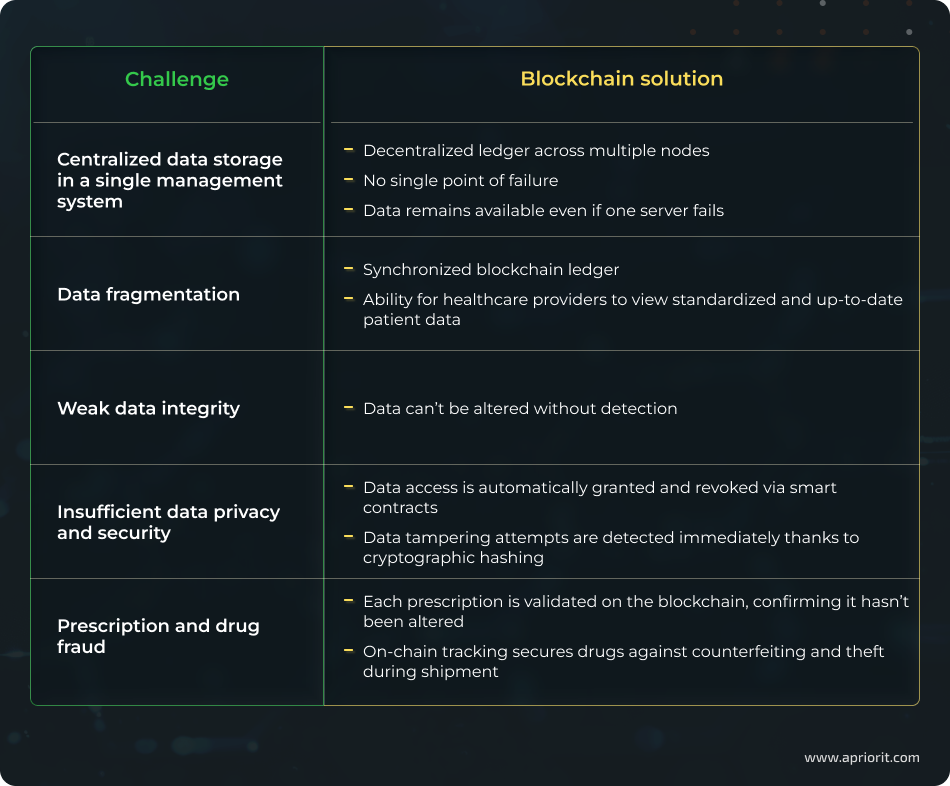
Centralized data storage in a single management system
Healthcare data systems are typically centralized, with patient data stored in one database. This creates a single point of failure in the event of a data breach, potentially leading to total data loss. In a decentralized blockchain system, patient data can be replicated across multiple nodes, reducing the risk of data loss and system failure.
Data fragmentation
Another challenge is when medical data is stored in separate silos and in different formats across a single healthcare system. This fragmentation makes it difficult to consolidate information into complete, unified patient records and can hinder care coordination.
Blockchain can help you address this challenge by establishing shared, synchronized infrastructure for exchanging standardized medical records. With this approach, authorized providers gain access to up‑to‑date patient information while maintaining the required privacy and permission controls.
We’ll demonstrate this blockchain‑based single source of data model in the demo below.
Weak data integrity
Traditional healthcare systems often struggle to ensure strong data integrity, which increases the risk of tampering. For example, medical data can be modified intentionally as the result of fraud or accidentally due to human error. Such changes are not always traceable or logged properly.
Immutability is especially important for electronic health records (EHRs), clinical trial data, and diagnostic histories, where accuracy is critical for patient care and legal compliance. In these contexts, blockchain can help reduce data integrity risks:
- Once data is written to the blockchain, it can’t be altered or deleted without detection.
- A blockchain creates a tamper-proof audit trail of all actions on patient data, where every request and update is timestamped and a full history of data usage is visible to authorized participants.
Insufficient data privacy and security
Healthcare data is highly sensitive. Maintaining its security and privacy is one of the major challenges for modern healthcare systems. When considering how to do so, it’s important to keep in mind that not all security threats are initiated by external actors.
Medical staff can have broader access to patient data than necessary due to a poor access-control system, or they might be able to access data even without authorization. This makes it difficult to guarantee patient data privacy.
Let’s see the opportunities of blockchain for healthcare data security:
- Cryptographic hashing ensures that each new record is securely linked to the previous through a cryptographic hash. This creates an immutable chain of information where altering any data breaks the hash sequence, making tampering immediately detectable.
- Smart contracts make it possible to automatically enforce predefined rules within a blockchain network. For instance, smart contracts can grant or revoke data access based on predefined permissions and automate patient consent processes for transparent and secure data sharing.
Prescription and drug fraud
Fraudulent activity involving prescriptions and medicines can occur at various points in healthcare and pharmaceutical workflows and may involve:
- Altering prescriptions
- Manipulating prescription records for insurance fraud
- Stealing drugs within the supply chain
- Selling counterfeit medicines
In traditional healthcare systems, data is often stored in a centralized location and can be modified without detection.
Using blockchain technology allows you to create tamper-proof prescription records that can’t be altered or deleted. Due to a shared and synchronized ledger, any prescriptions can be instantly verified by authorized stakeholders.
In addition, because all blockchain transactions are recorded, you can ensure end-to-end traceability of the drug supply chain, making it difficult to steal or counterfeit medicines.
In the next section, we examine practical applications of blockchain for healthcare data management (and in the pharmaceutical industry).
Facing challenges with blockchain integration?
Trust the Apriorit team to provide full‑cycle development and comprehensive audits of your blockchain product tailored to your needs.
6 use cases for handling medical data through blockchain
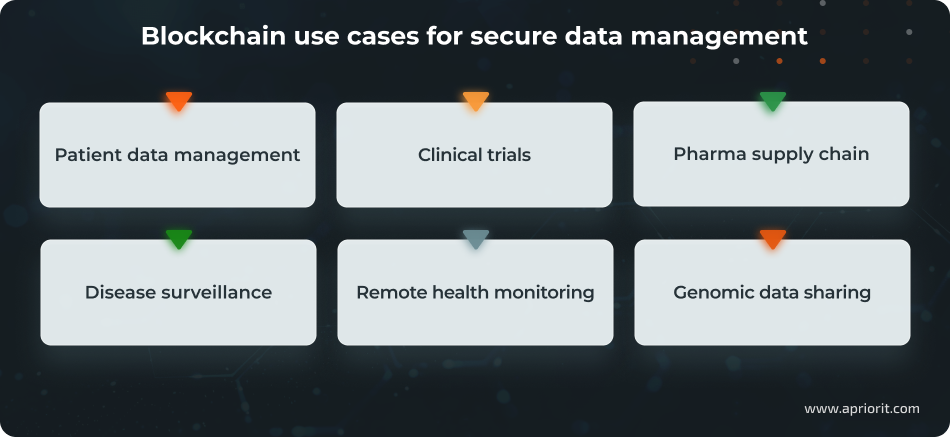
Common use cases of blockchain in healthcare data management include:
1. Patient data management
Blockchain can be used as a secure coordination layer for managing patient data across multiple healthcare stakeholders, while actual data can be stored off-chain.
For example, a blockchain can store cryptographic hashes of medical records, metadata, and pointers to medical data in the healthcare system. At the same time, EHRs can be stored in a secure cloud or database, minimizing data exposure.
2. Clinical trials
Blockchain can help to make clinical trials transparent and secure for all participants. For example, recording trial data on an immutable ledger makes unauthorized changes detectable, improving research credibility and regulatory trust.
Sharing secure trial data via blockchain, with decryption available only to authorized parties, reduces the risk of data leaks. At the same time, a tamper-proof audit trail of all research activities, including patient enrollment, data collection, and trial protocol amendments, can simplify audits.
3. Pharma supply chain
In the pharmaceuticals industry, manufacturers and distributors use blockchain to overcome issues such as counterfeit drugs, lack of traceability, poor data visibility, and compliance issues. Blockchain records every step of a drug’s journey via unique identifiers that are logged as drugs move through the supply chain. Since blockchain records can’t be altered without agreement from the network, it becomes much harder to counterfeit medicines.
Moreover, blockchain’s immutable records create a secure, transparent audit trail for regulators and manufacturers, simplifying compliance with laws like the U.S. Drug Supply Chain Security Act (DSCSA).
4. Disease surveillance
Blockchain can be used in disease-monitoring platforms, where physicians and health authorities can upload and exchange standardized case information (such as symptoms, treatment outcomes, and geographic data) in a tamper-resistant format. A decentralized architecture helps ensure data integrity and improves cross‑regional information sharing, making it easier to monitor how diseases spread across different regions and countries.
For example, a prototype system for COVID-19 surveillance and global infectious disease information exchange was designed based on blockchain architecture.
5. Remote health monitoring
Blockchain can help integrate physiological data (such as heart rate, blood pressure, and glucose levels) collected by IoT devices and wearable sensors into a unified and secure framework.
For example, devices can submit data securely to a blockchain network, where smart contracts manage data storage and access. Since blockchain supports interoperability across different vendors’ medical devices and health record systems, it can reduce data silos.
6. Genomic data sharing
Blockchain can be used to store cryptographic proofs (hashes) of genomic files and control who can access the encrypted data. Individual users can grant and revoke access via smart contracts, ensuring that only authorized parties can see or download the data.
For example, Nebula Genomics gives users full control over their personal genomic data. The company is building a blockchain-enabled multiparty access control system that doesn’t rely on a single trusted party. This reduces the risk of security breaches by hackers, prevents unauthorized government access, and protects against data privacy infringements by genetic testing providers.
While use cases vary, implementing a blockchain solution requires careful planning. Let’s explore the main steps that can help you prepare for development.
Read also
Cybersecurity Risks in Healthcare Software: Key Threats and How to Address Them
Explore practical steps that help you protect sensitive medical data and maintain system reliability.

Core steps to implement blockchain in the healthcare system
Building an effective blockchain solution requires a deep understanding of the entire development and integration process. Having delivered numerous blockchain projects, including solutions for healthcare and pharma, Apriorit has accumulated extensive practical expertise.
Below, we outline key steps we’ve identified based on years of hands‑on experience:
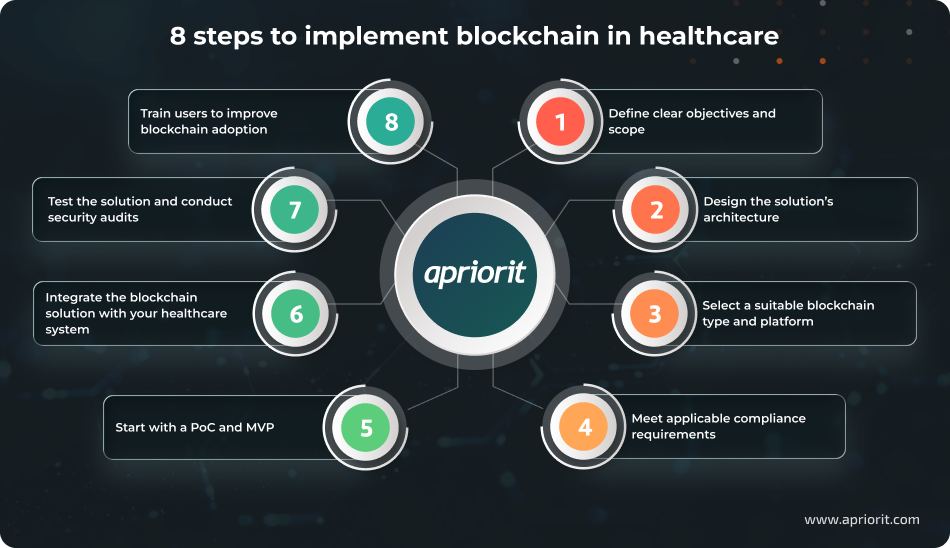
1. Define clear objectives and a clear scope for blockchain implementation
Effective blockchain adoption in healthcare starts with identifying the core pain points you want to address, such as fragmented data across providers, limited interoperability, or insufficient auditability. Once these challenges are clear, you can translate them into concrete objectives: for example, establishing a verifiable audit trail for all data interactions or improving traceability to support regulatory audits.
With well‑defined objectives, the next step is to outline a detailed scope of work. This scope should reflect the features you plan to implement, the regulatory obligations your solution must meet, integration requirements, security controls, and the internal and external resources needed to deliver the project.
Without clearly established boundaries and priorities, blockchain initiatives risk becoming unfocused, over‑engineered, or even counterproductive.
Maryna Prudka, VP of Engineering
2. Design the solution’s architecture
Designing a blockchain solution architecture for healthcare systems is a critical step, as the architecture defines how the blockchain network, data storage, system components, applications, and existing healthcare infrastructure work together.
Key architectural activities include:
- Selecting the appropriate type of blockchain network
- Defining an on‑chain and off‑chain data storage strategy
- Choosing or configuring the consensus mechanism
- Designing smart contracts and identity management workflows
- Creating system interfaces
- Incorporating necessary compliance and security requirements
A strong architecture is what makes a blockchain solution practical, secure, compliant, and scalable in real healthcare environments.
3. Select a suitable blockchain type and platform
The type of blockchain you choose has a direct impact on data privacy, regulatory compliance, scalability, and overall cost. To select the most suitable option, you need to analyze the sensitivity of the healthcare data you plan to process and your specific privacy requirements.
For example, a private blockchain managed by a single organization offers tight access control, while a permissioned network governed by a group of trusted healthcare stakeholders can support secure data exchange across multiple participants.
When evaluating blockchain platforms, consider factors such as built‑in compliance features, privacy and access control mechanisms, interoperability with existing healthcare systems, scalability options, and available smart contract functionality.
If existing platforms don’t meet your operational or regulatory needs, you can also explore building a custom blockchain-based solution tailored to the specifics of your healthcare environment.
4. Meet applicable compliance requirements
Since healthcare systems deal with extremely sensitive personal data, your blockchain-based solution must meet all applicable compliance requirements to mitigate the risk of data breaches and avoid legal penalties and fines under laws and regulations like HIPAA and the GDPR.
For example, a smart contract can encode compliance logic, including patient consent and data access policies. At the same time, protected health information can be stored off‑chain to support GDPR requirements related to data modification and erasure while still benefiting from blockchain‑based integrity and traceability.
Thus, it’s crucial to consider compliance demands during architecture design.
5. Start with a Proof of Concept (PoC) and Minimum Viable Product (MVP)
A PoC can reveal whether a blockchain approach can meet technical and compliance requirements before investing in full-scale development. It helps answer questions such as whether the blockchain solution can integrate with the existing healthcare system or whether it can handle real data types and data volumes.
When your PoC confirms the feasibility of your blockchain idea, you can proceed to building an MVP, which lets you test whether your solution will meet users’ actual needs. Building an MVP allows you to get valuable feedback from early adopters (clinicians and patients), understand usability issues, prioritize features, and validate your assumptions about workflows.
This staged approach avoids building large solutions that may not deliver real value or be adopted and serves as a foundation for further scaling.
6. Integrate the blockchain solution with your healthcare system
Integrating a blockchain solution with an existing healthcare system is about adding a trusted coordination layer without disrupting clinical workflows, regulatory compliance, or legacy infrastructure. To ensure that a blockchain communicates effectively with existing systems, it’s important to use established healthcare interoperability standards, such as FHIR, for consistent and seamless data exchange.
It’s also essential to use middleware components such as integration layers, API gateways, and protocol adapters to bridge blockchain operations with existing healthcare software. These components can translate healthcare data formats (such as FHIR resources) into blockchain transactions and synchronize legacy databases with the blockchain layer.
Integration may also require updates to frontend systems so that patients can manage consent and providers can access the most current verified information.
Implementing robust interoperability approaches aligned with established healthcare standards, such as FHIR, can significantly strengthen system compatibility and accelerate blockchain adoption among healthcare stakeholders.
Maryna Prudka, VP of Engineering
7. Test the solution and conduct security audits
Inadequate security and compliance testing of a blockchain solution can lead to data breaches, incorrect smart contract behavior, and violations of healthcare regulations, leading to loss of trust in the entire healthcare software system.
Thus, it’s essential to conduct comprehensive testing of blockchain solutions. This includes:
- functional testing to verify that blockchain features and workflows behave as expected
- penetration testing to identify security vulnerabilities
- smart contract auditing to uncover flaws in logic and implementation weaknesses
Together, these activities ensure that your solution operates reliably, resists attacks, and remains compliant with relevant healthcare laws and regulations.
8. Train users to improve blockchain adoption
Blockchain introduces new concepts, such as distributed ledgers, hashes, and smart contracts, that many healthcare workers aren’t familiar with. Without proper training, users may feel uncomfortable, slowing adoption or causing misuse.
Comprehensive training is essential to ensure that clinicians, administrators, and technical staff understand how to use the blockchain solution safely and consistently.
Effective training directly influences data quality, regulatory compliance, workflow efficiency, and outcomes delivered across healthcare organizations.
In the next section, we demonstrate in practice how a blockchain solution can help enhance medical data management.
Looking to integrate blockchain into your healthcare system?
Partner with our dedicated team to design, develop, and deploy robust decentralized solutions.
Implementing a blockchain-based medical record management system: A demo by Apriorit experts
To show how blockchain technology can improve storage and access to medical data, Apriorit experts have created a demo network based on Hyperledger Fabric. This network includes a smart contract for handling basic medical records.
Disclaimer: The records used in this example do not represent real patient data. However, they are indicative of the type of private data that may be stored in a similar production environment.
Let’s explore our blockchain solution in detail to find out the difference between a traditional database and a blockchain network for data management.
In this demo case, the smart contract serves as a database for basic patient data and medical visit history. By storing medical records on a blockchain network, we provide a single source of data to several organizations. (In this demo, data is collected from three organizations.) The key benefits of using a centralized blockchain-based database instead of a traditional database are data immutability and traceability.
To ensure a secure and efficient exchange of information among patients, doctors, and nurses, we created a channel that provides a secure communication path between system actors. No one outside this channel has access to its internal data.
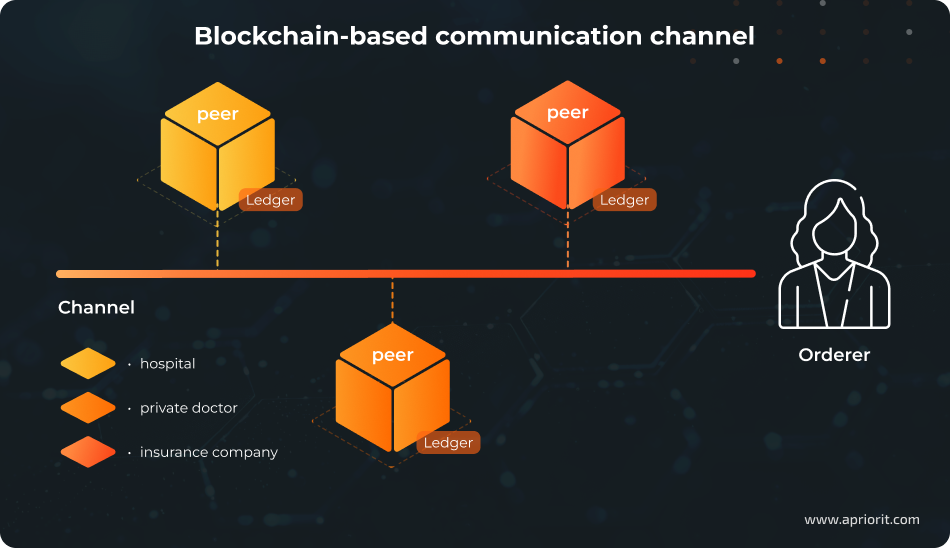
Different organizations that connect to the channel (e.g., hospitals, insurance companies, private doctors) have dedicated peers to access it. One organization can have as many peers as it needs. Each peer hosts its own copy of the shared ledger.
In addition, each Hyperledger channel has an orderer service. The orderer maintains the channel and validates transactions. In our example, we have only one orderer, but if you need to scale the network, you can add more.
A channel separates data from the external world and provides access control at the organizational level. But it’s also important to keep patient data private. To ensure the privacy of patient data, we use the following Hyperledger features:
- Encrypted private data collections. In Hyperledger, you can create a collection to ensure granular management of sensitive digital data. For example, you can unite several organizations into a collection and use this collection to hide private data within a channel. Data within a collection isn’t shared with peers whose organization doesn’t belong to the collection.
- Permissioned data access via smart contracts. Permissioned data access allows us to further refine access based on custom policies. Our demo smart contract provides read and write access only. However, it can be improved to allow more fine-tuning and granular access control.
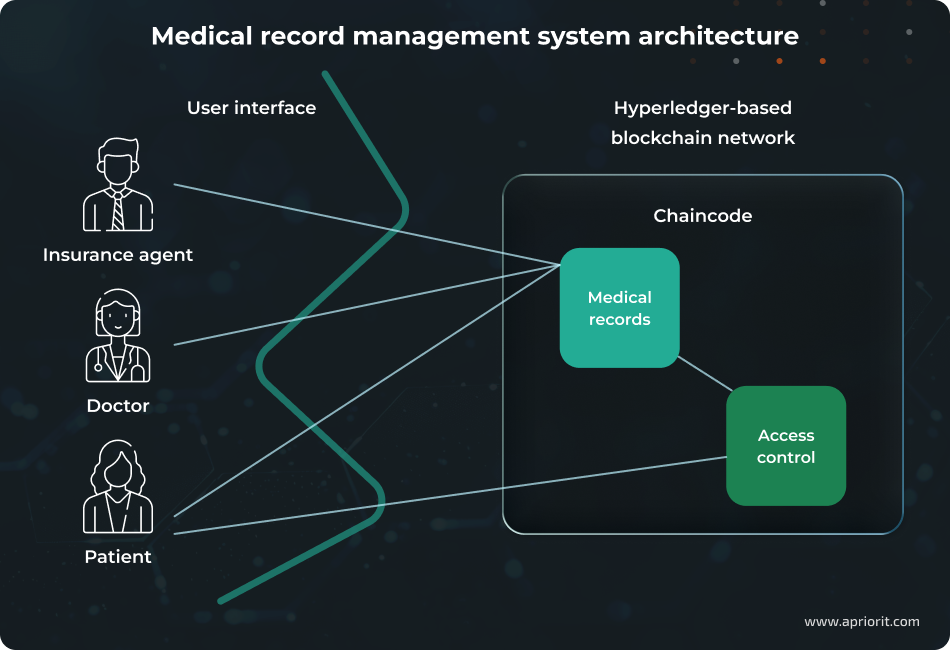
Our system was deployed locally for testing purposes using Docker containers. Because Hyperledger doesn’t provide a built‑in graphical user interface (GUI), we developed a custom one. The most common approach is to build a web-based interface, but desktop or mobile applications are also viable options.
Such a GUI calls the Hyperledger API to execute smart contract operations. For simplicity, our demo uses a command-line interface (CLI) provided with Hyperledger binaries.
In our demo, we use three types of users:
- Doctors can create and update patients’ medical histories.
- Patients can read their own medical histories and control who has access to their data.
- Insurance agents can only read a patient’s medical history data, and only if the patient provides explicit permission.
Below, we compare a blockchain network and a traditional database to see what pros and cons you need to consider before implementation.
Comparing a blockchain network and a traditional database
Let’s compare a traditional database and a blockchain network approach for data storage and access based on the following criteria:
Blockchain network versus traditional database
| Criterion | Blockchain network | Traditional database |
|---|---|---|
| Physical data location | Decentralized across several peers | Centralized on a single server |
| Encryption | Built-in data encryption with additional access management | – No built-in data encryption – Possible encryption of the whole database |
| Access monitoring | Immutable history of every action | Access logs are stored separately and can be changed or deleted |
| Infrastructure costs | High (need to implement multiple medium to high-end nodes to act as peers and orderers) | Low (need to implement a single medium-range server) |
| Scalability | Built-in scalability of a distributed network | Requires custom replication solutions to scale |
| Implementation period | Longer (need to build complex architecture with multiple components) | Faster (need to build a basic architecture that can be launched rapidly) |
| Maintenance | Difficult (need to monitor and maintain peer nodes) | Easy (need a single server with a single database) |
| Integration | Can be integrated with other systems by adding new smart contracts | Can be integrated with other systems by cross-communication, which leads to data fragmentation |
As you can see, a blockchain network can offer better protection for sensitive medical records than a traditional database. Thanks to built-in data encryption, decentralized storage, and immutable change history, a blockchain makes it nearly impossible to delete, alter, or tamper with sensitive data.
By deploying additional blockchain features such as private data collections and permissioned data access, you can make sure that only authorized users access specific records.
At the same time, a blockchain-based network takes more time to build and requires extra resources and investments for its development and further maintenance compared to a traditional database.
Outsourcing complex blockchain development tasks to a reliable partner can significantly accelerate delivery while ensuring the resulting solution is secure, stable, and aligned with your business goals. With the right vendor, you gain access to specialized expertise, mature development processes, and proven security practices.
Read also
Hyperledger Fabric: Concepts, Configuration, and Deployment
Explore practical examples from an Apriorit expert that will help you deploy Hyperledger Fabric faster.

How Apriorit can help you create a secure blockchain solution for healthcare and pharma
With 20+ years of experience in cybersecurity, we can help you strengthen the security posture of your blockchain products by improving data protection, refining encryption approaches, and applying secure SDLC principles across the entire development lifecycle.
Drawing on our extensive experience delivering diverse blockchain solutions, we also offer a full range of services designed to support secure, reliable, and scalable blockchain implementations:
- Blockchain software development. Whether you want to build a customized blockchain solution from scratch or integrate blockchain into existing software, we can assist you in validating your idea through a PoC and MVP and designing an architecture for further scaling that meets compliance requirements. Moreover, we can perform blockchain integration that will enhance your existing solution according to your expectations.
- Blockchain security audit and testing. If you need to check your blockchain solution for vulnerabilities, Apriorit professionals can perform a detailed security audit of consensus mechanisms, blockchain network logic, crypto wallets, and cloud infrastructure. We can also test backend components, network architecture, and integration of blockchain protocols to verify your product’s resilience.
- Smart contract audit services. To improve the performance and protection of your smart contract, we can audit its security and provide tips for mitigating issues. During an audit, we perform security testing, penetration testing, and threat modeling to check your smart contract’s resilience to attacks, conduct code review to discover bottlenecks, and provide a detailed list of weaknesses, including recommendations on how to fix them. In addition, we can assess fixes your team makes in response to our audit.
Apriorit has experience developing customized healthcare software of varying complexity. With a deep understanding of the specifics of regulatory compliance requirements (like HIPAA and the GDPR), we can perform seamless and secure integration of blockchain solutions into healthcare systems that correspond to your vision and demands.
Ready to solve complex problems with blockchain technology?
Let Apriorit’s expert developers build robust, future-ready systems that enhance trust and transparency.
FAQ
What is blockchain-based data management in healthcare and pharma?
<p>Blockchain-based data management involves using a distributed ledger to securely store, verify, and exchange healthcare and pharmaceutical data, such as patient records, clinical trial results, or drug supply chain information. Instead of relying on a centralized database, all records are replicated across multiple nodes and protected through cryptographic hashing and consensus algorithms.</p> <p>This decentralized structure reduces the risk of tampering, ensures data lineage, and provides transparent, auditable traceability for highly regulated medical workflows. It helps organizations maintain the integrity and reliability of sensitive medical information while enabling secure, controlled data sharing across stakeholders.</p>
Why is secure data management a critical issue in healthcare and pharma?
<p>Healthcare and pharmaceutical organizations handle multiple categories of highly sensitive data, including electronic health records (EHRs), genomic and other biomarker data, clinical trial datasets, drug manufacturing records, and supply chain documentation.</p> <p>Because these assets carry high financial and operational value, they are frequent targets of cyber attacks. A single breach can compromise vast volumes of records, disrupt medical operations, and lead to substantial financial and regulatory consequences.</p> <p>Moreover, many healthcare ecosystems rely on fragmented legacy systems spread across hospitals, labs, research institutions, and pharmaceutical companies. These create data silos and heighten the likelihood of leaks and human error.</p>
Can blockchain ensure patient data privacy and regulatory compliance (e.g., with HIPAA / GDPR)?
When properly architected, a blockchain can ensure patient data privacy and regulatory compliance. Most healthcare blockchain solutions deliberately avoid storing raw patient data directly on the blockchain. Instead:
<ul class=apriorit-list-markers-green>
<li>Sensitive data remains off‑chain in secure databases or cloud environments that meet HIPAA/GDPR requirements.</li>
<li>Only encrypted hashes, metadata, or pointers are stored on‑chain, enabling verification without exposing personal information.</li>
</ul>
<p>This hybrid model preserves patient privacy while allowing secure, auditable, consent‑based access.</p><p>Additionally, smart contracts can automate permission checks, enforce data sharing policies, and support regulatory workflows by ensuring that only authorized entities can read or write specific records.</p>
Have a question?
Ask our expert!

VP of Engineering