
 Skip to main content

Considering project management as a service (PMaaS) instead of internal hiring often sparks debate: Does bringing in an external PM really add value, or can in-house teams handle project management just as well?
Business leaders have reasons to doubt whether outsourcing project management is the right strategy for their company. Some get confused by blurry responsibilities, others stress about hidden challenges and unclear task volume, and many simply don’t see the benefits clearly enough to consider this option at all.
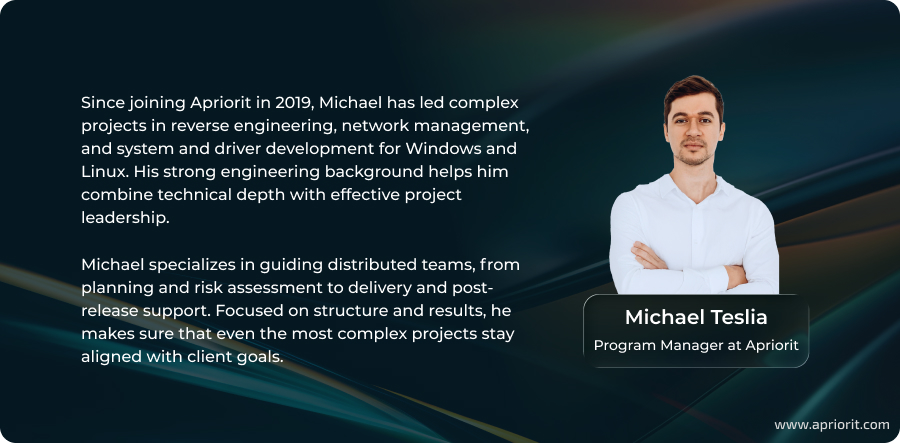
To shed light on the specifics of PMaaS and get all the facts you need to decide whether it will truly benefit your business, we asked Apriorit’s Michael Teslia to share his insights on the topic.
Responses have been lightly edited and formatted for readability.
Contents:
- Why is simply tracking tasks not enough?
- What challenges are specific to in-house PMs?
- What’s so tricky about managing distributed teams?
- Why do external managers handle PM challenges better?
- Is PMaaS worth the extra cost?
- When should a business consider PMaaS?
- Are external PMs as committed as internal ones?
- Can outsourced PMs adapt to a company’s culture?
- Why is time-limited PMaaS partnership good for your business?
Q: Many people assume that appointing someone to track tasks is enough to guarantee a project’s success. Yet deadlines are missed, budgets are overshot, and accountability remains unclear. Why does this happen so often?
A: When we’re talking about a PM’s work, we should understand that the future of project management isn’t just about task tracking, Jira boards, and deadlines. It’s about leadership. A PM isn’t simply a coordinator; they’re a strategist who anticipates chaos and structures it. Besides top-level communication and soft skills, they need strong analytical and critical thinking, almost like a chess player who sees several moves ahead.
Imagine you’re launching a new marketplace. On the surface, it sounds straightforward: design, build, release. But in reality, it’s an intricate web:
- First, you have to coordinate multiple parallel processes: architecture design, UX design, development, and QA.
- Then come the sprints, planning sessions, EVA analysis, and Gantt charts.
- After the first delivery, you’re already running beta testing and hotfixes in parallel with implementing new features.
- Add to that the constant need to balance business expectations: leadership wants quick results, early demos, and a clear view of risks. These requests are natural, since time to market and risk control are critical for any business. But meeting them effectively requires a PM who not only understands delivery mechanics but also has deep insight into the industry and market niche.
- On top of this, there’s budget management: aligning forecasts with actual spending, keeping costs transparent, and ensuring resources are allocated wisely.
- You must also control compliance with the legal, regulatory, and other requirements, such as the GDPR and payment system requirements.
- And we haven’t even touched on people management yet. Motivating a tired team, balancing their load, and handling vacations is crucial for preventing burnout while still delivering the promised results, especially on long-term projects.
Someone who only tracks tasks isn’t enough here. You need a professional manager who can drive, orchestrate, and know exactly which levers to pull to keep your project moving forward.
“Project management is not just about tracking tasks. It’s leadership. It’s strategy. It’s the ability to predict chaos — and, more importantly, to structure it.”
Q: We’ve established that project management is not only about tracking. Are there any specific challenges that in-house PMs usually face?
A: Quite a lot, actually. Let me break it down:
- Limited authority. An internal PM, especially if they are junior or middle, often can’t push back when leadership keeps increasing the scope. According to the Project Management Body of Knowledge (PMBOK), they should set clear boundaries and resist scope creep. But in reality, many hesitate because they’re worried about their reputation or job security, and they end up silently accepting changes. The result is delays, blurred accountability, and projects that drift off course. It’s understandable that the business wants a killer product immediately, and it’s the PM’s job to help understand when aiming solely for speed of delivery will not bring the desired results.
- Loss of focus. An in-house PM at, say, a medical company may find themselves reporting to two different department managers, each of whom is pulling the project in their own direction. On top of that, they are likely involved in tasks that have little to do with the actual project: audits, weekly syncs, even marketing or sales activities. Instead of concentrating on the project’s progress and long-term goals, their attention gets scattered across competing demands. This constant tug-of-war dilutes focus, makes it harder to see the big picture, and ultimately slows down delivery.
- Limited objectivity. Long-term in-house PMs can become too entangled in team dynamics, causing them to overlook recurring issues or favor certain approaches simply because “that’s how it’s always been done.” For instance, I once worked with a company where every two-week sprint automatically included two days for documentation, even though the team usually needed just one. Nobody remembered why this rule existed — it was just the way things were done. Once we reevaluated it objectively, productivity improved almost immediately. External PMs bring distance from internal politics and habits, making it easier for them to spot patterns, raise tough questions, and keep the focus on project outcomes.
- Insufficient expertise. To cut costs, some companies hire less experienced PMs who lack knowledge of modern methodologies or industry context. They may even lack domain expertise. Imagine a PM in web development who can’t distinguish Node.js from Java or doesn’t understand UI patterns. The knowledge gap is even bigger in industries like AI or system development. Without leadership, PMs become task administrators rather than project drivers, leaving teams to figure things out for themselves.
Q: Many companies today work with both in-house and external teams spread across different locations and time zones. What makes this especially challenging for internal PMs?
This actually might be one of the most significant issues. Many in-house PMs are used to one office and one time zone. In one real-life case that I am aware of, the PM was in Canada, developers were in India, the designer was in Poland, and the client was in the US. The PM scheduled daily standups at a time that was convenient for them but inconvenient for everyone else. As a result, participants joined passively, context was lost, and coordination suffered.
If a PM has little experience with distributed teams, they may not treat time zone differences as something important and recognize remote dynamics as a real issue. They assume that if everyone is on the project, it’ll work out. But without experience in asynchronous communication or flexible planning, the cracks show quickly.
The PM might expect instant replies or keep working in their usual rhythm, while real collaboration requires adjusting workflows in tools like Slack, Notion, Jira, or Azure DevOps. When responses arrive a day later and reviews get delayed, productivity and engagement steadily decline.
Another hidden issue is scheduling. When team members have to join meetings late at night or early in the morning to match someone else’s time zone, their productivity inevitably drops, even if they initially think it’s fine. Over time, this constant discomfort leads to fatigue and disengagement, which a skilled PM must anticipate and manage proactively.
“An in-house PM often struggles to say ‘no’ to the company management. That’s how scope creep, blurred responsibility, and missed deadlines quietly become the norm.”
Q: Aren’t external PMs also susceptible to these challenges?
A: While they definitely face the same challenges as in-house PMs, people offering PMaaS respond to these challenges of project management differently simply because of the nature of their experience and the collective expertise of the entire PM office supporting them. Unlike many small or midsize companies that may have just one or two project managers, PMaaS providers draw on shared knowledge, tools, and lessons learned from dozens of professionals who have faced similar issues across industries and project types. This collective experience helps them act faster and find proven solutions to complex problems.
From a business point of view, that means delivering better results and better mitigating common PM risks. If we dig deeper, we’ll see that there are several reasons for this:
- Cross-industry know-how. PMaaS providers accumulate extensive experience by handling a wide range of projects across the entire PM office. Over just a few years, they accumulate experience that most in-house PMs won’t get within a decade. What feels like a crisis to an in-house PM is routine for them.
- Fresh perspective. Over time, internal teams adapt to inefficiencies — duplicated processes, overloaded experts, or outdated routines become “just the way things are.” An external PM brings an unbiased view, quickly spotting bottlenecks and suggesting practical fixes. For example, if one senior developer becomes the only gatekeeper for code reviews, deadlines inevitably slip, but the team may treat this as normal. An outsourced PM can challenge that assumption, propose backup reviewers, or even connect the team with additional expertise. This outside perspective helps projects move faster without being weighed down by old habits.
- Focus. Unlike in-house PMs, outsourced ones aren’t pulled into marketing, HR, or internal busywork. Their focus stays on the project.
- Specialized expertise. Some projects require niche knowledge of things like SaaS automation, AI, or complex compliance. Hiring a permanent senior PM with that expertise can be unreasonably expensive, especially if you only need them for one small project. Outsourcing lets you access the exact skillset you need for the project’s duration.
- Modern methodologies. External PMs have to stay on top of trends, tools, and best practices to be competitive in the market. They bring in what has worked elsewhere and avoid — or help you eliminate — what hasn’t.
- Advanced communication skills. Since they often work with distributed teams, external PMs have firsthand experience balancing multiple time zones, structuring async updates, and setting up workflows in Slack, Notion, Jira, or Azure DevOps that keep everyone aligned without expecting round-the-clock availability. Their perspective is simply wider because they’ve already seen these problems play out and solved them.
I would say that outsourced PMs aren’t just filling a role, as they bring a playbook built from dozens of real-world situations along with them.
Q: You mentioned that an experienced PM is expensive. Why should businesses pay extra for PMaaS?
A: Because the hidden costs of not having a PM are far higher. I’m talking about building things wrong and delivering them too late, thus losing your funds, failing to attract new customers and investors, and damaging your brand image. These are the costs of poor project performance. And I’m sure that for any business, they will be higher than the PM’s fee. An external PM helps avoid those expensive setbacks.
Q: Let’s talk about practice. When is it worth every cent for a business to work with a PMaaS provider?
A: Let’s see. For one, digital transformation. Say you’re digitalizing a hospital. Moving from paper records to cloud databases requires strict GDPR or HIPAA compliance, and staff are often resistant to change. An outsourced PM who has led similar projects knows exactly where the pushback will come from and how to navigate compliance pitfalls before they derail progress.
Startups are another case. They rarely have the budget for a full-time senior PM, yet they desperately need one to keep up with investor expectations and tight deadlines. Hiring an external PM temporarily gives them access to high-quality management without the long-term cost.
And then there are multinational product launches. Imagine a FinTech app with teams in Ukraine, the UK, and Argentina. Without careful coordination, time zone gaps and endless calls could slow everything down. But with an outsourced PM who replaces daily meetings with structured async reporting, such a launch can run smoothly and stay on schedule.
Outsourced PMs give you the advantage because they’ve seen it all before and know how to act fast.
“What feels like a breakthrough for an in-house PM is often routine practice for an outsourced PM who’s already seen dozens of similar projects.”
Q: But what about loyalty? Won’t an external PM be less committed to the company?
A: They may not be loyal to office politics, but they are absolutely loyal to results. And let’s be honest. In many companies, loyalty just means agreeing with leadership or playing along with internal dynamics. A good PM isn’t there to play politics. They’re there to deliver outcomes.
Q: Some companies worry that outsourced PMs won’t fit into their culture. What’s your take?
A: That’s actually one of their strengths. An external PM brings an independent point of view. They aren’t bound by “how we’ve always done things,” which makes it easier for them to spot inefficiencies and improve processes. Instead of blending in, they bring clarity.
At the same time, experienced PMaaS professionals know how to adapt to different corporate and cultural contexts. They’ve worked with teams across regions and understand communication nuances. They can tell when a decision requires full stakeholder alignment versus when it’s better to go straight to the developer, and they adjust their tone and approach accordingly.
Q: Isn’t an outsourced PM just a temporary fix, though?
A: Exactly. And that’s the point. By definition, a project is a temporary enterprise. A PM is needed to bring order, drive the project to release, and protect your team from chaos. Once the project is complete, their mission is done, and your company is better off for it, until you start a new project.
Need stronger control over your development process?
Leverage our project management services to reduce risks, save time, and deliver predictable results.
FAQ
What is project management as a service (PMaaS)?
PMaaS is an on-demand model for hiring project managers. Instead of committing to full-time staff, you scale PM support up or down, gaining proven tools and expertise only when you need them. This flexibility helps companies reduce overhead while still making sure that projects are delivered with professional oversight. It’s particularly useful for organizations with fluctuating workloads or short-term initiatives.
What’s the difference between an in-house PM and an external PM?
In-house PMs are often jacks of all trades: writing documentation, negotiating device supply, checking quality, and even participating in hiring. Naturally, quality and productivity drop as a result. Outsourced PMs focus only on delivery and bring wider experience from managing many different projects. They’re less influenced by internal politics and can apply best practices learned from diverse industries, making them valuable for high-stakes or unfamiliar domains.
In what cases does outsourcing project management shine?
<p>Outsourcing project management is most useful when projects are:
Complex or compliance-heavy</p>
<ul class=apriorit-list-markers-green>
<li>Spread across multiple time zones</li>
<li>Short-term but high-stakes</li>
<li>Beyond your internal expertise (for example, if you need expertise in SaaS, AI, or digital transformation)</li>
</ul>
Outsourcing ensures you’re not reinventing the wheel. Instead, it lets you tap into the expertise of a team that has already solved similar challenges.
How quickly can an outsourced PM start on a project?
Usually quite fast — often faster than hiring or training internally. While an external PM will still need time to learn your product and team dynamics, service providers typically have experienced PMs who can adapt quickly, start organizing processes, and bring structure from day one. This quick start can be critical for organizations facing tight deadlines or urgent client commitments.
Can an outsourced PM coordinate sensitive or regulated projects?
Absolutely. For example, Apriorit PMs have experience with industries like healthcare, finance, and cybersecurity and understand the GDPR, HIPAA, and other compliance requirements. They also know how to integrate security and compliance checkpoints directly into the project workflow, minimizing the chance of costly delays or regulatory issues.
Have a question?
Ask our expert!

Program Manager