
 Skip to main content
Key takeaways:
- ADAS features are critical for delivering safe and comfortable driving experiences.
- Expanding ADAS features is necessary for enabling autonomous driving.
- Factors like market pull, regulatory requirements, and customer demand push automakers to design and integrate new ADAS capabilities.
- Technical feasibility, business impact, and security play a key role in prioritizing ADAS features.
The ADAS features you choose to build today will shape how autonomous driving looks tomorrow.
Advanced driver assistance systems (ADAS) are no longer optional add-ons that differentiate premium vehicles. Many UX-enhancing ADAS capabilities have become the expected baseline across segments, while critical safety functions are mandated by regulators globally.
For product leaders, the central challenge has shifted. It’s no longer about asking if ADAS development belongs on your roadmap; it’s about determining which features to prioritize and how.
In this article, we explore the essentials of ADAS, discuss future trends for ADAS innovations, and analyze which features will dominate demand in the next few years. These insights will be helpful for automotive product leaders who want to better understand current industry dynamics and strategically plan the expansion of their ADAS solutions.
Contents:
Understanding ADAS essentials
Let’s start with defining what ADAS is.
The term advanced driver assistance systems refers to a broad set of safety-critical features that can function independently or as part of an integrated automotive system. Commonly known ADAS features include parking assistance, driver monitoring, and emergency braking.
The core purpose of ADAS is not to replace the driver. ADAS supports vehicle autonomy by:
- Increasing the safety and comfort of driving experiences
- Reducing the need for direct human control
Note: While ADAS is often seen as a step toward autonomy, it’s important to distinguish it from Automated Driving Systems (ADS). For example, as noted by Japan’s National Police Agency, ADAS still requires a driver’s continuous responsibility, even in advanced systems. ADS, on the other hand, takes over driving completely under defined conditions.
Different levels of vehicle autonomy require different ADAS and ADS features.
According to the SAE J3016 framework, there are six levels of driving automation, from fully manual vehicles (Level 0) to fully autonomous (Level 5). Some industry experts also distinguish an extra level between Level 2 and Level 3 automation, calling it Level 2+. L2+ systems combine multiple driver-assistance functions and can offer a hands-free experience in certain conditions, while still requiring the driver to stay attentive at all times.
Table 1: Levels of vehicle automation
| Automation level | Description | Driver involvement | Example features |
|---|---|---|---|
| L0 No automation | The vehicle has assisting features but offers no driving automation | The driver is involved and in control full-time | – Automated emergency braking – Blind spot warning – Lane departure warning |
| L1 Driver assistance | The vehicle has automation in either steering or speed control | The driver monitors and controls vehicle operation | – Lane centering OR – Adaptive cruise control |
| L2 Partial automation | The vehicle has automation for both steering and speed control | The driver monitors and controls vehicle operation | – Lane centering AND – Adaptive cruise control |
| L2+ Enhanced partial automation | The vehicle offers partial L3 automation on top of L2 capabilities | The driver monitors and controls vehicle operation | – Lane centering – Adaptive cruise control – Conditional traffic jam assistance |
| L3 Conditional automation | The system performs all driving tasks under certain conditions | The driver must be ready to intervene upon request | – Traffic jam assistance |
| L4 High automation | The system handles all tasks under specific operational design domains (ODDs) | The driver isn’t needed within ODDs | – Autonomous driving (within restricted locations and operational conditions) |
| L5 Full automation | The vehicle operates independently across all conditions and environments | No driver required | – Autonomous driving (with no restrictions) |
While we are still moving towards L4 to L5 automation, today’s ADAS solutions form the solid grounds for this technological advancement. Many regulators even mandate ADAS to increase driving safety and reduce driver errors. This means that for automakers and software vendors, postponing the development and implementation of new features may not be an option.
Want to expand the capabilities of your ADAS product?
Delegate this task to a reliable, TISAX-certified partner. Whether you need to upgrade existing functionality or implement a brand-new feature, Apriorit’s software engineers will deliver results that exceed your expectations.
There’s a need for ongoing ADAS innovation, and here’s why
ADAS is set to become the new standard for modern vehicles.
Frost & Sullivan projected the number of vehicles with L0 ADAS features to drop to just around 8% in 2024, expecting the majority of vehicles on the market to offer L1–L3 ADAS functionality. Analysts from IDTechEx highlight similar ADAS trends. They expect L0 vehicles to still be produced and sold in the next two decades, but with a continuous decrease in sales numbers. Another crucial trend highlighted by IDTechEx is the expected growth of L3 and even L4 automation past 2029–2030.
Demand for adopting and innovating ADAS functionality is already here, backed by three main sources:
- The automotive market itself, specifically OEMs
- The regulatory push for driving safety and monitoring
- Rising customer expectations
Let’s analyze each of these factors.
Market competition is changing
Horsepower and fuel economy are no longer the key competitive differentiators. Instead, automakers compete on software capabilities.
Software-defined vehicles (SDVs) dominate today’s automotive market, with different market players supporting this shift towards increased vehicle autonomy in their own ways:
- OEMs like Mercedes-Benz and BMW are orchestrating ADAS innovation by gradually upgrading vehicles with ADAS functionalities, combining L2 and L3 functionalities and testing the first L4 systems.
- Tier 1 suppliers like Bosch and Aptiv are designing innovative ADAS stacks that leading OEMs must integrate or compete against.
- Chipmakers and sensor providers like NVIDIA and Qualcomm are offering solutions that dramatically expand the computing and sensor capabilities available to automakers.
- Startups like Phantom AI and Waabi are introducing new solutions in perception and simulation, driving ADAS innovation even further.
Regulators act as market drivers
Regulatory requirements shape the market.
Regulators push automakers and automotive software vendors to continually innovate their products. At the same time, the level of required innovation may differ depending on your target region.
For instance, starting July 2024, the EU’s General Safety Regulation (GSR) makes features like intelligent speed assistance, lane keeping, and driver distraction and drowsiness monitoring mandatory for all new models of cars and vans.
In the US, the National Highway Traffic Safety Administration has mandated that by September 2029, all new light vehicles, such as passenger cars and light trucks, must have automatic emergency braking (AEB) with pedestrian detection.
In China, Japan, and South Korea, automakers and software vendors are participating in pilot programs for L3 and L4 autonomy in restricted zones, mostly in the form of robotaxis.
These mandates define who can access the market in the next few years. Those who fail to align their vehicle capabilities with regulatory roadmaps will face challenges both entering particular markets and withstanding the growing competition.
Consumers keep raising the bar
More and more people see ADAS as a baseline necessity and not a luxury feature.
According to the AutoPacific 2025 Future Attribute Demand Study (FADS), 43% of the surveyed new vehicle intenders expect their new vehicles to have hands-off highway assist, naming GM’s Super Cruise and Ford’s BlueCruise as common in-market examples. Other high-demand features include rear AEB, adaptive cruise with lane centering, lane change assist, rear cross-traffic with AEB, and evasive steering assist.
Demographic patterns also matter. Younger drivers tend to embrace hands-off features quickly, while older drivers value systems that mitigate accident risks, such as cross-traffic alerts and blind spot monitoring.
Meeting such often contradictory demands requires automotive product leaders to look for the right balance between compliance mandates, market expectations, and product necessities. And the biggest challenge here is to identify which innovative features will deliver scalable value across diverse markets.
Read also
Automotive Software Development: Trends and Challenges
Get strategic insights into evolving automotive software trends and prepare your team to deal with emerging challenges.

What’s on the radar for new ADAS features?
Capabilities that enable hands-off, semi-autonomous highway driving will play a crucial part in developing new ADAS solutions. The 2025 FADS survey highlights that in 2025, the number of consumers expecting the availability of hands-off, semi-autonomous highway driving experiences increased by 20% compared to 2024.
However, these capabilities can be delivered by various combinations of ADAS features. For the sake of this discussion, we’ll group the most in-demand features based on their core functional roles:
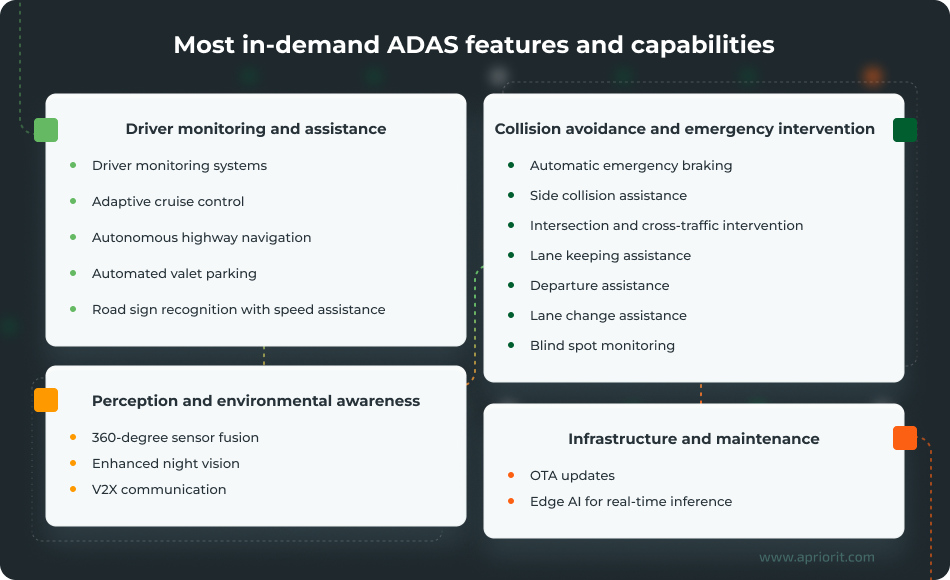
Let’s take a closer look at each group and discuss which specific features you need to target for this scope of functionality.
Driver monitoring and assistance
This group covers capabilities that are necessary to create a safe, comfortable driving experience and assist human drivers with commonly challenging tasks:
- Driver monitoring systems (DMSs): These systems monitor driver behavior by watching the driver’s eye movement and position. Mandated under the EU’s GSR, DMSs are especially critical for enabling safe L2+ and L3 automation.
- Adaptive cruise with stop-and-go: Helps reduce driver fatigue and maintain safe following distance in different traffic conditions; particularly useful on highways and when navigating urban congestion.
- Autonomous highway navigation: Supports hands-free, partially supervised driving within specified speed limits and on mapped highways.
- Automated valet parking: Enables self-parking for vehicles in pre-mapped or sensor-enhanced environments like garages and drop-off zones. This feature is often seen as an L4 use case in constrained ODDs.
- Road sign recognition with speed assistance: Detects and interprets road signs to alert drivers on speed limits or automatically adjust vehicle speed.
Collision avoidance and emergency intervention
These features aim to prevent accidents and assist drivers in responding timely to potentially dangerous situations, especially in complicated weather or traffic conditions.
- Automatic emergency braking (AEB): A feature that is especially crucial for the US market, as the National Highway Traffic Safety Administration (NHTSA) will require AEB with pedestrian detection from 2029 onward. AEB systems are designed to help drivers mitigate or avoid frontal collisions, using forward-facing radars and cameras to detect potential threats.
- Blind spot monitoring and side collision assistance: Designed specifically to reduce and prevent lane-change collisions, this feature is highly valuable for both commercial and urban fleets. It usually relies on data from short- to mid-range radar, ultrasonic sensors, or side-mounted cameras.
- Intersection and cross-traffic intervention: Combines radar, camera, and trajectory prediction to detect cross-traffic threats or risky maneuvers at intersections. This feature often comes with AEB extensions.
- Lane keeping and departure assistance: Already common for L1–L2 systems worldwide, this feature is also essential for New Car Assessment Program (NCAP) scoring and compliance. It helps monitor if the vehicle is within marked boundaries, mostly using front-facing cameras and lane-detection algorithms.
- Lane change assistance: Widely applied in L2+ systems, this feature aims to simplify long-distance highway travel by monitoring surrounding vehicles and assisting drivers with safe lane changes. To determine the safest way to move between the lanes, it analyzes vehicle speed, monitors blind spots, and plans the vehicle’s trajectory.
Perception and environmental awareness
This group of features helps drivers navigate complex environments and increase the safety and comfort of their driving experiences.
- 360-degree sensor fusion: Combines radar, LiDAR, ultrasonic sensors, and cameras into unified scene awareness; it’s mandatory for scaling beyond L2 autonomy.
- Enhanced night vision: Uses infrared cameras or thermal imaging to improve visibility in low-light or poor weather conditions.
- Vehicle-to-everything (V2X) communication: Enables data exchange and communication between vehicles, infrastructure, and pedestrians. Powered by 4G/5G, V2X supports features like red-light warnings, emergency vehicle alerts, and traffic optimization.
Infrastructure and maintenance
While not so driver-oriented as the features mentioned above, infrastructure and maintenance features are essential for increasing the longevity and improving the performance of software-defined vehicles:
- Over-the-air (OTA) updates: Enable continual upgrades, bug fixes, and security patches remotely. OTA updates are crucial for extending the lifespan of ADAS solutions and vehicles as well as for ensuring compliance with emerging standards.
- Edge AI for real-time inference: Processes sensor data locally for faster, context-driven decision making, which is vital for detecting edge cases, interpreting behaviors, and reducing cloud dependency.
These are some of the highly demanded features in ADAS solutions that are expected to support at least L2 automation. However, this doesn’t mean that your product must include each one. Instead, you may want to consider features that are not in high demand today but will create a strategic advantage for your product in the future.
Two more things to include in your ADAS evolution roadmap are machine learning and AI. While not standalone features, these technologies are in high demand in the ADAS market.
Why use AI/ML in ADAS development?
Many of the ADAS features we covered above rely heavily on real-time data interpretation to detect, classify, and respond to continuously changing environments and road conditions. AI and ML can help ensure the necessary data processing speed and precision better than other technologies.
For example, ML models help improve recognition of lane boundaries and nearby vehicles, especially in complex or low-visibility environments, which is critical for lane-keeping and lane-change assistance.
Surely, there are ADAS features that don’t need AI. Things like OTA updates or even blind spot monitoring can be implemented with other technologies such as traditional rule-based algorithms while still delivering a safe and comfortable driving experience. However, you should be prepared to evaluate the feasibility of enhancing your ADAS capabilities with AI or ML and plan for its timely integration.
How can you determine which features to invest in? That’s what we discuss in the next section.
Read also
AI in the Automotive Industry: 7 Key Applications for a Competitive Advantage
Discover practical AI applications in modern vehicles and how your automotive software can benefit from these intelligent technologies.

How to prioritize new ADAS features
Strategic feature prioritization is what can help you avoid wasting your budget and team resources on solutions that won’t be feasible and competitive in the long term. Below, we give you six key factors that will help you make the right choice.
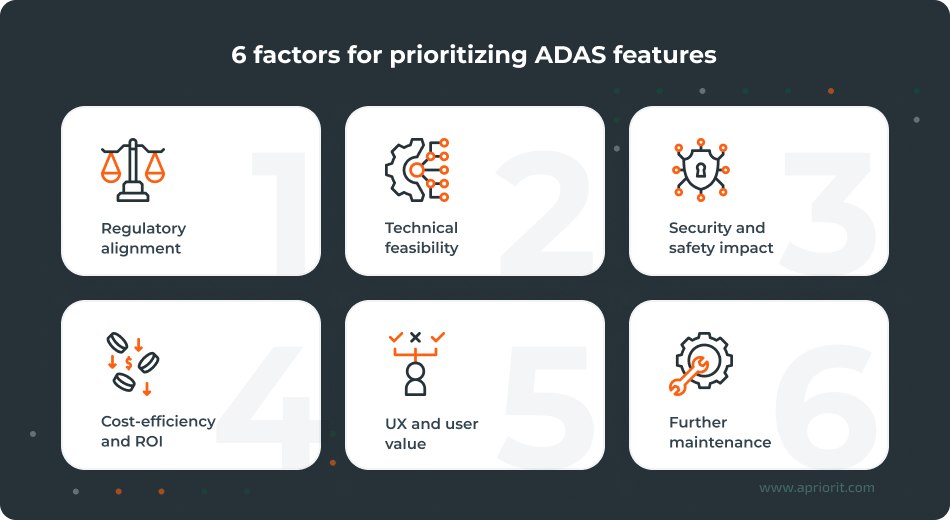
1. Regulatory alignment
Automakers and ADAS vendors must comply with dozens of regulations, standards, and guidelines. We’ve already mentioned some of them, such as the EU’s GSR and NCAP requirements.
Other international standards and regulations to account for include ISO 26262 and UNECE R155/R156. The GDPR and CCPA will help your team introduce proper privacy protection and data anonymization mechanisms. More industry-specific frameworks, which are especially important to automotive software vendors, include MISTA and AUTOSAR.
Start by identifying the full scope of regulations and standards you must or want to comply with. You need to look at requirements applicable to your company’s location and target markets or industries, including upcoming mandates.
Failing to ensure proper alignment of your ADAS features with relevant laws and regulations can result not only in fines for non-compliance but also in operational and market access restrictions.
2. Technical feasibility
The capabilities of your existing architecture will strongly impact your choice of new ADAS features. In particular, your team needs to evaluate the current architecture and technology stack, paying special attention to things like sensor compatibility and coverage, latency thresholds, and processing power limitations.
For example, if you plan on adding an AI-powered feature, you will need to ensure stable model performance and real-time data processing. Features like intersection assistance or highway navigation require strong sensor fusion and reliable redundancy protocols. If a newly implemented feature exceeds your system’s current capacity, it may delay critical decisions and create unnecessary security concerns.
3. Security and safety impact
Driving is a safety-critical process, where even the tiniest malfunction or error can lead to devastating consequences. That’s why it’s important to assess the potential security impact of every feature you add to your ADAS solution, paying special attention to:
- Potential expansion of the cyberattack surface
- Safety compliance of the intended functionality (ISO 21448)
- Compliance with functional safety requirements (ISO 26262)
Early threat modeling combined with thorough security audits and penetration testing of your system will help you avoid costly changes during pre-certification phases.
Read also
Automotive Functional Safety: Ensuring ISO 26262 Compliance
Strengthen your automotive projects by learning how to embed functional safety according to ISO 26262 and ensure long-term compliance from design to deployment.

4. Cost-efficiency and ROI
Along with security, you need to evaluate the potential business impact of new features. Factors to pay attention to include:
- Development complexity
- Hardware demands
- Necessary validation cycles
- Support and maintenance costs
Due to their complexity, most ADAS products require high initial investments. To achieve better long-term ROI, you may want to prioritize modular features with high scalability potential.
5. UX and user value
Features that improve the driving experience, reduce cognitive load, and address common frustrations can significantly improve the adoption and retention of your ADAS solution.
It’s important to strike the right balance between what’s necessary or highly expected and what can help you stand out among your competition.
Never make desirability and hype your only criteria for selecting new features.
Common examples of necessary features include driver monitoring and adaptive cruise control. With increasing demand from regulators and customers, failing to integrate these features may actually cause your brand to fall behind major market players.
On the other hand, features like enhanced night vision or automated parking can serve as crucial differentiators for your ADAS solution, especially in competitive markets.
What’s important here is not to make desirability and hype your only selection criteria. Evaluate the potential user impact of a new feature based on other criteria, such as ease of use, learnability, and consistency across various driving environments.
6. Further maintenance
ADAS lifecycle management requires a strategic approach, since post-deployment support can significantly influence the total cost of ownership for your new ADAS feature.
For example, features powered by machine learning require frequent updates. Therefore, it’s important to design them with OTA update delivery in mind. And if a new feature relies heavily on sensors, ensuring timely and proper calibration will become vital for ensuring a safe driving experience and accurate data processing.
The ability to deliver new capabilities securely, reliably, and within the bounds of evolving regulations will ultimately define the end value of your ADAS system. And for some non-trivial tasks you and your team encounter along the way, you may need assistance from true experts.
Read also
Cybersecurity Risks of Automotive OTA Updates and How to Mitigate Them
Explore how poor OTA implementations can expose your automotive software to security threats and what steps your team can take to prevent them.

How Apriorit supports strategic ADAS development
Innovating a complex ADAS solution requires product leaders to gradually balance performance, compliance, security, and scalability. Yet, ADAS vendors don’t always have all the necessary expertise and technical skills in-house.
As a TISAX-certified company, Apriorit helps automotive software vendors improve their existing solutions and build new products from scratch, enhancing their in-house teams with unique expertise in:
- Custom automotive software development — Offering full-scale R&D services, Apriorit can assist you with any task, whether you’re building a tailored ADAS platform or an innovative feature.
In particular, our business analysts can help you evaluate the feasibility of a new feature. A team of dedicated developers will then design and seamlessly integrate it into your platform. ISTQB-certified QA specialists can ensure the quality of delivered functionality, while our PMs will assist you with organizing a transparent and efficient workflow.
- Security audits and penetration testing — With over 20 years of experience in cybersecurity, Apriorit can thoroughly audit your automotive software to ensure its resilience against both known cyber attacks and emerging threats. Our specialists will look for potential weaknesses in your system using various code review techniques, reverse engineering methods, and attack simulations.
After the audit, we’ll provide you with a detailed report that describes detected issues, prioritizes them, and offers expert suggestions for their remediation.
For example, in one of our recent projects, the Apriorit team worked with a global V2X solution provider. To run a rigorous security audit of their vehicle communication system, we combined protocol fuzzing, reverse engineering, and compliance-focused code review. Our team also designed a detailed software bill of materials, helping the client to easily track and manage their software dependencies. To learn more about our collaboration with this client, read the full version of our case study on auditing the security of a connected vehicle communication system.
- AI and machine learning development — Enhance your ADAS solution with tailored, secure, and reliable AI and ML solutions. Apriorit’s AI experts can help you tackle any challenge on your AI journey.
Our data engineers will help you gather enough quality data and compose it into a well-balanced, bias-free dataset. Meanwhile, our software engineers will design, train, test, and deploy a reliable ML model. We will also fine-tune it to ensure the high accuracy and precision of model outputs so that you can deliver reliable and secure driving experiences to your end users.
Conclusion
Competition, regulations, and customer demand are dictating the future of ADAS. With increasing adoption across market segments and geographical locations, ADAS capabilities are shifting from optional to expected and mandatory.
For product leaders, the real challenge is to make the right choice when choosing the next ADAS feature to implement. Factors you need to account for range from compliance and safety impact to customer expectations and overall technical feasibility.
Building and integrating new ADAS features is a highly complex task, but with the right software development partner by your side, you can be sure of secure and consistent delivery. Whether you want to design a next-gen driver assistance solution or secure your existing platform, Apriorit will help you see the task through to its successful completion.
Ready to enhance your ADAS with new features?
Share your ideas and requirements with the Apriorit team. We’ll help you design and deliver a feature that perfectly balances security, compliance, and innovation.
FAQ
1. What are the key regulations and standards to consider when building ADAS features?
The list of regulations and standards that your ADAS product must comply with will mostly depend on your location and the types of data your product will have access to.
The main requirements to adhere to include ISO 26262 (functional safety), ISO/SAE 21434 (cybersecurity), SOTIF for safety of intended functionality, and regional requirements like the EU General Safety Regulation (GSR) and UNECE R155/R156. For data privacy, you may also need to meet requirements of the GDPR (in the EU) or the CCPA (in California).
2. Which ADAS features introduce the biggest cybersecurity risks?
Features that add external connectivity, such as V2X communication or OTA updates, will create the biggest cybersecurity risks for your ADAS product. Depending on the affected feature, potential risks can range from data interception and spoofing to full remote takeover of the vehicle.
To mitigate possible cybersecurity risks, make sure your development team incorporates threat modeling, protocol fuzz testing, and secure-by-design coding practices into the development process. Apriorit can assist you with any of these activities, ensuring top-level security for your ADAS solution.
3. How can you keep ADAS features scalable over time?
Scalability is less about adding features and more about sustaining them securely, reliably, and at controlled cost. To achieve that, invest in a modular software architecture and incorporate support for OTA updates early on.
In this way, you will enable scalability for your new ADAS features and be able to patch vulnerabilities, retrain ML models, or meet new regulations, all without risking the stability and performance of your system.
4. How will sensor fusion advancements influence ADAS capabilities in the future?
Relying on inputs from different radars, LiDAR, ultrasonics sensors, and cameras, sensor fusion is one of the key driving forces behind autonomous driving.
In particular, sensor fusion is crucial to reduce false positives and increase perception accuracy. It’s also an essential part of many L2+ and L3 features, especially those responsible for assisting drivers in challenging environments and weather conditions like heavy traffic or fog.
5. How much data (and what data) is needed to train robust ML models for ADAS?
When training an ML model for ADAS, you need to focus not only on the volume but also on the quality and relevance of training data. Training requires large, diverse, and properly annotated datasets with detailed data on different weather conditions, lighting, and regional scenarios.
If you’re concerned that you may not have enough data for model training, consider using synthetic data and simulation environments. Reach out to Apriorit to discuss the detailed requirements of your project. We’ll gladly help you prepare a custom dataset, train your ML model, and fine-tune it.
6. Why do modern ADAS solutions need edge AI?
Today’s ADAS systems can’t afford to deal with any kind of latency or connectivity gaps.
Edge AI enables real-time inference directly in the vehicle, reducing reliance on cloud connectivity. This supports real-time decisions in critical situations, such as to avoid possible collisions.
Using edge AI may also help you better protect the privacy of user data by processing it locally.