
 Skip to main content
Key takeaways:
- The biggest cost factors for driver development projects are scope, platform count, and testing coverage.
- Every operating system is a separate project — a Windows driver, a Linux driver, and a macOS driver are three independent development efforts.
- Unclear requirements and unvalidated feasibility are the most common sources of budget surprises. We use a discovery phase to eliminate both.
- For most driver projects, a fixed-price model is viable. Vendors with enough driver development experience can estimate accurately.
If you’ve ever asked a driver development vendor for a cost estimate, you’ve probably heard: That depends. This is because driver projects are difficult to price without knowing what’s under the hood.
The cost depends on:
✅ What the driver needs to do
✅ Which operating systems it needs to run on
✅ How mature your hardware and documentation are
✅ What compliance requirements apply to your platform
If a vendor misses any of these, their estimate will miss the mark too.
In this article, you’ll find out what factors influence the cost of driver development, what you’re actually paying for at each stage, and how to prepare for a project in a way that keeps the budget predictable.
This article is for product managers, CTOs, and technical leads who want to understand driver development costs, how they’re formed, and how Apriorit ensures you get your driver on time and within the agreed budget.
Contents:
Factors that affect driver development cost and timeline
The final cost of any development project depends on how much time an engineering team spends on it. But how can you possibly know how long it will take a driver development vendor to deliver a solution?
There are five crucial nuances that dictate whether a project will take a few weeks or a few months. Below, we list the factors that influence how much time it takes to build, test, and deploy a driver.
1. Completeness of initial requirements and input materials
Before Apriorit engineers can estimate a driver project, we need to understand what the driver needs to do.
Clients typically come to us either with a detailed list of requirements and documentation ready or with a clear goal but no technical specification: I need it to work like this, but I’m not sure how to do that.
In the first case, we can move straight to estimation. In the second, we’ll need a discovery phase to gather the information required for planning.
Even when requirements are detailed, a discovery phase may still be needed — not because requirements are incomplete but because their feasibility needs to be validated. Examples of requirements to be validated:
- Intercept network packets with metadata — This is a specific requirement, but it’s unfamiliar enough to our experts that they would need to assess how it can be done and what effort it would demand.
- The driver must use no more than 2% CPU — This requirement is concrete, but whether it’s achievable depends on many conditions and needs to be investigated.
To provide you with a reliable development plan and estimate your project accurately, we need to ensure that your driver requirements are technically feasible.
The question is whether you need a discovery phase to confirm this, as adding one will increase the final cost of the project.
Here’s what affects how quickly we can start:
- Completeness of specifications
- Firmware maturity
- Access to hardware samples
- Availability of your technical team for questions (SME availability)
A note on firmware instability: Developing drivers for custom hardware comes with an inherent risk that developing drivers for standard, well-documented hardware does not. While early testing and simulations can catch many issues, some low-level hardware and firmware interactions only surface during actual development and integration.
A discovery phase significantly reduces this risk. It allows us to test the device, analyze traffic, investigate protocols, and surface most compatibility issues before full development begins. That said, it doesn’t eliminate the risk entirely. Deeply embedded hardware issues can still appear later. The best way to manage this is through iterative development: building and validating the driver in stages rather than all at once so that issues are caught early and contained.
Define your expectations before the project starts. Bring your engineering team in early — even a rough description of expected driver behavior allows for a realistic assessment of technical risks and helps prioritize requirements. Clear expectations up front create a stable project roadmap and significantly reduce the risk of scope creep and late-stage changes.
Michael Teslia, Program Manager at Apriorit
Want to know exactly how much your driver will cost?
Reach out and share what you need your driver to do. We’ll provide a detailed estimate with no hidden costs or surprises.
2. Scope of work
Before estimating the scope, we need to identify what kind of project you actually have. The scope of driver work varies significantly depending on whether you need:
- A new driver built from scratch
- An update or extension to an existing driver
- A port of an existing driver to another OS
- Certification support for a driver that’s already built
Each of these has a different starting point and different risks. A port, for example, benefits from having a working reference — but it still requires full independent development and testing for the target OS.
Certification support may require no new code at all, but it adds testing and submission overhead that needs to be planned for.
When it comes to building a driver from scratch, the scope is typically divided into three possible categories: proof of concept (PoC), minimum viable product (MVP), or a fully-fledged driver. The timelines below are averages for a single OS and a single developer and will vary based on driver complexity.
PoC — 1 to 1.5 months, including testing
A proof of concept validates that the core idea works. It typically covers one scenario, with no configuration interface. The goal is simply to confirm that the approach is viable.
Example: A watermark driver PoC would take one printer model, run a print job, and confirm that the watermark appears. Nothing is configurable — it just proves that the concept works.
MVP — 2 to 2.5 months, including testing
An MVP is a minimal but production-ready solution. It covers the essential functionality, is ready for integration, and can be used by end users. Adding more developers can compress this timeline.
Example: An MVP of the same watermark driver would support several common printer models and include functionality for configuring watermark parameters and an API for remote configuration. This represents a more complete solution built around the driver.
Beyond an MVP
Additional features, interceptors, and hooks expand the estimate significantly — up to 8 to 10 months for complex implementations.
Example: During one of Apriorit’s recent projects, we built a backup solution where the driver was the core component. The project required a team of three developers and ran for eight months from kickoff to release.
Related project
USB Wi-Fi Driver Development
Learn how the Apriorit team ported an existing Linux driver to Windows, saving our client’s time and money as well as enhancing their product’s performance and reliability!

3. Target platforms and versions
Each operating system — Windows, Linux, macOS — is a fully separate development project. There is no shared codebase, and the driver for each platform is built independently. This means that if you need your driver to work on several platforms, you need several drivers.
Within a single operating system family, the number of OS versions you need to support also matters. In Windows, most version-to-version differences are manageable, but major kernel-level changes between older and newer releases can significantly complicate development. Supporting everything from Windows Server 2003 to Windows Server 2025, for example, is one of the factors that can push a project toward the 8- to 10-month range.
The wider the version range, the more edge cases need to be handled — particularly where Microsoft has changed how drivers interact with the kernel.
Develop for one target OS or a specific OS version first. There’s no shortcut to multi-platform support, but starting with one OS gives you a working, tested driver that serves as a real reference when planning the next platform. It helps you identify which functionality translates across operating systems — and which doesn’t.
Michael Teslia, Program Manager at Apriorit
Some features may behave differently or not be feasible at all on another OS. These limitations are typically identified during technical consultation before the next project begins so you can plan and budget accordingly.
4. Platform compliance requirements
Depending on your target platform and the market you’re operating in, your driver project may need to meet compliance requirements beyond getting the code right. These fall into three broad categories:
Platform-level requirements
Each OS has its own framework for driver validation and distribution:
- Windows: Drivers intended for broad distribution need to go through HLK testing and be submitted to Microsoft’s Dev Portal for signing to get a WHQL certificate.
- macOS: Depending on what your solution does and what system-level access it requires, you may need to obtain entitlements from Apple. This applies to any solution that requires elevated system permissions.
- Linux: There is no single vendor and therefore no universal certification process. Requirements vary by distribution — Red Hat, SUSE, and others have their own qualification programs if you need distribution-level support.
Industry and regulatory requirements
Some industries impose additional compliance requirements on software that interacts with hardware at the driver level. For example:
- AUTOSAR, ISO 26262 (automotive)
- FDA 21 CFR, IEC 62304 (medical devices)
- IEC 61508, DO-178C (industrial systems)
- And others
If your product operates in a regulated market, these requirements need to be factored into the scope from the start.
Security standards
General security standards such as NIST guidelines or secure SDLC practices may apply depending on your organization’s or your customers’ requirements. These affect how the driver is developed and validated, not just what it does.
5. Scope of testing and the compatibility matrix
Testing scales with the number of configurations your driver needs to support.
For Windows, this means the number of OS versions in your compatibility matrix. For Linux, it also includes the number of kernel versions and distributions. For macOS, it includes the range of OS versions or Apple’s newer DriverKit framework.
As each configuration in the matrix requires dedicated test coverage, it affects the project duration and cost. At Apriorit, we add all configurations to the testing plan before development starts. This helps us correctly estimate time and resources.
Read also
Agile and Hybrid Approaches to Kernel and Driver Development: Pros, Cons, Examples
Enhance collaboration between engineering and management teams in complex driver projects. Find out how customized Agile and hybrid approaches improve transparency, adaptability, and overall project outcomes.

What you’re really paying for in a driver project
Let’s look at what work actually happens during a driver development project and what you get at the end of each stage.
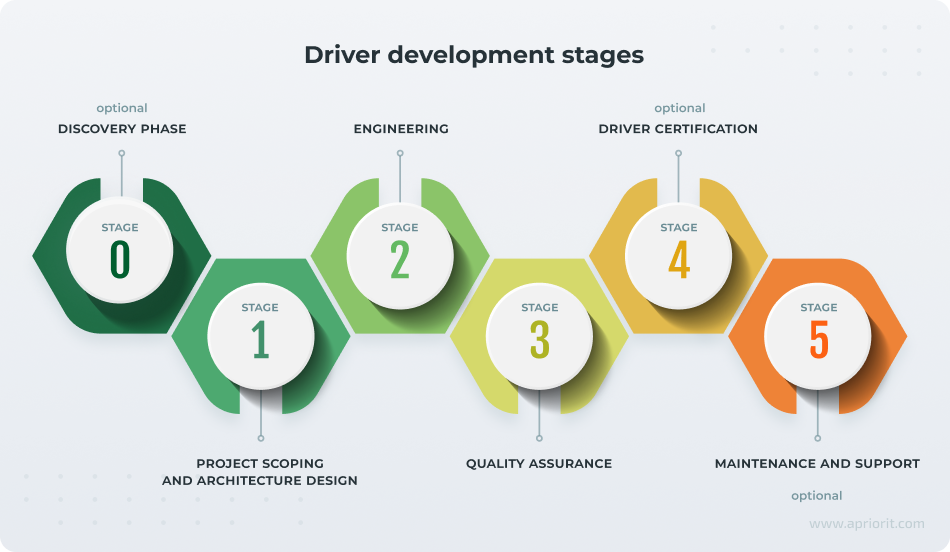
Discovery phase (optional)
If your requirements are clear and technically straightforward, we move directly to project planning. But if there are open questions about feasibility, architecture, or risks, a discovery phase is the right starting point. It’s what makes the rest of the project plannable.
During discovery, Apriorit experts:
- Elicit and analyze requirements
- Review available documentation and specifications
- Evaluate firmware maturity (for custom device drivers)
- Validate the architecture and development approach
- Define the project scope and constraints
- Assess technical resources required
- Prepare a development plan that includes budget, resources, and milestones
The discovery phase typically takes from three days to two weeks depending on the technical complexity of your request and the number of unknowns.
Deliverables:
- Documented assumptions, technical constraints, and risk register
- Recommended development approach
- Basic PoC upon request
- Project plan with milestones and budget estimate
Architecture design and development planning
Once we confirm the requirements and establish feasibility, we define the full technical foundation of your project — the architecture, the development roadmap, and, upon request, an assessment of what performance the driver can realistically achieve.
Deliverables:
- Detailed solution architecture package
- Performance research and assessment report (if applicable)
Engineering
At this stage, we build your driver. Depending on your project, the scope may include packaging and installation tooling alongside the core driver.
Deliverables:
- Driver source code and service (if applicable)
- Compiled binaries
- Technical documentation
- Installer (optional)
Quality assurance
Driver quality assurance goes well beyond basic functional testing. The specific test types depend on your driver and product requirements — but a thorough QA process at Apriorit typically includes functional tests, compatibility tests across your target OS matrix, stress and soak tests, performance tests, and security testing.
Deliverables:
- Test reports (separate per test type or consolidated)
- Bug reports
- Improvement recommendations
Driver certification (optional)
If your driver needs to be distributed through the Microsoft Store, it must obtain WHQL Certification. For this, it has to pass HLK testing and be submitted for signing through Microsoft’s Dev Portal. This is the driver owner’s responsibility — no third-party vendor can sign a driver on a client’s behalf, as the signature must come from the legal owner of the driver through their Microsoft account.
However, from our side, we can help you with testing and preparing everything you need for submission.
Deliverables:
- Compiled binaries
- HLK test report (.hlkx)
Additionally, we can assist you with the submission process in a consulting format. Our specialists can even walk you through the Dev Portal process step by step.
Note: Certification timelines and failed HLK runs can affect your release schedule. While we usually fix everything after the first round of testing, in some cases, your driver may need additional testing rounds.
Read also
Windows Hardware Lab Kit (HLK) Driver Testing for WHQL Certification: Timeline and Factors Affecting It
Avoid common pitfalls that slow down driver certification and impact release dates. Learn how long the HLK testing process takes and how to optimize the timeline for faster approval.

Maintenance and support (optional, post-release)
A driver that works on release day will inevitably need attention as the environment around it evolves: new OS versions, hardware revisions, security vulnerabilities, or edge cases that only appear as your solution scales. Planning for maintenance before the project ends is generally cheaper than handling it reactively later.
Typically, maintenance at Apriorit covers:
- Compatibility updates when new OS versions or kernel releases affect existing behavior
- Security updates in response to new vulnerabilities or compliance requirements
- Bug fixes for edge cases that surface in production
Deliverables:
- Updated driver code and binaries
- Test reports confirming existing functionality is intact after changes
Not every project goes through every stage above. The path depends on where you’re starting from and what you already have. A client with complete documentation and clear requirements skips straight to scoping and architecture. One with an early-stage idea and immature hardware may need to start with discovery.
Michael Teslia, Program Manager at Apriorit
How Apriorit can get you a precise estimate for your driver project
Developing reliable, secure drivers requires deep system-level expertise — and experience knowing where projects can go wrong before they do.
At Apriorit, we have been working on kernel and driver development for more than 20 years across Windows, Linux, and macOS, building hundreds of low-level solutions of all levels of complexity for various industries.
This is exactly what allows us to accurately estimate incoming projects, as we already know what to ask, what requirements to gather, and what nuances to watch out for before they have a chance to turn into budget and timeline issues.
Here are the engagement models we typically use for driver development:
Table 1. Pricing models for driver development projects
| Pricing model | Best fit when |
|---|---|
| Fixed price (most common option) | – Driver scope and compatibility matrix are stable and well-defined |
| Time & materials | – Hardware or specifications are evolving – Existing driver support, bug fixing, and maintenance work |
| Dedicated team | – Multi-release roadmaps – Ongoing maintenance – Evolving requirements over a long period of time |
Depending on the nature of your project, we can put together a team of any size — from a single developer for a focused PoC or MVP to a full team for complex, multi-platform, or long-running projects.
Apriorit is a trusted vendor for:
- Custom driver development. Whether you need a driver built from scratch or a solution tailored to specific hardware, we’ll design and develop it to meet your technical requirements and performance expectations.
- Legacy driver modernization. If your existing driver is falling behind in compatibility, performance, or security, we’ll assess your solution and find the most effective path to bring it up to current standards.
- Driver security improvements. We can strengthen your driver’s security posture through security code audits, static code analysis, and driver-specific security testing.
- Driver solution support and maintenance. For teams that need ongoing post-release support, we provide maintenance across the full lifecycle — new features on demand, security updates, and compatibility with new OS versions and hardware revisions.
But the first step is defining the scope, timeline, and budget. If you’d like to know what your driver project will actually cost — and why — we’re happy to take a look. Share your requirements with us and we’ll come back with a detailed estimate.
Looking for an expert driver development team?
Leverage Apriorit’s 20 years of experience in driver development to fortify your product and expand its capabilities!
FAQ
What factors impact the cost of driver development the most?
<p>Scope, platform count, and testing coverage are the main cost drivers. The type of work also matters. Building from scratch, updating an existing driver, or porting to another OS all have different baselines. How complete your requirements are and how mature your hardware also affects how quickly we can start the project. The wider your compatibility matrix, the more testing is required, which directly extends the timeline.</p>
How do you ensure stability and security in kernel code?
<p>Kernel-level code has no safety net: a bug can crash the entire system. Our engineers follow secure development practices throughout, including code reviews, static code analysis, and security-focused testing. QA includes stress and soak tests designed to surface edge cases that only appear under load or over time. For Windows, HLK testing provides an additional validation layer before release.</p>
How long does driver development usually take?
<p>A PoC typically takes 1 to 1.5 months including testing. An MVP runs 2 to 2.5 months with a single developer and can be compressed by adding more team members.</p>
<p>Complex implementations with additional features, interceptors, or broad OS version support can reach 8 to 10 months. These are averages for a single OS, so each additional platform is a separate project with its own timeline.</p>
What inputs do you need from my hardware/firmware team?
<p>We need hardware samples, technical specifications, and register-level documentation where applicable.</p>
<p>Access to your firmware team matters too. When questions come up during development, slow turnaround adds to the timeline. The more complete and stable your hardware and documentation are at kickoff, the more predictable the project will be.</p>
Do I need WHQL certification? What does HLK involve?
<p>If your driver will be distributed on Windows, certification is strongly recommended and, in many cases, required. HLK (Hardware Lab Kit) is Microsoft’s test framework for validating driver quality and compatibility.</p>
<p>At Apriorit, we run the HLK test and prepare the submission package, including the .hlkx report. Actual submission and signing must be completed by you through your Microsoft Dev Portal account, as only the driver’s legal owner can do this.</p>
How do you handle driver signing and release readiness on Windows?
<p>Apriorit delivers compiled binaries and the HLK test report required for submission. We’ll also guide you through the Dev Portal submission process. Signing itself must be done by you as the driver owner — no vendor can sign on your behalf. We flag certification timelines early in the project, so they’re built into the release plan rather than discovered at the end.</p>
Who maintains the driver after release?
<p>That depends on your team’s capacity and preference. Apriorit offers post-release maintenance covering compatibility updates for new OS versions, security patches, performance improvements, and bug fixes that surface in production.</p>
<p>If you anticipate ongoing needs like new hardware revisions, expanding platform support, or evolving requirements, a dedicated team model is usually the most cost-effective way to handle it.</p>
Have a question?
Ask our expert!

Program Manager