
 Skip to main content

Key takeaways:
- AI agents automate incident response activities to help security teams speed up mitigation and recovery processes.
- Yet, agentic incident response systems are prone to risks like permission overuse, prompt injection vulnerabilities, and alert misclassifications.
- To avoid introducing additional cybersecurity risks, agentic AI for incident response requires deliberate configuration and clear access and autonomy limitations.
- For irreversible agent actions and major decisions, human oversight and approval are mandatory.
- Building a reliable agentic incident response system requires a secure architecture, deep security tooling expertise, strong compliance alignment, and continual post-deployment monitoring.
Agentic incident response systems can gather relevant signals across SIEM, EDR, and identity platforms, assess the scope of an incident, and either execute initial containment steps directly or suggest a prioritized, evidence-backed recommendation for the analyst handling the incident.
But when poorly designed, an agentic incident response system may actually introduce new security risks and increase alert fatigue for security teams using it.
In this article, we analyze:
✔ Benefits and risks of AI-enhanced incident response
✔ Where agentic AI fits within the incident response lifecycle
✔ What agentic AI can and can’t reliably do at each stage of the lifecycle
✔ Core implementation requirements
This is a useful read for CISOs, heads of security, CTOs, and VPs of engineering who are evaluating whether agentic incident response is the right investment for their product or environment.
Contents:
The shift to agentic AI in cybersecurity
Growing adoption of AI-powered tools is accompanied by a significant increase in the use of agentic AI in security operations. In particular, McKinsey highlights that organizations largely adopt agentic AI across both their engineering and security environments.
A few years ago, incident response was largely handled using rule-based automation and Security Orchestration Automation and Response (SOAR) playbooks. Organizations were deploying platforms like Splunk SOAR and Palo Alto XSOAR to automate multi-step response actions, such as blocking an IP, quarantining a host, and opening a ticket.
However, playbooks operate within predefined logic trees. They are most useful for handling known threats, while everything else requires human intervention or manual updates. Previously unknown attack patterns, incomplete data, or scenarios that fall outside the script can cause them to stall, escalate incorrectly, or skip steps.
With AI technologies entering the picture, security analysts started additionally using copilots and AI assistants to augment their work. AI-powered bots help security teams by surfacing relevant context, suggesting next steps, and generating incident summaries.
Yet when working with AI-powered assistants, there’s little to no AI autonomy, since every action still requires explicit human request and approval. Take Microsoft Security Copilot as an example: it can correlate signals across Microsoft Defender and Sentinel, summarize an incident, and recommend an investigation path. But the decision on what to do next is still left to the user.
Agentic AI addresses this lack of autonomy in incident response workflows, minimizing both the necessity of involving a human analyst and the time to containment. Agentic AI systems operate with a higher degree of autonomy than either copilots or SOAR playbooks. Rather than following a fixed script, AI agents assess the current situation, plan a sequence of actions, and adapt as new information comes in.
Currently, there are two ways to implement agentic AI: with separate agents or entire agentic systems.
Individual agents are typically scoped to a single task, such as querying a threat intelligence feed or correlating log entries from a specific source.
Agentic systems orchestrate multiple specialized agents, working in sequence or in parallel, and coordinate their outputs to manage the entire investigation lifecycle.
An agentic system can:
- Take an initial alert
- Investigate it across your SIEM, EDR, and identity platforms
- Assess the scope
- Determine containment options
- Prioritize recommendations for mitigating the threat
- Initiate containment directly (within defined boundaries)
Which implementation tactic to choose will depend on the variety and complexity of the incident response tasks you plan to delegate to agentic AI.
Need AI agents for cyber defense?
Engage our AI consultants to design, validate, and deploy agentic AI systems for your cybersecurity goals.
Who should invest in agentic AI for incident response, and why?
You can already see major technology vendors deploying agentic AI solutions for incident response.
For example, Microsoft’s Phishing Triage Agent in Microsoft Defender handles user-submitted phishing reports autonomously, reportedly triaging thousands of alerts each day, typically within 15 minutes of detection.
In turn, AWS added agentic AI-powered investigation capabilities to AWS Security Incident Response. The investigative agent automatically gathers evidence across multiple AWS data sources including CloudTrail, IAM, and EC2. It then correlates the data and presents findings in actionable summaries, reducing the time required for manual evidence gathering.
Does this mean you should consider investing in agentic AI technology too?
Let’s start with analyzing the why behind the deployment of agentic incident response. First off, how does AI improve incident response?
The operational benefits of agentic AI in incident response fall into four areas:
- Speed and coverage at scale. An agentic system can begin investigating an alert the moment it’s triggered, gathering context across various connected tools — SIEM, EDR, threat intelligence feeds, identity platforms — without waiting for an analyst to open a queue. This matters most in the early minutes of an incident, when attacker dwell time is still short and containment is least disruptive.
- Better escalation quality. Rather than sending raw alerts to analysts, agentic systems surface enriched, prioritized incidents with investigation context already assembled. As a result, analysts spend less time on evidence gathering and more time on assessment — the part of the work that still requires human expertise.
- Controlled automated remediation. Agents can execute containment steps directly for well-understood, reversible actions and request human approval only for actions with greater consequences. The main candidates for automated incident response include blocking a known malicious IP address, disabling a compromised service account, or isolating an endpoint from the network. This reduces time to containment without removing human oversight from decisions that carry significant operational risk.
- Audit trail by default. Agents log both the actions they take and the reasoning behind them. In highly regulated environments, this replaces the complex, time-consuming process of reconstructing timelines from disparate system logs after an incident.
Next, let’s establish who can benefit from agentic incident response.
Overall, agentic incident response isn’t a one-size-fits-all investment. The value it can deliver depends on the organization’s operational context:
- Volume and complexity of triggered alerts
- Applicable regulatory constraints
- Coverage gaps left by already deployed tools
Deploying an agentic incident response promises the most benefits to those who fall under one of the following categories:
- Product and platform companies with high alert volumes and lean security teams. A security team of five or ten people can’t manually triage thousands of alerts per day, although that’s the operational reality for many mid-sized SaaS and platform companies.
- Companies with regulatory incident response obligations. Laws and regulations like HIPAA, PCI DSS, DORA, and the EU AI Act require documented evidence of how and when an organization responds to an incident. Companies operating in finance, healthcare, and government sectors face this pressure directly.
- Organizations running complex, distributed infrastructures. Security incidents in multi-cloud environments, hybrid architectures, or platforms with large identity surfaces often affect multiple systems simultaneously. They require correlation across multiple data sources — something that agentic systems are well suited to.
So if you or your customers operate in a highly-regulated industry, it’s worth considering investing in your own agentic incident response solution.
Read also
Telemetry in Cybersecurity: Improve Security Monitoring with Telemetry Data Collection (+ Code Examples)
See how well-designed telemetry pipelines strengthen cybersecurity monitoring and prepare your infrastructure for AI-powered and agentic security systems. Streamline data flows to improve detection, investigation, and automated response capabilities.

Where agentic AI fits across the incident response lifecycle
Not all incident response activities carry the same risk profile, and the right level of agent autonomy varies accordingly.
Higher autonomy is generally appropriate for reversible, well-understood actions with clear success criteria. For actions that affect live production systems, can’t be undone cleanly, or carry regulatory exposure, human approvers should remain in the loop.
Once you have decided to adopt agentic AI for cybersecurity purposes, it’s important to understand where to apply this technology across the incident response lifecycle.
To analyze the incident response lifecycle, let’s use the NIST SP 800-61 Rev. 3 framework [PDF].
This framework includes three levels:
- Preparation
- Incident response
- Lessons learned
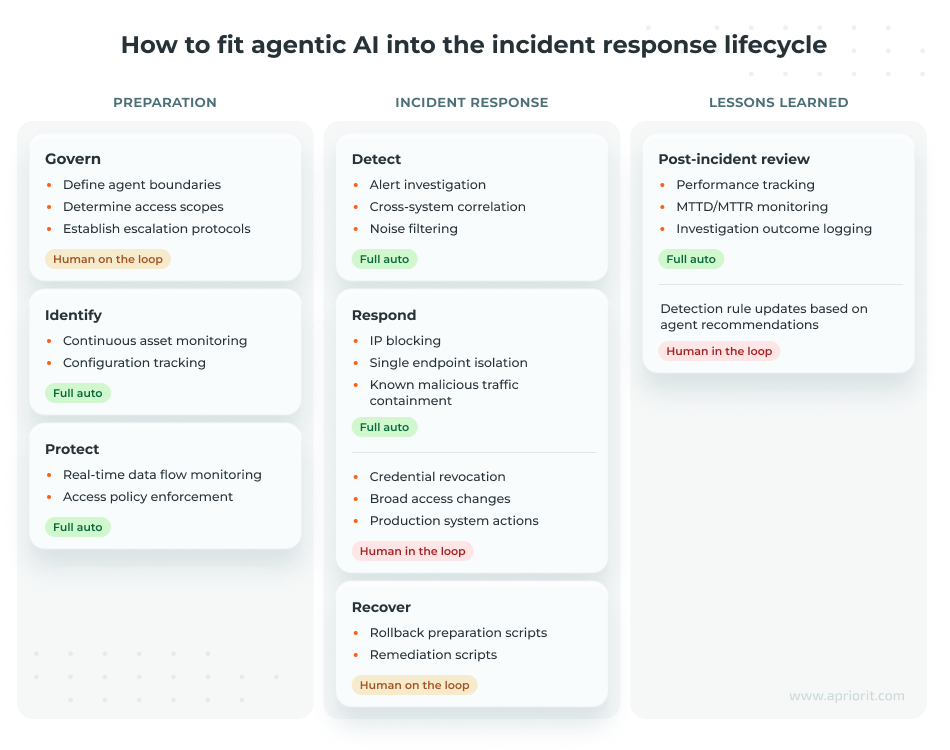
At every level of the NIST framework there are different ways to fit agentic AI into the lifecycle, with varying levels of human expert involvement — from full automation requiring zero human involvement to partial supervision (human on the loop) and direct involvement (human in the loop).
Before an incident: preparation
At this level, we work with three functions:
Govern. Agentic systems can monitor activity across systems against established security policies. They can flag deviations from defined baselines, track regulatory compliance obligations in real time, and surface policy gaps that would otherwise require manual auditing.
Identify. Before agents can investigate incidents effectively, they need an accurate inventory of what they’re protecting. Agentic systems can continuously support this by monitoring asset registers, tracking configuration changes, and flagging coverage gaps.
Protect. Agents can monitor data flows in real time and enforce access policies, flagging anomalous behavior before it escalates into an incident.
Related project
Custom Cybersecurity Solution Development: From MVP to Support and Maintenance
Explore how Apriorit delivered a custom cybersecurity solution focused on protection and operational reliability to help our client enable secure monitoring, centralized control, and long-term product scalability.

During an incident: response
Once an incident occurs, we work with three more functions:
Detect. Rather than placing every alert in an analyst’s queue, agents can investigate them autonomously. They can query threat intelligence, correlate behavior across endpoints and identity systems, and filter noise.
Behavior-based anomaly detection is particularly relevant here: agents can identify patterns that static rules miss, especially in multi-vector attacks where no single signal crosses a threshold but the combination is significant.
In practice, this may look like someone logging in at unusual hours, accessing data they don’t commonly work with, and exporting small volumes of data. Individually, each event seems legitimate or only mildly concerning. In sequence, they form a recognizable pattern of credential-based lateral movement.
Rule-based systems can’t identify this in time. Yet an AI agent can, as it correlates access history, baseline user behavior, and asset sensitivity across various cybersecurity systems.
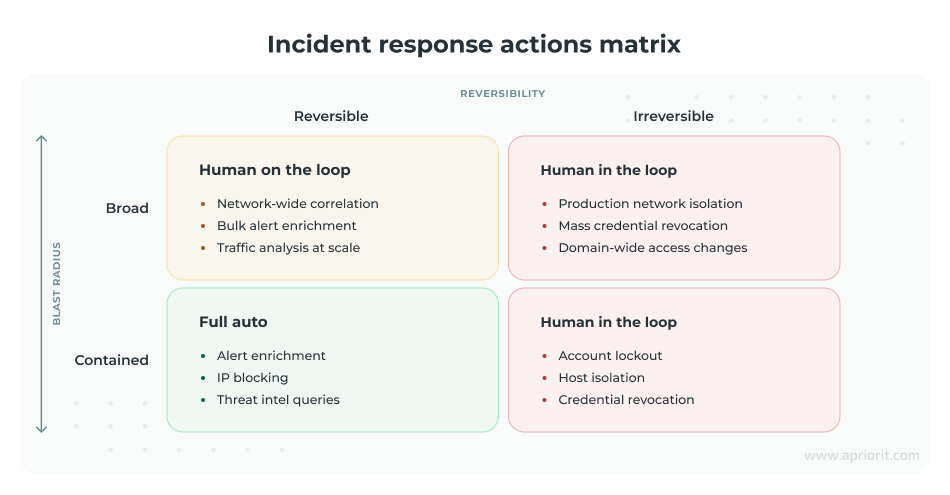
Respond. Agents can plan and execute multi-step response sequences, such as isolating a compromised host, revoking leaked credentials, and blocking malicious traffic at the network layer. However, the threshold for automatic execution versus human approval should be tied to reversibility and blast radius.
Well-designed agentic systems apply approval gates selectively. This way, actions with high volume and low consequences can move quickly, while high-consequence steps are still approved by humans to minimize potential risks.
The following framework maps common incident response action types against reversibility and blast radius to help determine where each oversight model applies.
Recover. Recovery actions, such as restoring endpoints, reinstating accounts, or rolling back infrastructure changes, require both precision and context about the pre-incident state. Agents can handle evidence gathering and the execution of granular rollback steps, and they can generate remediation scripts for infrastructure recovery.
The appropriate autonomy level here is generally supervised: agents propose and prepare the recovery actions, while humans authorize execution for anything that touches production systems or user access.
After an incident: lessons learned
This is where agentic incident response systems offer a capability that’s easy to undervalue.
Every investigation an agent conducts produces structured data:
- Signals that triggered the investigation
- Actions that were taken
- The outcome
- How long each step took
That data can feed directly back into detection rules and playbook logic, so that the agent can use actual incident outcomes to close coverage gaps.
If that data isn’t feeding back into your detection rules on a regular cycle, you’ve built a system that stays as accurate as day one forever. The feedback loop is where the compounding value lives. Most teams instrument everything except this, then wonder why classification quality plateaus.
Vadim Nevidomy, Head of AI at Apriorit
Over time, this creates a system that becomes progressively better calibrated to the specific threat patterns and infrastructure characteristics of the organization it operates in. Standard performance metrics here are mean time to detect (MTTD) and mean time to respond (MTTR).
Agents can also suggest relevant improvements to incident detection and response rules. However, humans should continue to approve rule changes to prevent the creation of new coverage gaps through miscalibrated updates.
Challenges of implementing AI agents for incident response
Deploying agentic AI for incident response introduces operational and security challenges that should be addressed before implementation.
Authorization and autonomy boundaries. Agents need access to the systems they investigate: SIEM, EDR, identity platforms, and network controls. Without explicit limits on that access, an agent can take actions beyond its intended scope and even disrupt legitimate operations.
Defining least-privilege access scopes at deployment and enforcing those boundaries is a non-negotiable part of an agentic incident response architecture.
Agents executing containment actions need sufficient context to assess the blast radius before acting, including asset criticality and active dependencies. They should also have a rollback path for each action type defined before deployment.
Human-in-the-loop versus human-on-the-loop. Getting the HITL/HOTL mapping right and keeping it up to date over time is one of the more demanding operational requirements of agentic incident response.
Human-in-the-loop requires explicit human approval before an action executes, making it most suitable for high-consequence, potentially irreversible steps such as disabling a service account or isolating a production system.
Human-on-the-loop allows the agent to act while a human monitors with override capability. This approach is most suitable for reversible, well-understood actions where speed matters more than gate-by-gate approval.
Most regulated deployments need both models, but the right mapping isn’t static. The same action may call for different oversight as your environment, threat landscape, and agent accuracy evolve over time.
Multi-agent coordination. Agentic systems typically involve multiple specialized agents that can conflict with each other. For example, they can assess the same event differently or produce outputs that other agents can’t properly work with.
Working with multi-agent systems requires additional orchestration and failure planning. So it’s important to outline potential failure modes for your multi-agent architecture and explicitly define handling logic for each scenario.
Say that a triage agent fails to properly assess a phishing alert. If that happens, all subsequent agents in the investigation pipeline risk missing or mishandling the incident.
To prevent this, you’ll need to identify key failure scenarios, such as an agent receiving only partial data or the approval gate timing out, and determine appropriate ways to handle them. You may even add an orchestrator agent that monitors the pipeline and routes failures to the appropriate handling path.
Read also
Why OCSF Is Shaping the Future of Cybersecurity Integration
Enable smarter security automation with a unified data schema. Explore how OCSF supports scalable telemetry pipelines and prepares your environment for AI-powered and agentic security solutions.

Sensitive data exposure. Agents investigating incidents analyze data across production systems and constantly encounter PII, financial records, health data, and other regulated information. The key challenge is designing a granular data access system that enables your agents to work efficiently while minimizing non-compliance and data exposure risks.
Here, it’s important to plan ahead for what the agent can read, what it can log, and what it can pass between subsystems, as well as to implement those data handling policies at the architectural level.
Misclassification at scale. The speed and scalability promised by agentic incident response systems can only be beneficial if threats are correctly identified and classified. If agents repeatedly misclassify events, it increases alert fatigue for human analysts and can eventually result in devastating security incidents.
Validation in realistic environments before production deployment (and ongoing monitoring of classification accuracy post-deployment) are must-haves for mitigating misclassification risks.
Agent security. Agents that connect to external data sources and act on retrieved content are themselves an attack surface. Attacks like prompt injection and service identity compromise can trigger containment actions, exfiltrate investigation data, or disrupt coordination logic between agents.
Every external data source your agent reads is untrusted input. A crafted log entry can tell your agent a healthy host is malicious and get it isolated without the attacker ever touching a credential. This demands the same input sanitization discipline you applied to SQL injection in 2005 — different layer, identical principle.
Vadim Nevidomy, Head of AI at Apriorit
Security controls for the agentic system itself need to be designed with the same rigor as the controls it’s meant to enforce. Otherwise, you’ll need to start planning your incident response for AI agents themselves.
Transparency and explainability. When an agent makes a containment decision, like isolating a host or revoking credentials, security teams and compliance auditors must be able to understand the reasoning behind this decision.
Agentic systems that can’t produce clear, human-readable decision rationales create operational and compliance friction that can outweigh their efficiency benefits. Thus, you need to incorporate explainability into the system’s logging and reporting architecture from the start.
While these challenges are significant, they can be mitigated with correct architecture, governance, and security controls, which may require additional expert assistance.
Apriorit’s take on building an effective agentic incident response system
Years of experience in cybersecurity and AI development show that when developing an agentic incident response system, it’s vital to prioritize security over capability. Only then can you effectively address the challenges and risks discussed above.
In practice, this can look like a bottom-up architecture where every next layer depends on the previous:
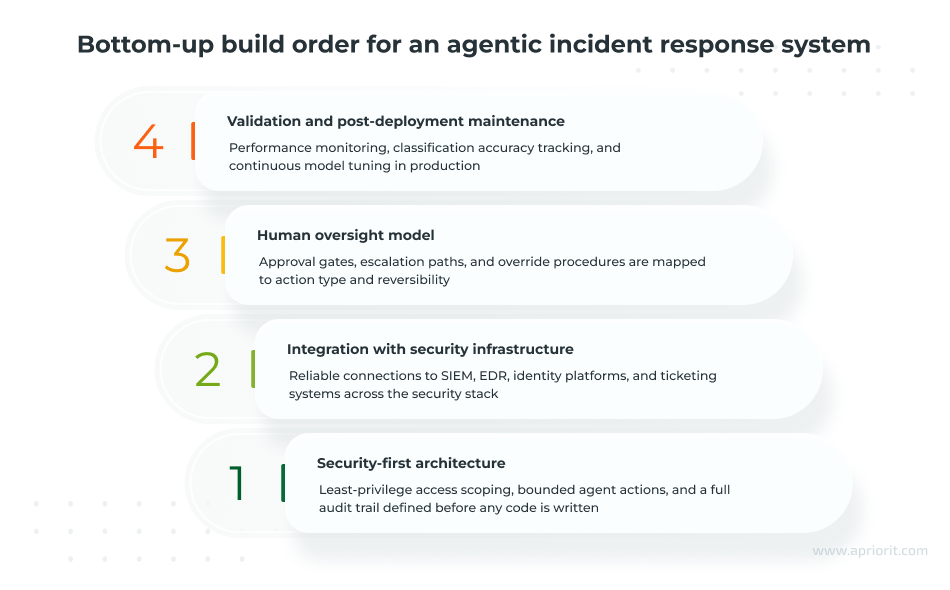
Building such an agentic system requires engineering depth that spans security architecture, AI/ML development, and compliance alignment — capabilities that rarely exist within a single in-house team.
With Apriorit, you get both:
- Security engineers who understand threat models and secure development lifecycle principles
- AI/ML specialists with experience building agent workflows that operate reliably in production environments
If you’re scoping a new system or reinforcing an existing one, we’ll gladly assist you with:
- AI and ML development — agent design, multi-agent orchestration, and production deployment
- AI consulting — architecture review, autonomy model design, and implementation roadmap
- Cybersecurity engineering — security-first architecture, access controls, and audit trail design
- Cybersecurity solutions development — end-to-end development for security-focused products in regulated environments
You can delegate your entire project to the Apriorit team, taking advantage of our expertise in business analysis, project management, and quality assurance. Or strengthen your in-house team with the top-level expertise you need most.
Want production-ready AI agents for cyber defense?
Partner with our AI and ML engineers to build agentic AI solutions that monitor environments, identify threats, and respond intelligently.
FAQ
How can AI agents speed up incident response without increasing risk?
<p>Agents accelerate the parts of incident response that don’t require human judgment:</p>
<ul>
<li>Evidence gathering</li>
<li>Alert enrichment</li>
<li>Cross-system correlation</li>
<li>Execution of well-understood containment actions</li>
<li>And so on</li>
</ul>
<p>To keep potential risks under control, you need to apply approval gates to high-consequence or irreversible steps and ensure the agent’s permission model is explicitly bounded at deployment.</p>
What should an agent do automatically, and what must stay human-approved?
<p>Take into account the reversibility and impact of agent actions.</p>
<p>Processes like blocking a known malicious IP address, enriching an alert with threat intelligence context, or correlating log entries across systems are good candidates for full automation. They have a low or moderate impact on system operations and are perfectly reversible.</p>
<p>In turn, actions such as disabling a user account, isolating a production host, or triggering a broad network containment action warrant a human approval gate because misclassification could have significant operational consequences.</p>
<p>However, the approval threshold can be adjusted, as different agents can offer different levels of accuracy for specific action types.</p>
How to prevent over-privileged agent access in production?
<p>Applying the principle of least privilege is the gold standard for minimizing agent privileges.</p>
<p>Each agent component should have access only to the specific systems and data it needs for its defined task. Furthermore, service identities for agent components should be treated the same way as privileged human accounts: they should be monitored, rotated, and audited.</p>
How do you keep agent actions traceable and audit-ready?
<p>When working on agentic cybersecurity systems, we ensure that every agent action is logged with sufficient detail, including the decision context that triggered it.</p>
<p>Action logs typically capture what the agent did, the evidence it acted on, the outcome, and whether human approval was involved. This log structure may be adjusted to better align with the audit trail requirements of the relevant compliance framework, especially for solutions designed for highly regulated industries.</p>
How can I start implementing agentic incident response?
<p>You can start with a scoped pilot: </p>
<ul>
<li>Identify one or two high-volume, well-understood incident response tasks that will benefit your business the most, like phishing triage or alert enrichment.</li>
<li>Build the agent capability around those specific tasks.</li>
<li>Test, improve, and gradually expand your agentic system with new tasks and features.</li>
</ul>
<p>This limits the integration surface, makes validation manageable, and produces measurable results that inform the broader rollout.</p>
<p>Before implementing your pilot, you need to make several critical architectural decisions: define access scoping, build the human oversight model, and plan the logging structure and escalation logic. If you want expert assistance with any of these tasks, reach out to Apriorit by filling out the form below.</p>
Have a question?
Ask our expert!

R&D Delivery Manager