



Background
A mature yet innovative telecom company operating worldwide reached out to Apriorit for reverse engineering services.
Alongside offering various other telecom-related products and services, the client manufactures small form-factor pluggable (SFP) modules with high interoperability capabilities. However, one of their customers had their own routers that wouldn’t work with these modules, and our client needed a way to ensure compatibility.
To fulfill this specific customer request, our client required specialists in ethical reverse engineering, firmware analysis, and customization.

The client
Our client has been operating in the telecom industry for several decades. They offer cutting-edge solutions across continents, as well as customized products.
The company provides telecom infrastructure, networking solutions, optical network enhancement services, broadband access networks, radio access networks, and optical transport.
| Our client | Telecom infrastructure and service provider |
| Operational geography | Global |
| Industry | Telecom |
| Collaboration with Apriorit | Short-term |
| Solutions delivered | PoC for SFP module customization |
| Services provided | Reverse engineering |
The challenge
Our client develops SFP modules that integrate with a wide range of networking equipment. However, one of their customers used a specific router model that failed to recognize or correctly interact with these modules.
By achieving firmware compatibility, the client could meet the customer’s requirements and deliver a working solution.
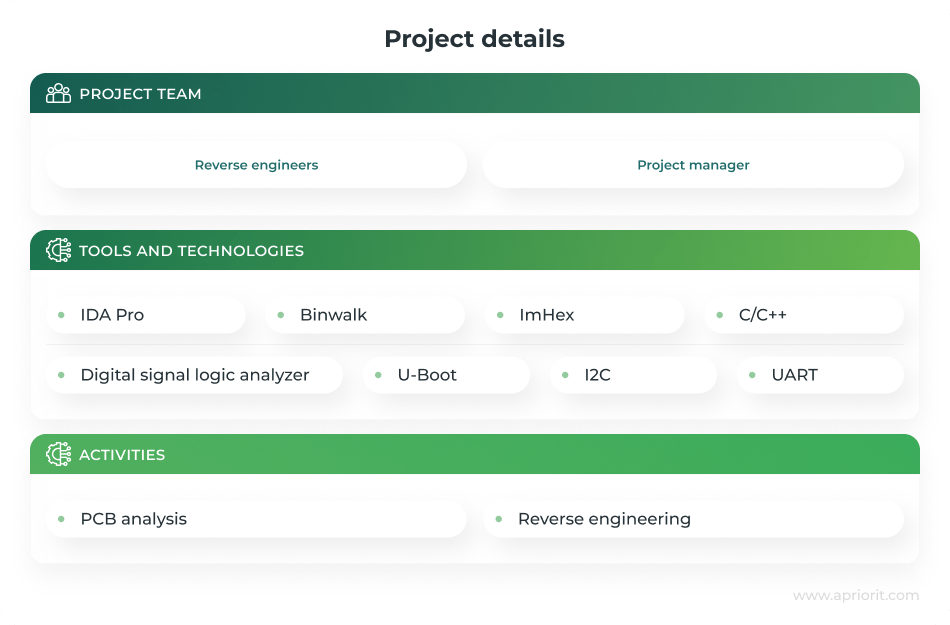
To do this, the client needed to analyze the communication protocol between the customer’s router and their SFP module and find a way to ensure connectivity. Since such expertise is rare, they started looking for a vendor capable of overcoming non-trivial engineering challenges. Apriorit was their top choice for PCB analysis and reverse engineering.
The result
By ethically reverse engineering the communication protocol, the Apriorit team identified the exact conditions under which the router accepted or rejected SFP modules. Based on that, we provided the client with recommendations for adapting their firmware to ensure compatibility with their customer’s devices.
As a result, the client established interoperability between their SFP modules and the customer’s routers.
Here are the key results our client received:
✔ Identification of hardware components and interfaces involved in module–router communication
✔ Analysis of vendor-specific protocol behavior and constraints
✔ Detailed recommendations for firmware modifications to ensure compatibility
✔ Ongoing consultations and support for implementation and validation
✔ A proof of concept (PoC) demonstrating the feasibility of the proposed solution
How we did it
After discussing the client’s needs for this project, we agreed to collaborate under the time and materials model.
Throughout the one-month project, Apriorit provided preliminary results and discussed next steps with the client’s team via emails and sync calls.
Stage 1
Apriorit’s team analyzed the router and identified components responsible for communication.
While analyzing communication on UART port lines and I2C, we reversed the handling of vendor-specific commands. This allowed us to understand why the client’s module originally failed to connect to the specific router.
Our team offered a way to modify the client’s firmware for the SFP module to ensure proper compatibility with the customer’s routers.
Stage 2
After we delivered our initial solution, the client validated it with their customer. However, the customer couldn’t reproduce the fix for some reason. So, the client came back with additional questions and research requests to ensure everything worked properly for the end customer.
Apriorit’s team assisted with all questions and helped to resolve remaining issues.
Stage 3
Finally, we conducted a demo of SFP customization for the client’s team. Our engineers presented the proof of concept and showed how to use the implemented solution.
Together with our client, we verified the implemented fixes and made sure everything worked as promised.
The impact
By adapting their SFP modules with our guidance, the client eliminated a critical compatibility barrier and managed to establish a connection with customer devices. This allowed them to proceed with component delivery without redesigning their hardware from scratch or compromising on product functionality.
As a result, the client:
- Successfully fulfilled a technically challenging customer requirement, avoiding potential project delays or contract risks
- Strengthened their ability to support non-standard networking environments
- Maintained their reputation as a reliable telecom solutions provider capable of handling complex integration scenarios
Additionally, the insights gained from Apriorit’s analysis can now be reused in future projects, enabling our client to accelerate similar interoperability efforts and reduce engineering uncertainty when working with vendor-specific devices.
Solve complex firmware compatibility challenges with Apriorit
Reach out to get expert help in seamlessly integrating with custom, proprietary, or undocumented devices.