
 Skip to main content


Key takeaways:
- Emerging technologies will allow healthcare organizations to continue addressing a lack of medical professionals and the need to provide services to more patients in more areas.
- In 2026, adoption of AI will only increase, as healthcare companies will use it for diagnostics, research, and paperwork automation.
- Care providers will also invest in IoMT and robotics, both for automating care and conducting procedures that require surgical accuracy.
- VR, digital twins, and brain–computer interfaces are gradually moving from concept to reality, though their use in 2026 will remain limited.
- Cost and security are the key concerns when adopting new tech in healthcare.
With an ever-increasing number of patients, challenging medical cases, and a lack of professionals, the healthcare industry can no longer stand still.
Industry leaders agree: 45% of non-US health system executives name care model transformation as the leading trend for the healthcare industry in 2026. Artificial intelligence (AI), big data, robotics automation, and other technologies allow medical providers to change the way they provide care and manage medical facilities.
However, implementing new technology is expensive and time-consuming. Almost 70% of medical insurers report the cost of new medical technologies as the top driver of the cost of medical services. That’s why medical providers should thoroughly assess healthcare technology trends and consider real-life use cases before adoption.
At Apriorit, we have helped many healthcare clients benefit from custom cutting-edge solutions. In this article, our experts share their vision of key healthcare trends and how technology will continue transforming healthcare in 2026.
This article will be useful for healthcare IT professionals researching healthcare tech trends and looking for ways to make their products and services more competitive.
Contents:
1. Mass adoption of regulated AI models
Healthcare software developers and service providers already rely on artificial intelligence to analyze medical images, predict patient outcomes, support clinical decision-making, and carry out other tasks. MarketsAndMarkets estimated the value of the global AI medical market at $21.7B in 2025 and forecasts it to reach $110.6B by 2030.
It has become clear that AI is already reshaping the way care is delivered. It helps address some of the industry’s most pressing issues, such as operational efficiency, patient engagement, and personalized medicine. However, in previous years, healthcare organizations have adopted AI sporadically.
In 2025, we saw the implementation of the EU AI Act as well as the publication of guidelines by the US Food & Drug Administration on the use of artificial intelligence to support regulatory decision-making for drug and biological products. These and other mechanisms enforce strict rules for the security and transparency of AI-based healthcare solutions, as well as costly fines for distributing or using a non-compliant solution. For example, breaking the rules of the EU AI Act can cost a company up to €35 million or 7% of global annual turnover.
Fines and regulations will not deter healthcare companies from using AI. But in 2026, companies will look for solutions designed to accommodate new and emerging requirements.
We expect to see increased AI adoption in these areas of healthcare:
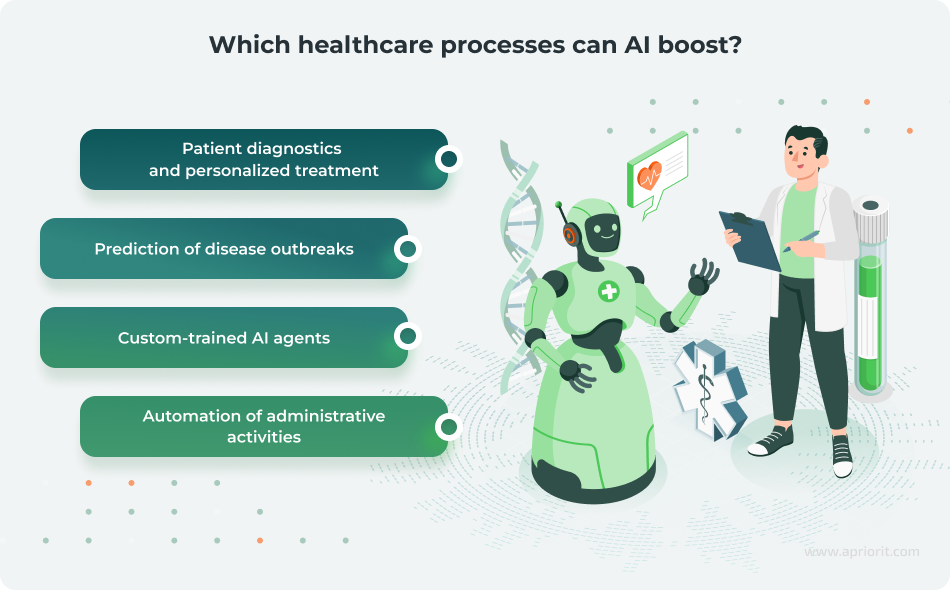
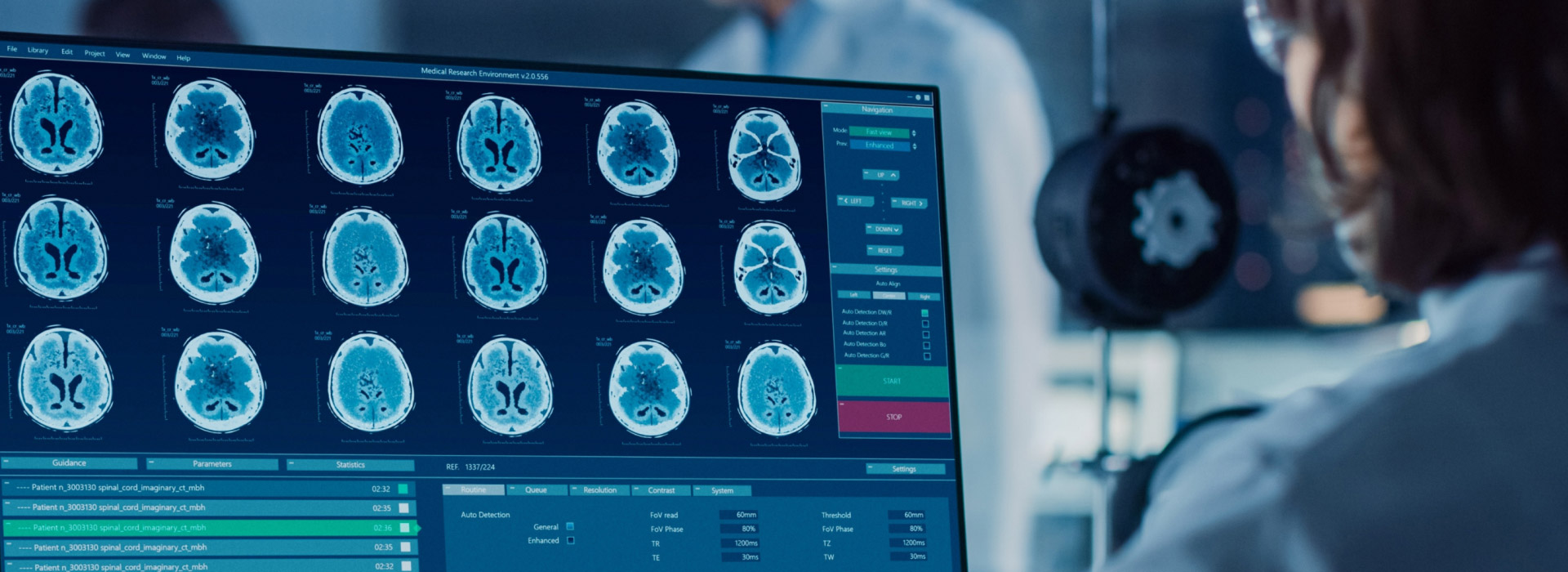
Patient diagnostics and personalized treatment. AI algorithms can analyze imaging, laboratory results, genetic information, and other patient data to identify diseases earlier and with higher accuracy than was previously possible. AI-based tools have been particularly successful in radiology, pathology, and early detection of cancer and heart disease.
AI solutions help medical organizations better understand and use the data they collect, improving the quality of care with tailored and unbiased decisions. AI remains a tool for medical professionals, not a replacement for human judgment. By handling data processing, AI allows clinicians to spend more time with patients and less time with paperwork.
Custom-trained AI agents. Unlike AI solutions that generate predictions or insights on demand, AI agents can autonomously manage multi-step workflows across clinical and administrative systems. They act as 24/7 helpers for medical professionals and administrators.
Custom training of AI agents allows companies to adjust AI models to local clinical protocols, care pathways, EHR structures, and regulatory constraints. When trained on institution-specific data, AI agents can more accurately process data and more effectively automate complex processes without removing human control from critical medical decisions.
Prediction of disease outbreaks. In a globalized world, disease outbreaks not only threaten local communities but can affect the whole planet. AI-powered predictive analytics can provide governments, healthcare organizations, and public health agencies with valuable lead time to prepare resources, inform the public, and implement containment measures.
Notably, this capability was beneficial during the COVID-19 pandemic, when AI-driven models helped track the virus’s spread and forecast case surges.
Automation of administrative activities. AI already helps doctors and hospital administrators reduce time spent on paperwork by managing scheduling and payments and by filling out insurance claims. But there are a lot more ways AI can help them use their time more efficiently.
Administrative automation can help address staffing shortages by increasing the operational efficiency of healthcare facilities and optimizing resource allocation. When integrated with electronic health record (EHR) systems, automation will also reduce the burden on administrative personnel and reduce instances of human error.
Read also
Healthcare Software Development: Challenges and Solutions
See how addressing security, compliance, and integration issues early helps healthcare software projects succeed. Learn proven approaches for building robust and regulation-ready healthcare solutions.
2. Care automation with IoT and robotics
Using smart devices and robots already allows healthcare providers to improve the quality and reach of their services. Aided by sensors and cameras, providers can automate routine tasks like patient monitoring and provide care to patients in remote areas.
Internet of Medical Things (IoMT) devices enable effective and consistent care, particularly for those with chronic conditions or mobility limitations, while reducing the number of non-complex and non-emergency hospital visits. On top of that, robotics systems in hospitals help medical professionals partially automate and speed up diagnostics, surgery, rehabilitation, and other activities that require accuracy and constant attention.
Here are the key use cases of this healthcare IT trend to look out for in 2026:
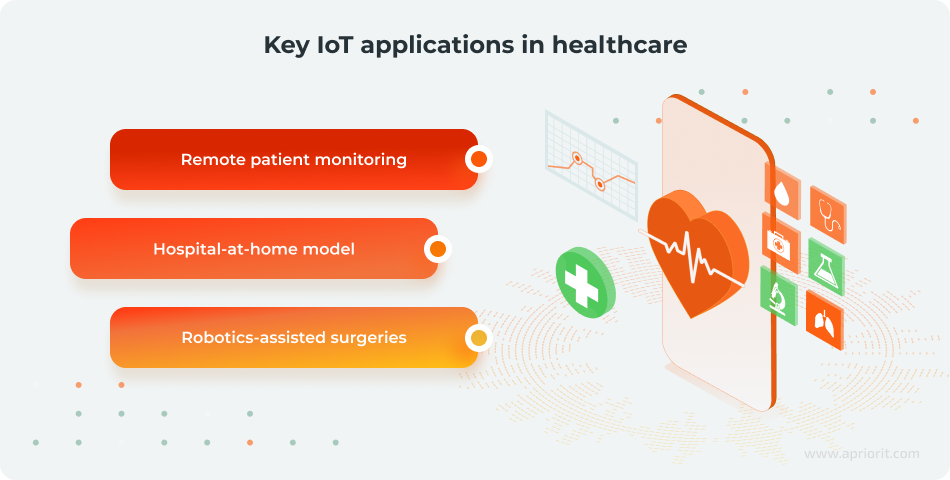
Remote patient monitoring (RPM). RPM uses IoT devices like smartwatches, glucose monitors, and insulin pumps to collect real-time health data from patients, track their condition, and prepare doctors for remote consultations without frequent in-person visits.
In 2025, RPM will likely incorporate more sensitive IoMT devices like smart prosthetics and implantable cardiac monitors. Such devices are capable of collecting additional metrics and detecting subtle changes in a patient’s health. Enhanced algorithms will allow IoT devices to adapt their monitoring frequency based on real-time data, promptly alerting providers of potential issues.
Hospital-at-home model. The hospital-at-home, or care-at-home, model leverages remote patient monitoring and IoT-enabled devices to deliver hospital-level care in patients’ homes. Providers can offer this model to patients who require close monitoring but don’t need to be in a hospital.
IoT devices such as blood pressure monitors, ECG machines, and oxygen level sensors can continuously collect data, enabling healthcare providers to respond quickly to any issues. Telemedicine platforms can support regular virtual check-ins, while mobile care teams can visit patients to provide more hands-on care if needed.
Robotics-assisted surgeries. Devices like robotic arms and the da Vinci Surgical System have been an integral part of modern operating theaters for years. Now, the convergence of advanced embedded devices, connectivity, and AI is enabling the development of new robotics systems that will further enhance surgeons’ abilities.
For example, these technological advances enable robot-assisted cataract surgeries, urologic procedures, and precision dissection. Robotics systems help surgeons conduct procedures faster, make them less invasive, and ease patient recovery. It’s only a matter of time until patients start looking for medical providers that heavily rely on robotics.
Read also
Medical Device Software Development 101: Types, Use Cases, and Software Development Tips
Discover key requirements and best practices for developing medical device software that meets regulatory standards and ensures patient safety.

3. Precision medicine based on big data and data analytics
Adoption of AI, IoMT, and robotics solutions calls for collecting terabytes of data on patients, medical procedures, devices, and administrative activities. This data not only enables day-to-day operations of healthcare organizations but also allows them to conduct deep research and provide personalized treatment.
Key applications of big data technologies in healthcare will include:
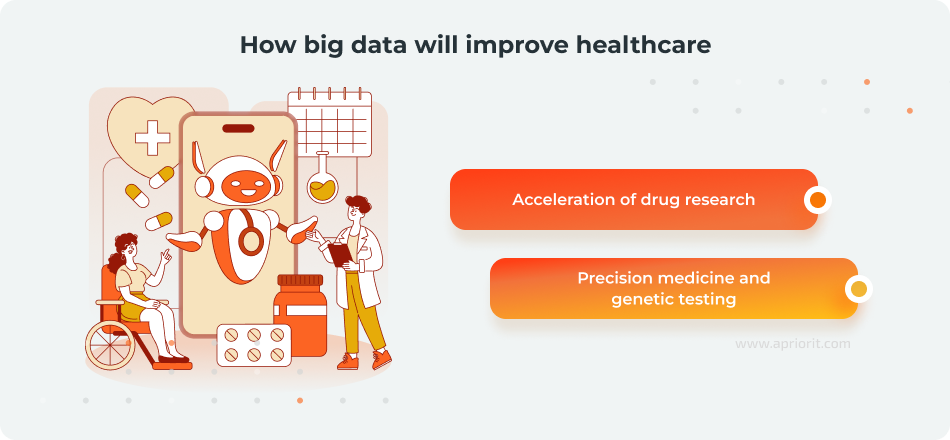
Acceleration of drug research. Big data is streamlining drug discovery by allowing researchers to efficiently analyze massive datasets. AI algorithms and predictive analytics can mine data for insights, enabling researchers to shorten development timelines and focus resources on the most promising treatments.
Improved data sharing platforms enable researchers across institutions and countries to collaborate on large datasets, accelerating breakthroughs. These innovations in data-driven research will lead to faster drug discovery and a quicker response to emerging health crises.
Precision medicine and genetic testing. Precision medicine allows healthcare providers to analyze patient information on a granular level, from genetic profiles to lifestyle factors, supporting the development of treatments tailored to individual patients. By analyzing extensive genetic data alongside patient records, doctors can identify the most effective treatments for each patient, particularly for complex diseases like cancer, where genetic variations greatly influence how patients respond.
In the future, precision medicine will incorporate not only genetic information but also lifestyle, diet, and environmental exposure data. Advanced analytics will allow healthcare providers to identify increasingly specific biomarkers. This evolution will enable personalized and effective treatment plans with fewer side effects.
Related project
Developing and Supporting a CRM System for a Medical Transportation Company
Explore how we helped our US-based client align their existing CRM system with HIPAA requirements, optimize existing code, and add new features to make their business more competitive.

4. Integration of VR and AR into medical workflows
The COVID-19 pandemic boosted the adoption of virtual reality (VR) and augmented reality (AR), as these technologies support remote care and telemedicine. After the pandemic ended and patients returned to in-person visits, the market for AR and VR continued to grow. However, the application of these technologies has shifted to specific use cases such as training and education for doctors and patients.
Here’s how AR and VR are used by healthcare professionals in 2026:
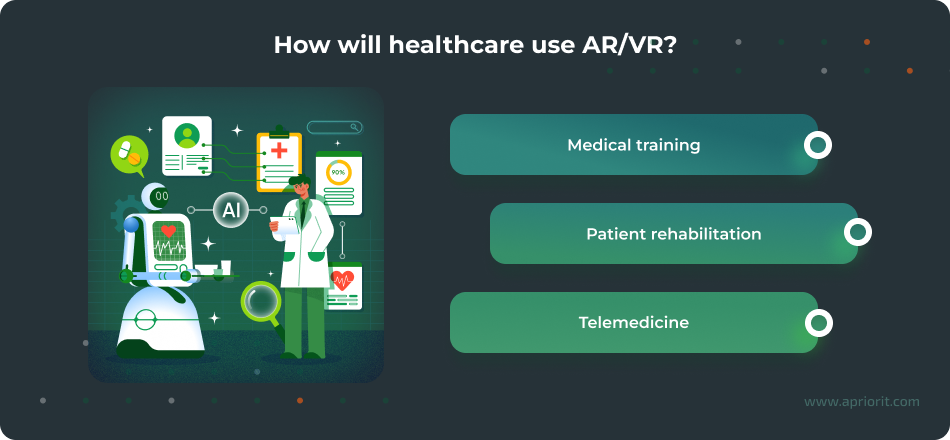
Medical training. Through virtual simulations, medical students, surgeons, and other healthcare professionals can practice complex procedures, gaining hands-on experience while reducing training costs and the risk of harming actual patients.
VR surgical simulations allow trainees to practice procedures repeatedly and receive instant feedback. AR can project digital overlays onto physical models, helping practitioners better understand anatomy and improving spatial awareness during surgery. As virtual and augmented reality technologies advance, they will provide increasingly realistic simulations that prepare healthcare professionals for real-world challenges.
Patient rehabilitation. VR environments can simulate activities that help patients regain movement and strength following an injury or surgery. Using VR is one of the health technology trends as VR therapy immerses patients in controlled environments where they can confront and manage fears, anxieties, or trauma under the guidance of mental health professionals.
Such applications of augmented and virtual reality tools can speed up recovery and help patients understand and adhere to treatment plans while requiring less in-person time with their doctors.
Telemedicine. AR/VR allows healthcare providers to enhance communication with patients and observe patients’ physical conditions more closely, improving the quality of remote care.
AR also supports telemedicine by enhancing remote diagnostics and guidance. For example, AR can project a doctor’s instructions onto the screen of a patient’s device in real time, helping the patient follow complex instructions during a video consultation. Or remote specialists can guide local healthcare providers through procedures by overlaying step-by-step visuals onto their field of vision. Such use cases could help healthcare providers address the growing need for accessible care, especially in rural and underserved areas.
Related project
Developing Drivers for Low Latency Virtual Reality Headsets
Explore the story of our client who builds VR headsets for professional use, including for healthcare training. We helped the company develop custom drivers that allow their devices to operate with 3–10 ms of latency and provide realistic experiences to end users.
Niche IT healthcare trends to watch for
While AI analytics, robotics automation, and improved data security are among the top healthcare technology trends, some organizations require rarer tech to accommodate their unique needs. For example, research departments of pharmaceutical companies need strong and accurate research tools, and treatment of certain rare disorders requires deeper human–computer integrations than an average patient will ever need.
In 2026, healthcare organizations will invest in researching and testing:
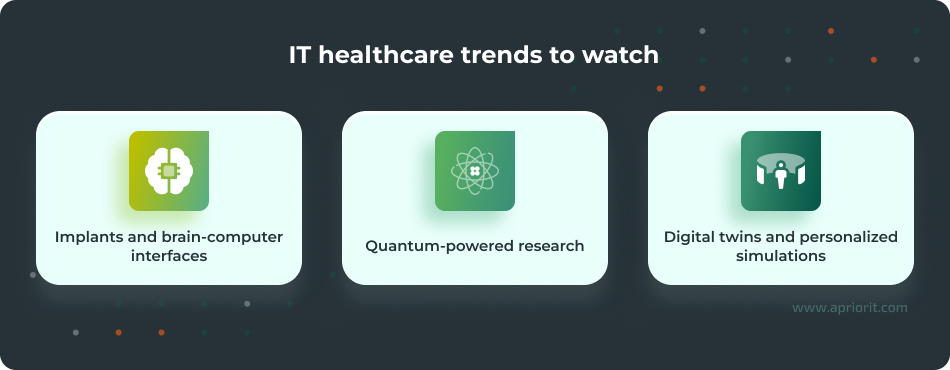
Implants and brain–computer interfaces (BCIs). Brain–computer interfaces enable direct communication between the human brain and digital systems by translating neural signals into machine-readable commands. Advancements in sensor precision, wireless connectivity, and miniaturization are making BCIs more practical for healthcare use.
These technologies are increasingly applied in neurorehabilitation, assistive communication for patients with paralysis, and recovery after stroke or brain injury. For example, Stentrode, a minimally invasive device, enables patients with motor impairment to interact with devices such as laptops and smartphones, thus improving their quality of life and potentially avoiding open brain surgery. As integration with cloud platforms and AI improves, BCIs are becoming more accessible and adaptable to individual patient needs.
Quantum-powered research. By modeling biological and chemical systems at the quantum level, researchers get more accurate and faster simulations of protein structures, drug interactions, and genetic processes. This approach has the potential to accelerate drug discovery and support the development of personalized therapies.
Although adoption is still in its early stages, quantum-powered research is expected to influence pharmaceutical development and biomedical science in the coming years.
Digital twins and personalized simulations. Traditionally, digital twins are virtual replicas used for predictive analytics, monitoring, and maintenance of machinery. Gathering patient data from wearables, medical devices, and electronic health records, healthcare providers can build digital twins of their patients. These models are continuously updated to reflect changes in a patient’s condition, lifestyle, and environment.
Digital twins can help healthcare providers simulate treatment outcomes, predict disease progression, and be proactive with care plans.
Implementing any modern technology is costly and risky for healthcare providers. Not only are an organization’s reputation and finances at stake — technology errors can lead to incorrect treatment and harm to patients. That’s why at Apriorit, we help healthcare clients build custom solutions that work alongside their medical professionals. With our development assistance, clients get modern systems that fit their organization’s budget, specific use cases, and compliance requirements.
How Apriorit can help you benefit from technology trends
Apriorit has been working with healthcare providers for years, helping them build modern, secure, and compliant solutions. We provide our clients with full-cycle development, from project research and requirements elicitation all the way to post-release maintenance.
Our development and QA experts care about the balance between cutting-edge and proven technologies, focusing on delivering solutions that fit the particular needs of your business.
Some of our recent healthcare development projects include:
Case 1. A custom NLP model for analyzing medical reports
An international medical research organization asked us to build a custom NLP tool for data processing and analysis. Speed and accuracy of analytics mean everything to the client’s business, so the requirements for this internal tool were high.
The Apriorit team delivered a tool that:
- Satisfied the client’s requirements for security and data processing practices
- Extracted valuable data from reports in PDF and XML formats
- Analyzed and summarized scientific reports and medical research with over 92.8% accuracy
Case 2. An AI-powered LMS module that improves training efficiency
Employee education and professional training are core values for a global pharmaceutical company. To help their employees grow, they decided to integrate an AI module for personalized training into their existing learning management system (LMS).
By collaborating with Apriorit, our client received:
- AI-generated personalized learning plans for each employee that helped increase course completion rates by 35% compared to the previous LMS
- A scalable module capable of supporting 1,000+ concurrent users
- A GDPR-compliant module that securely manages employee data
Case 3. A CRM system for medical transportation
Our client was pushing their development limits with the maintenance of their internal custom CRM and decided to look for outside expertise. Apriorit experts improved the CRM to bring it up to modern cybersecurity and usability standards.
In particular, modernization allowed our client to:
- Move their business platform from a desktop application to a web portal
- Optimize CRM performance and improve response times
- Improve HIPAA compliance with a new access control system
- Reduce the average call handling time
To make sure your sensitive health records are well-protected at all times, we introduce a secure SDLC approach to our projects. This helps us ensure data security and achieve compliance with laws and regulations like HIPAA and the GDPR.
Looking for ways to enhance your IT solutions?
Partner with Apriorit to leverage new technologies while staying compliant and protected.
FAQ
How should healthcare organizations prioritize which emerging technologies to invest in first?
<p>Start by aligning technology investments with patient safety, compliance, and operational efficiency. Prioritize trends that address regulatory requirements (HIPAA, GDPR), improve data security, and enhance care delivery. You should also evaluate ROI, scalability, and interoperability with existing systems. </p>
<p>Common starting points include cloud migration, telehealth platforms, and AI-driven analytics for clinical decision support. Use a risk-based approach: focus on technologies that reduce costs, improve outcomes, and meet compliance requirements before exploring emerging innovations like robotics or blockchain.</p>
Which cybersecurity controls are must-haves for healthcare IT in 2026?
<p>Essential controls include zero trust architecture, multi-factor authentication, data encryption (at rest and in transit), and continuous threat monitoring. It’s also important to implement endpoint detection and response, network segmentation, and secure access for remote staff. </p>
<p>If you’re not sure which controls suit your organization best, consider following HIPAA, NIST, and ISO 27001 requirements. They outline reliable cybersecurity frameworks for healthcare to ensure resilience against common attacks and data breaches.</p>
What are the biggest risks of using AI with patient data?
<p>While using AI in healthcare automates and speeds up care provision, it also introduces significant risks around privacy, security, and the ethical use of patients’ and doctors’ data. Poorly protected AI models can be hacked or manipulated, leading to data leaks and distortions.</p>
<p>Another major concern is algorithmic bias. AI models trained on incomplete or skewed datasets may produce inaccurate diagnoses or unequal treatment outcomes. Additionally, lack of transparency in AI decision-making (the “black box” problem) can make it hard for clinicians to validate recommendations, impacting patient trust and safety. </p>
<p>To mitigate these risks, consider implementing data anonymization, robust encryption, and audit trails. Regular bias testing and compliance with ethical AI frameworks are essential to ensure fairness and accountability.</p>
What’s the difference between telehealth and a virtual hospital?
<p>Telehealth is a broad term for remote healthcare services, including video consultations, remote monitoring, and digital prescriptions. It typically supports outpatient care and short-term interactions.</p>
<p>A virtual hospital replicates the functions of a physical hospital in a digital environment. It offers continuous care, often for chronic conditions or post-surgical recovery, using connected medical devices, real-time data monitoring, and medical teams available 24/7. Virtual hospitals integrate advanced technologies like AI-driven diagnostics, remote imaging, and robotic assistance.</p>
How is robotics being used in healthcare beyond robot-assisted surgery?
<p>Robotics has a variety of applications in healthcare:</p>
<ul class=apriorit-list-markers-green>
<li>Hospital and pharmacy logistics, such as delivering medications, linens, and supplies, reducing staff workload and risk of infection</li>
<li>Maintaining sterile environments with disinfection robots equipped with UV lights or chemical sprayers</li>
<li>Rehabilitation using exoskeletons that assist patients recovering from stroke or spinal injury</li>
</ul>
<p>Using robots in these and many other cases helps medical professionals partially automate manual work, increase their efficiency, and deliver better care to patients.</p>
Have a question?
Ask our expert!

VP of Innovation and Technology, Canada Branch Director