
 Skip to main content
Key takeaways:
- Off-the-shelf AI agents often can’t meet enterprise needs, as they lack the security, customization, and scalability required for complex sales ecosystems.
- With a custom AI sales agent, you can achieve proper data protection, efficient automation of your unique sales processes, and seamless integrations.
- Building your own agent requires careful planning: defining business goals, mapping workflows, preparing quality data, and choosing the right LLMs and frameworks.
- Partnering with an experienced AI team helps you tackle challenges like complex integrations, model tuning, and compliance, ensuring your agent scales securely without sacrificing performance.
When the sales team is buried under repetitive tasks, lead response times are slipping, and scaling headcount is too expensive, a business starts looking for solutions. AI sales agents offer a fix — and many ready-made solutions deliver quick wins for smaller businesses.
But for enterprises dealing with sensitive data, complex sales cycles, or strict compliance requirements, off-the-shelf tools often fall short. Limited customization, data privacy concerns, and shallow integrations can turn a convenient solution into a risky one.
In this article, we explore why building a custom AI sales agent can be a smarter long-term move for enterprises. You’ll learn how a tailored system can meet your specific security, scalability, and integration needs — and why the initial investment can pay off in sustainable sales performance and operational control.
This article will be useful for sales team leaders and product managers who are looking for a way to automate their sales processes in the long term and boost business growth by reducing the manual workload for their sales teams.
Contents:
- What is an AI sales agent?
- The good and bad of ready-made AI agents
- Why your business may need a custom AI sales agent
- Сore components of a custom AI sales agent
- Challenges of developing a custom AI agent
- How to build an AI agent for your business
- Cost and timeline of developing an AI sales agent
- How Apriorit can help you build an AI sales agent from scratch
- Conclusion
What is an AI sales agent?
An AI sales agent is an intelligent system powered by a large language model (LLM) that can understand, communicate, and take action to support or automate parts of the sales process.
Unlike traditional chatbots, AI agents don’t just respond to questions — they can reason, access data, and perform multi-step tasks. Thus, they can automate processes such as qualifying leads, scheduling meetings, and updating CRM records.
By combining natural language understanding with automation, AI sales agents help teams scale without expanding headcount, improve response times, and deliver personalized communication across channels.
There are many benefits of AI agents in sales: they offer 24/7 availability, scalability, and cost-efficiency while delivering personalized interactions that boost conversions and revenue. They also learn from data and continuously adapt, making your sales process smarter and more effective over time.
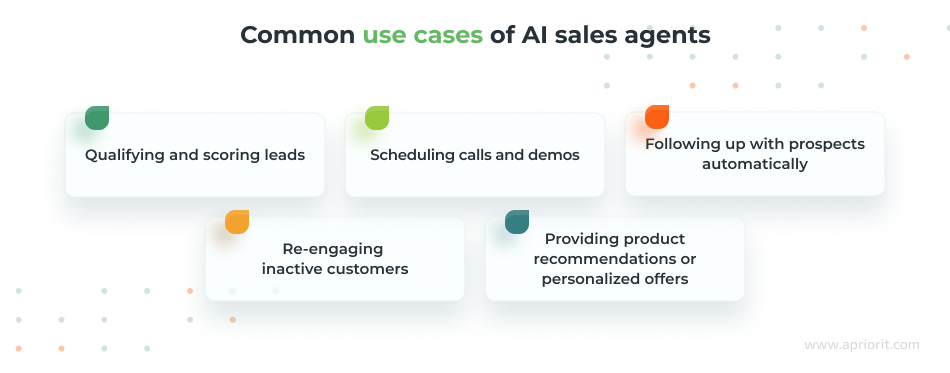
How can you get a powerful AI agent for your sales team?
There are two main paths: using a ready-made AI agent or building a custom AI agent designed specifically for your business needs.
Most organizations start with a commercially available solution, as ready-made agents are faster to deploy and require less technical effort. Let’s take a look at how they work and what they offer.
Want to power your sales team with AI?
Automate your sales processes securely by developing your own AI sales agent that integrates seamlessly into and grows with your organization.
The good and bad of ready-made AI agents
Many companies like Zoho, HubSpot, Clay, and Salesforce build AI agents for sales. They make it easy for businesses to adopt AI in sales, usually providing ways to set up sales workflows without coding. SaaS products by these companies come with pre-integrated features, dashboards, and automation capabilities.
Let’s talk about their pros and cons.
The good:
- Fast deployment. AI sales agents can be launched much faster than a custom solution built from scratch. Since the core functionality is already in place, you only need to configure integrations and train the agent on your specific sales data to start seeing results.
- Pre-integrated features. Depending on the platform you choose, you’ll have a different set of features, but almost all platforms give you instant access to a CRM, chat, analytics, and automation.
- Minimal technical expertise required. You don’t need to hire AI engineers, data scientists, and developers to use a ready solution. Most require minimal to no coding to set up sales processes.
- Low upfront costs. Because you don’t need to build the system itself, you can start with a free trial or a monthly subscription to try the service out.
The bad:
- Recurring costs. Subscription fees may not sound like a lot for small and medium-sized businesses, but for enterprises, they start from $12–15K per year, which becomes costly at scale.
- Limited control. Many platforms rely on predefined funnels and workflows, which can make it difficult to adapt or customize your AI agent when you want to optimize or change your sales processes.
- Data and security constraints. With a ready-made solution, you rely on the vendor’s infrastructure and policies, which can be a concern if your enterprise handles sensitive data.
- Compliance gaps. Ready-made tools rarely account for industry-specific regulations or complex internal security protocols. Avoiding compliance gaps is especially critical if your business operates in a heavily regulated industry such as finance, healthcare, or cybersecurity.
Off-the-shelf AI agents offer speed and simplicity — but at the cost of flexibility, ownership, and long-term control. When commercially available AI agents can’t meet your compliance, security, or scaling needs, it may be time to build your own solution.
Read also
Top LLM Use Cases for Business: Real-Life Examples and Adoption Considerations
Find out how you can benefit from large language models and what to consider before adopting them.

Why your business may need a custom AI sales agent
Large businesses often have complex sales processes, strict compliance standards, and high customer volumes that a ready-made solution simply can’t handle. Going without automation altogether isn’t an option, however, as hiring more sales specialists can quickly become too expensive.
A custom AI sales agent gives you full control over data, performance, and functionality so you can adjust it to your business, not the other way around. Let’s discuss the advantages of a custom AI sales agent.
1. Compliance and data privacy
Out-of-the-box chatbots often store customer conversations on third-party servers — a major concern for industries like FinTech, banking, and e-commerce, where data privacy and regulatory compliance are critical. A custom AI agent can be hosted on your company’s secure infrastructure, ensuring customer data never leaves your environment and ensuring compliance with the GDPR, SOC 2, PCI DSS, and other laws, regulations, and standards.
2. Integration and workflow continuity
A custom-built AI agent can connect seamlessly with all your existing systems — from internal databases to analytics dashboards — and even trigger custom sales workflows or API calls that off-the-shelf agents can’t handle. Moreover, if your business relies on a legacy CRM or unconventional data formats, a custom solution can ensure compatibility so that nothing is left out of your sales ecosystem.
3. Security of AI models and APIs
Every AI model or API connection can be an attack vector. Common risks include prompt injection, model manipulation, and API abuse that can lead to data exposure or biased outputs. With a custom AI agent, you can implement enterprise-grade security controls, monitor model behavior, and isolate sensitive operations within your own environment.
4. Scalability and performance
As your business scales, your AI system needs to handle thousands of simultaneous interactions across channels (for example, web chat, email, and WhatsApp) without downtime. Many commercial solutions throttle performance or charge per interaction. A custom solution gives you the freedom to optimize for high load, auto-scale infrastructure, and maintain consistent performance under pressure.
5. Consistency of brand voice
Generic AI agents often sound impersonal or inconsistent. A custom-built agent can be fine-tuned on your brand tone, sales scripts, and regulatory communication guidelines, ensuring every message sounds like it came from your company.
6. Cost of ownership
While ready-made agents appear cheaper up front, hidden expenses — from licensing and per-seat fees to customization and scalability limitations — add up fast. A custom solution requires higher initial investment, but it eliminates recurring costs and provides long-term ROI by giving you full ownership of the system and its data.
Table 1. Ready-made vs custom AI sales agents
| Aspect | Ready-made | Custom |
|---|---|---|
| Data control | Low | High |
| Integration flexibility | Limited flexibility | Fully customizable |
| Compliance & security | Platform-dependent | Fully controlled |
| Scalability | Moderate | High |
| Brand consistency | No control (generic) | Full control |
| Long-term cost | Recurring fees | One-time + maintenance |
| Personalization | Limited | Extensive |
Consider building a custom AI sales agent if your business:
- Is an enterprise with high sales volumes
- Works in a heavily regulated industry such as finance, healthcare, or insurance
- Handles sensitive or proprietary data that can’t be shared with third-party platforms
- Needs full control over data storage, compliance, and security frameworks
- Requires deep integration with legacy or custom-built systems (CRM, ERP, or proprietary databases)
- Needs custom workflows and sales logic that standard agents can’t replicate
- Requires the agent to operate under your company’s brand voice and UX, not a generic agent interface
- Needs multi-agent orchestration — e.g., specialized agents for lead scoring, outreach, and analytics
- Has proprietary data that the agent should be trained on, such as product catalogs, compliance documentation, or sales scripts
- Requires on-premises or private cloud deployment for full infrastructure control
- Needs a high level of customization (e.g., new tools, channels, or data sources) that is impossible with vendor restrictions
- Aims to differentiate your customer experience through advanced personalization or AI-driven insights
How can you build an AI sales agent?
Building a custom AI sales agent requires careful planning and the right technological foundation. To understand what goes into creating an agent, let’s break down an agent into its core components.
Read also
How to Create a Custom AI Chatbot: Key Features, Costs, and Time Estimates
Learn how a custom AI chatbot can maximize your conversions and bring you superior security and compliance — and what it takes to build one.

Сore components of a custom AI sales agent
The architecture of your custom AI agent will depend on the use cases you’d like it to cover. It can be as simple as an AI chatbot with the ability to perform basic actions or as complex as a fully-fledged multipurpose agent that automates a large part of your sales processes.
Let’s go over the most common components of a mid-complexity AI sales agent.
1. Backend layer
The back end powers the agent’s intelligence, reasoning, and decision-making, enabling it to understand language, access knowledge, and manage workflows. It consists of these components:
- Large language model (LLM). This is the brain of the agent, responsible for understanding and generating natural language. Commonly used LLMs include OpenAI’s GPT-4, Anthropic’s Claude, Google’s Gemini, and Meta’s LLaMA series. These models can be fine-tuned or connected via frameworks to handle enterprise-specific tasks and knowledge.
- Agent framework. This component connects the LLM to tools, workflows, and data sources. The most popular frameworks are LangChain, LlamaIndex, and Semantic Kernel. They differ in their functionality, scalability, and complexity, so it’s important to choose an appropriate framework for your specific solution.
- Memory systems. This component stores session context and long-term knowledge so that your agent can access relevant information during conversations. Often, AI agents use retrieval-augmented generation (RAG), which allows the agent to dynamically retrieve facts from documents, databases, or knowledge bases instead of relying solely on the general knowledge of the LLM.
- Task and workflow management. This part of your AI agent is responsible for orchestrating multi-step sales processes, from lead capture to conversion, by combining automation, rules, and AI-driven decision-making. It ensures that every step happens smoothly and efficiently.
2. Integration and data layer
This layer connects the AI agent to business systems, external tools, and automation triggers, ensuring a seamless flow of data across the organization.
- APIs and tool access. This component allows your AI agent to take meaningful actions automatically, such as updating CRM records, triggering workflows, or interacting with other enterprise tools. It enables the agent to move beyond conversation and perform real tasks.
- Webhooks and automation triggers. This part of the system enables real-time responses to events such as the creation of new leads, ticket updates, or order changes. Webhooks allow the AI agent to automatically respond to business events without human intervention.
- Platform integrations. This component connects the AI agent to enterprise systems and third-party platforms, ensuring seamless data flow and workflow continuity. Examples include:
- CRM systems (HubSpot, Salesforce)
- Marketing and analytics tools (Mailchimp, Google Analytics)
- ERP systems (Oracle, SAP)
- Helpdesk platforms (Zendesk, Intercom)
3. Frontend interaction layer
The front end handles how the agent communicates with users and other systems, delivering personalized and consistent experiences across channels.
- Natural language generation (NLG). This component allows your AI agent to produce human-like responses tailored to user intent and brand voice. It ensures that every interaction feels natural and personalized, improving engagement and conversions.
- Communication protocols. This part of the system defines how the AI agent exchanges data with users and other systems, using protocols such as REST, WebSockets, or gRPC. These protocols enable reliable, real-time interactions across multiple platforms.
- User channels. This component determines where your AI agent can interact with users, including website chat widgets, messaging apps (e.g., WhatsApp, Telegram, Facebook Messenger), email, phone calls, and internal collaboration tools like Slack or Teams. This way, your agent can reach customers wherever they prefer to communicate.
4. Maintenance and optimization layer
This layer is responsible for the agent’s ongoing reliability, accuracy, and improvement.
- Monitoring and debugging. This component tracks the agent’s behavior, detects errors, and ensures compliance with workflows and standards. It helps maintain reliability and identify issues before they impact users or sales performance.
- Logging and analytics. This part of the system captures interaction data and performance metrics, allowing your team to evaluate the agent’s effectiveness and identify areas for improvement.
- Retraining and performance optimization. This component updates the AI models, incorporates new data, and fine-tunes behavior over time so that your AI agent stays accurate, efficient, and aligned with current business goals.
Depending on your target features and scale of automation, the architecture of an AI sales agent can be simpler than this, or it can be more complex. To better understand what your AI sales agent should look like, consider your goals and needs.
Another important consideration is the challenges of developing a custom AI agent. Let’s talk about what technical nuances you need to be prepared for when building your own AI agent for sales.
Read also
How to Develop Smart Chatbots Using Python: Examples of Developing AI- and ML-Driven Chatbots
Discover how to optimize your business with smart chatbots. Explore two ways of developing chatbots with Python tools.

Challenges of developing a custom AI agent
Building a custom AI sales agent gives you full control and flexibility, but it also comes with significant technical and operational challenges. Below are the key challenges that we have noticed (and worked through) over the years to provide successful and sustainable implementations.
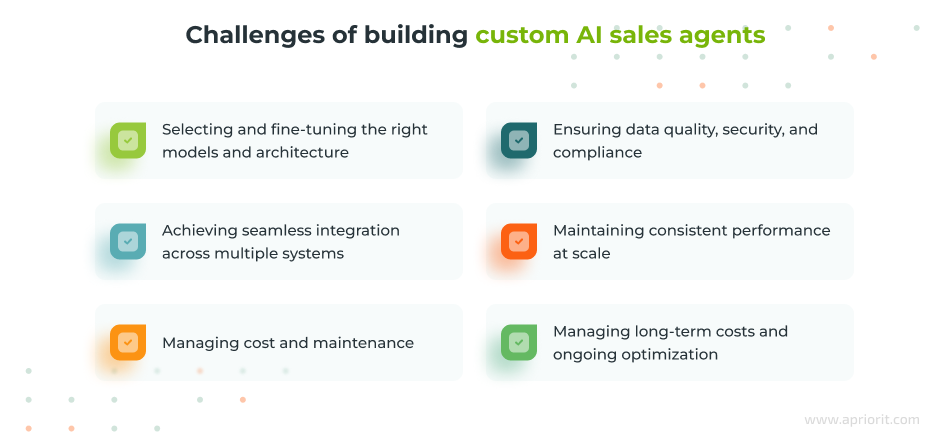
1. Technical complexity
Developing an AI agent involves much more than plugging an LLM into a chatbot interface. It requires deep technical expertise across architecture, prompt design, and model management.
Prompt engineering
Even the most advanced LLMs need precise prompts and guardrails to perform consistently. Without careful design, your AI agent can produce irrelevant or inaccurate responses that damage customer trust. Effective prompt engineering often includes dynamic context injection, fallback prompts, and custom output formatting.
Architecture design
The agent’s architecture determines the scalability, modularity, and maintainability of your solution. To ensure the best results, your development team needs to define how different components (such as memory, API connectors, and RAG pipelines) interact. Poor design decisions at this stage can make later integrations or scaling increasingly complex. As a result, you may need to rework parts of your AI agent to make the necessary changes, which is expensive and time-consuming.
2. Data and knowledge management
AI sales agents are only as smart as the data they’re trained on and have access to. Managing that data effectively and securely is one of the most critical challenges. If you build an AI sales agent, you are responsible for its security, so your team needs to have expertise in that area to protect your solution from external threats.
Data quality and preparation
Collecting data is one of the hardest tasks that most businesses face. Many organizations have disparate data that is duplicated across multiple systems that may use different data formats. Inconsistent or outdated sales data can lead to poor predictions and irrelevant recommendations. Before feeding data to your sales agent, your team needs to clean and structure it.
Security
AI sales agents often process sensitive customer and business data, making strong security measures a must. Protecting your systems requires encryption for data in transit and at rest, secure authentication and access controls, and regular security testing to identify and patch vulnerabilities before they can be exploited.
Compliance
Meeting compliance requirements is one of the toughest parts of building an AI sales agent. Requirements such as the GDPR, HIPAA, and the EU AI Act are complex and constantly evolving, making it difficult to ensure full compliance. Achieving compliance often requires deep legal and technical expertise, extensive documentation, and careful handling of user data.
3. System integrations
The best thing about AI sales agents is their ability to automate processes across platforms. But achieving that automation requires consistent, reliable connections between systems. If your sales pipeline relies on multiple platforms built on different technologies, integration can become a major challenge. However, with a custom AI solution, it’s often easier to design flexible workarounds and build deep integrations than to adapt rigid third-party tools.
Platform connections
Your AI agent must be seamlessly connected to various CRMs and marketing automation tools to avoid data duplication. This often requires developing a custom API that connects various systems that may use different technologies.
Real-time data access
Features like sales recommendations or lead scoring require real-time access to current customer interactions and campaign results. For this, your development team needs to set up secure webhooks or message queues to ensure all data is streamed in the right order.
Multi-channel communication
Customers engage across multiple touchpoints. Your AI agent needs to understand the unified context regardless of the communication channel so that customers don’t need to repeat their requests when switching channels.
4. Performance and reliability
An AI sales agent must deliver fast, accurate, and consistent responses — even under heavy load.
Scalability and performance
Handling thousands of simultaneous customer interactions requires efficient load balancing and model optimization. You may need to use techniques like model quantization or response caching to maintain performance without skyrocketing costs. Also, it’s important to build the AI agent with future growth in mind from the very start so you can scale it without having to rework your architecture down the line.
Monitoring and debugging
AI systems require proactive monitoring to catch hallucinations, API failures, or latency issues. Implementing centralized logging and dashboards allows your technical team to identify and fix issues quickly.
5. Cost and maintenance
Custom AI agents are long-term investments. Their development and upkeep require financial planning beyond the initial build.
Development costs
The initial phase involves data engineering, model setup, and system integration — each requiring skilled professionals. Costs can vary widely depending on the project scope and level of customization.
Infrastructure expenses
Hosting large models, maintaining GPU clusters, and storing vector databases can become costly. Many enterprises adopt a hybrid approach, using on-premises infrastructure for sensitive data and cloud resources for scalability.
Ongoing optimization
AI systems degrade over time without regular retraining and evaluation. To maintain and improve your agent, you need to regularly test it, fine-tune it, update prompts, and retrain on new data. This will ensure your agent stays relevant and compliant as your business evolves.
In the next section, we explore how you can approach building an AI agent for your business, from planning and preparing to building your first PoC or MVP and expanding your agent’s abilities.
Related project
Building AI Text Processing Modules for a Content Management Platform
Discover how the Apriorit team helped our client’s content management platform stay competitive by implementing AI modules that allowed end-users to translate, generate, and format text.

How to build an AI agent for your business
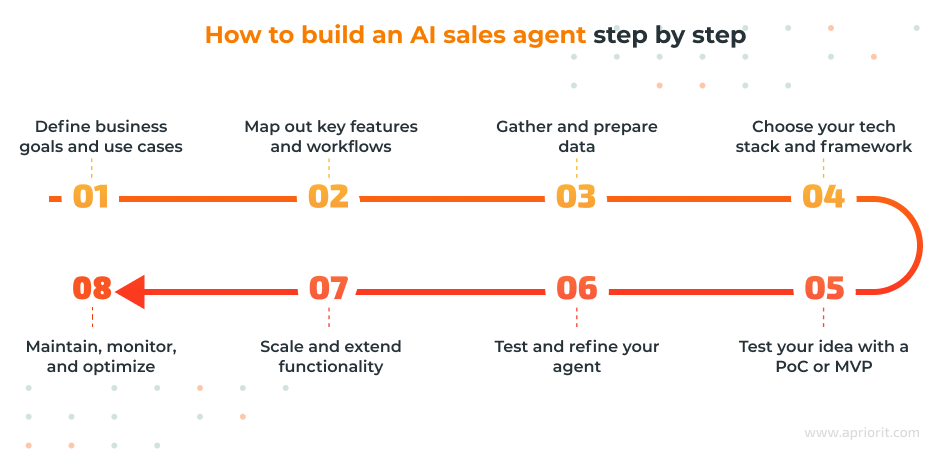
1. Define business goals and use cases
Start by identifying where an AI agent can bring measurable impact — whether it’s qualifying leads faster, improving response times, or reducing the cost of scaling human sales teams. The clearer your use cases, the easier it will be to design task flows and success metrics.
Apriorit tip: Focus on one or two high-value pain points first. For example, it’s easier to measure and scale automating lead qualification or handling inbound sales queries than it is to attempt full-cycle automation right away.
2. Map out key features and workflows
The next step is to translate your goals into actual workflows. For example, it can look like this: lead intake → qualification → CRM update → sales rep notification. Define what actions the agent should take and what data it needs at each step.
Involve your sales team to define their current workflows, then determine which parts of those workflows can be automated and what data and integrations you’ll need for it.
Apriorit tip: Involve your sales team to define their current workflows, then determine which parts can be automated and what data and integrations you’ll need to do so.
If you don’t have an in-house team of technical experts, you can find external IT experts to help you translate your workflows into concrete features and integrations. At Apriorit, we provide AI consulting for exactly that purpose. After you share your business goals and current processes, we’ll give you a comprehensive technical document that contains a full AI implementation roadmap with high-impact use cases and recommendations on the technology stack and architecture of your AI sales agent.
3. Gather and prepare data
Your AI agent is only as good as the data it can access. Collect and structure internal documentation, FAQs, CRM data, and product information into usable knowledge sources.
Prioritize clean, labeled, and current data, as outdated or inconsistent records can lead to incorrect answers or poor lead qualification. Use retrieval-augmented generation (RAG) pipelines to ensure the agent always pulls the latest information.
Apriorit tip: If the data you possess is unstructured or insufficient, we can help you normalize and label it or use synthetic data for training, so it can be used for training your AI sales agent.
4. Choose your technology stack and framework
The next step is selecting a large language model (LLM) such as GPT-4, Claude, Gemini, or LLaMA, along with an agent framework like LangChain, LlamaIndex, or Semantic Kernel to handle orchestration and integrations. The choice of framework and LLM for your agent will influence its performance and compliance, so it’s important to think about this from the start.
Apriorit tip: Depending on your data security requirements, you can decide to deploy your agent on-premises or in a private cloud. For highly regulated businesses, we usually recommend LLMs like LLaMA that can be hosted locally on your own servers. If this isn’t a strict requirement, you can use LLMs like GPT-4, Claude, or Gemini and connect to them securely in the cloud.
5. Test your idea with a PoC or MVP
Because AI sales agents are quite large investments, we usually recommend that our clients start small and first validate them through a proof of concept (PoC) or minimum viable product (MVP). This allows you to test the real-world performance and ROI of your agent without going all in.
Apriorit tip: Start with a few key features and set KPIs that will define if your AI sales agent is successful. For example, your KPIs might be a 25% faster lead response time or a 15% higher qualification rate. After testing your MVP, you’ll be able to expand it in places that matter and further automate your sales processes.
6. Test and refine your agent
Conduct user testing with real sales reps to evaluate response accuracy, integration stability, and the user experience. Address weak points in the agent’s logic, personalization, and security.
Apriorit tip: Monitor prompt injection risks and data leaks during testing. AI agents connected to external APIs can unintentionally expose sensitive information if not sandboxed properly.
7. Scale and extend functionality
Once validated, scale your AI agent to handle higher volumes or additional workflows, such as personalized outreach or account follow-ups. Introduce new integrations as your needs evolve.
Apriorit tip: Ensure that your team uses an Agile approach during development. This will allow you to develop your AI agent gradually and prioritize features dynamically based on what your business requires right now.
8. Maintain, monitor, and optimize
An AI sales agent requires ongoing support after its core functionality has been developed. Because it uses AI, it needs continuous retraining, performance monitoring, and optimization to keep it accurate and reliable.
Apriorit tip: Schedule regular security testing that includes API penetration tests, prompt injection resilience checks, and data access audits so that your AI agent remains protected as it evolves. This is especially critical for businesses handling sensitive customer or financial data.
Now, let’s talk about how much time and budget go into an AI sales agent development project.
Read also
How to Build a Context-Aware AI Chatbot: Development Challenges and Solutions from Apriorit Experts
Learn how to overcome the limitations of LLMs and improve their contextual awareness, memory retention, and behavior using Python and the Langchain library to make your chatbot truly smart.

Cost and timeline of developing an AI sales agent
The cost and timeline for building a custom AI sales agent depend heavily on the complexity of your workflows, the number of integrations, the volume of data, and the level of customization required. Because each enterprise has unique requirements, it’s difficult to provide a one-size-fits-all estimate.
As a rule of thumb, PoC or MVP delivery times start at around four weeks, allowing you to quickly test the feasibility and value of an AI agent before committing to full-scale implementation.
If your organization doesn’t yet have detailed documentation or a clear plan for maximizing ROI with an AI agent, Apriorit can help. As part of our AI consulting services, we will provide you with:
- A clear understanding of how an AI agent can meet your business goals
- Technical and business feasibility validation
- Recommendations on your architecture and technology stack, considering your future scaling needs
- Development of a PoC to validate concepts and workflows
Once the PoC has proven that your AI agent can deliver tangible benefits, we can expand its functionality to create a fully-fledged solution that integrates with your sales processes and improves their efficiency, your lead conversion, and the overall productivity of your team.
How Apriorit can help you build an AI sales agent from scratch
Apriorit specializes in creating secure, custom AI solutions that comply with regional and industry-specific requirements including HIPAA, the GDPR, and the EU AI Act.
Our experts understand the challenges of the sales industry and know how to design AI agents that align with complex workflows, integration needs, and business goals.
We apply a secure software development lifecycle (SDLC) to every project, ensuring that your AI sales agent is built with security in mind and protected against common attack vectors and vulnerabilities.
Beyond development, Apriorit provides AI consulting services that help you:
- Assess AI readiness and capabilities within your organization
- Validate and prepare data for model training
- Identify high-ROI use cases where AI can maximize sales efficiency and profitability
With Apriorit, you get a partner who can take your AI sales agent from concept to a fully operational, secure, and scalable solution tailored to your business needs.
Related project
Improving Research Efficiency and Privacy: Corporate AI Chatbot Development for a Consulting Firm
Discover how the Apriorit team created a scalable corporate AI chatbot that summarizes files, enhancing employees’ research while keeping sensitive corporate data secure.

Conclusion
For enterprises with large volumes of requests and strict security requirements, off-the-shelf AI sales agents often fall short. As a result, you might miss opportunities, experience workflow disruptions, and face surging subscription costs.
Building a custom AI sales agent addresses these challenges by providing full control over integrations, workflows, security, and brand voice. A custom solution can scale with your business, operate under strict compliance requirements, and leverage proprietary data to improve lead qualification, outreach, and conversion rates.
Apriorit can help you navigate this process from start to finish. Our team combines expertise in secure AI development, industry-specific workflows, and AI consulting to ensure that your agent is not only technically robust but also aligned with your business goals. From PoC or MVP development to full-scale deployment and ongoing optimization, we will deliver an AI solution that maximizes ROI, boosts productivity, and protects your most sensitive data.
Looking for ways to automate your sales?
Get an expert Apriorit team who can implement the most suitable AI and ML models to automate your sales processes and close deals faster.
FAQ
What is an AI sales agent?
<p>An AI sales agent is an intelligent virtual assistant that uses artificial intelligence to engage with prospects and customers. It can handle routine sales tasks such as lead qualification, outreach, follow-ups, and scheduling, helping sales teams save time and focus on closing deals.</p>
<p>Unlike simple chatbots, AI agents can understand context, adapt conversations in real time, and integrate with CRM systems to keep your pipeline running smoothly.</p>
How do AI sales agents work?
<p>AI sales agents rely on natural language processing (NLP) and machine learning (ML) to understand and respond to customer inquiries in real time. They can perform actions such as lead outreach, qualification, or appointment booking automatically.</p>
<p>For example, if you build a custom AI sales agent for your CRM and connect it to sales tools, it can automatically update all interactions and data across your systems. This will allow your sales pipeline to stay organized and responsive without constant manual input from your team.</p>
What’s the difference between an AI sales agent and a chatbot?
<p>AI sales agents go beyond conversational chatbots — even those powered by large language models. While chatbots primarily focus on responding to user messages, AI sales agents can take action across systems.</p>
<p>They update CRM records, create new leads, schedule meetings, send emails, or trigger workflows automatically. In other words, chatbots talk, while AI agents act. Agents combine conversations with automation, driving parts of your sales processes and allowing your sales representatives to focus on more complex tasks.</p>
What tasks can AI sales agents handle?
AI sales agents can automate a wide range of sales tasks, including lead outreach, qualification, nurturing, follow-ups, and meeting scheduling. They can also respond to product inquiries, provide pricing information, and route conversations to the right sales representatives.
Can I get a custom AI sales agent tailored to my industry?
<p>Yes, Apriorit can build you a fully custom AI sales agent trained on your company’s data, sales processes, and industry terminology. This ensures that your AI agent understands your customers’ specific needs and communicates in your brand’s tone of voice.</p>
<p>Whether you work in finance, healthcare, cybersecurity, or SaaS, a custom-trained AI agent will deliver more relevant, compliant, and effective interactions than any generic solution.</p>
What data do I need to give Apriorit so they can develop a custom AI sales agent?
If you already have sales data — such as CRM records, call transcripts, or FAQs — Apriorit will use it to select and train the right model. If data is limited, we’ll recommend what to collect and help you design a data strategy. When no internal data is available, we can use open-source or synthetic datasets to train a prototype model so that the development process can move forward efficiently.
How much does it cost to build an AI agent?
<p>The cost of developing a custom AI sales agent depends on your business goals, data availability, and system complexity. At Apriorit, we typically deliver a proof of concept (PoC) or MVP within approximately four weeks. Once the PoC has demonstrated its value, we can scale it into a full-fledged, enterprise-grade AI sales agent tailored to your specific needs.</p>
<p>To receive a preliminary estimate, schedule an introductory call with our team to discuss the core features and scope of your project. For full documentation along with a detailed cost and timeline assessment, we recommend starting with our AI consulting service.</p>
Can Apriorit create an AI sales agent that complies with regional regulations and industry standards?
Yes. Apriorit specializes in secure and compliant AI development. We follow laws, regulations, and standards such as the GDPR, HIPAA, NIST, and ISO/IEC 42001, and we provide responsible AI governance models. Our team also monitors emerging legal and regulatory requirements such as the EU AI Act and new US frameworks to ensure that your AI sales agent meets both current and future compliance requirements. Additionally, we can perform regulatory readiness assessments to ensure your deployment is future-proof.