
 Skip to main content


Key takeaways:
- In December 2027, the Cyber Resilience Act will come into full force, demanding strict security requirements for all software products (SaaS included) placed on the EU market.
- When figuring out how to make your SaaS product truly protected, pay the most attention to OWASP Top Ten risks, Security by Design Pledge goals, secure SDLC principles, and practical tips from software development experts with cybersecurity backgrounds.
- Systematic measures like risk management and regular penetration testing are key to detecting and mitigating issues that vulnerability scanning tools might miss.
Security isn’t just a feature; it’s the foundation of every successful SaaS product.
However, establishing SaaS security is complex and tricky. From managing third-party dependencies to enforcing robust authentication, the challenges are real and often overwhelming. Add evolving laws and regulations such as NIS2, DORA, and the Cyber Resilience Act into the mix, and the stakes get even higher.
The good news? With the right practices and mindset, you can build a SaaS solution that’s not only functional and scalable but also secure by design.
And Apriorit experts are ready to help you out.
Whether you’re building a new SaaS product or strengthening the security of an existing one, in this article, you’ll find practical advice to help you prioritize resources, protect sensitive data, and stay compliant while maintaining your competitive edge.
This article will be helpful for CTOs, product managers, and development leaders who are offering SaaS products and want to enhance their software and data protection.
Contents:
- Why go the extra mile when securing your SaaS product?
- Top 4 SaaS security risks
- 9 best practices to secure SaaS solutions
- 1. Reduce the public attack surface
- 2. Enforce password policies
- 3. Configure multi-factor authentication
- 4. Deny use of default passwords and configurations
- 5. Implement strict authorization mechanisms
- 6. Validate user input
- 7. Validate and monitor third-party components
- 8. Leverage penetration testing to detect vulnerabilities
- 9. Develop an incident response plan
- Why consider a secure SDLC approach
- Deliver a secure SaaS solution with Apriorit (+ 3 real-life cases)
- Conclusion
Why go the extra mile when securing your SaaS product?
Whether you’re working on a B2B, B2C, or even a custom SaaS solution to be used within your organization, ensuring advanced cybersecurity measures is essential in order to:
- Protect your company data (intellectual property, technological innovations, confidential information, employee data, etc.) from leaks and theft.
- Secure sensitive user data to retain customers, avoid legal expenses, and maintain your business reputation.
- Remain competitive in the market over the long run, as robust protection reduces security incidents and offers more time and resources for further innovations.
- Comply with requirements that are relevant to your industry, as directives and acts like NIS2, DORA, the EU AI Act, and the GDPR contain strict data security requirements.
- Comply with NIST, ISO, and other standards, or participate in the Secure by Design Pledge for reputational benefits or to meet partners’ requirements. For example, ISO 27001 is not legally required in most cases, but it is often required by businesses as one of the most widely recognized international standards for information security.
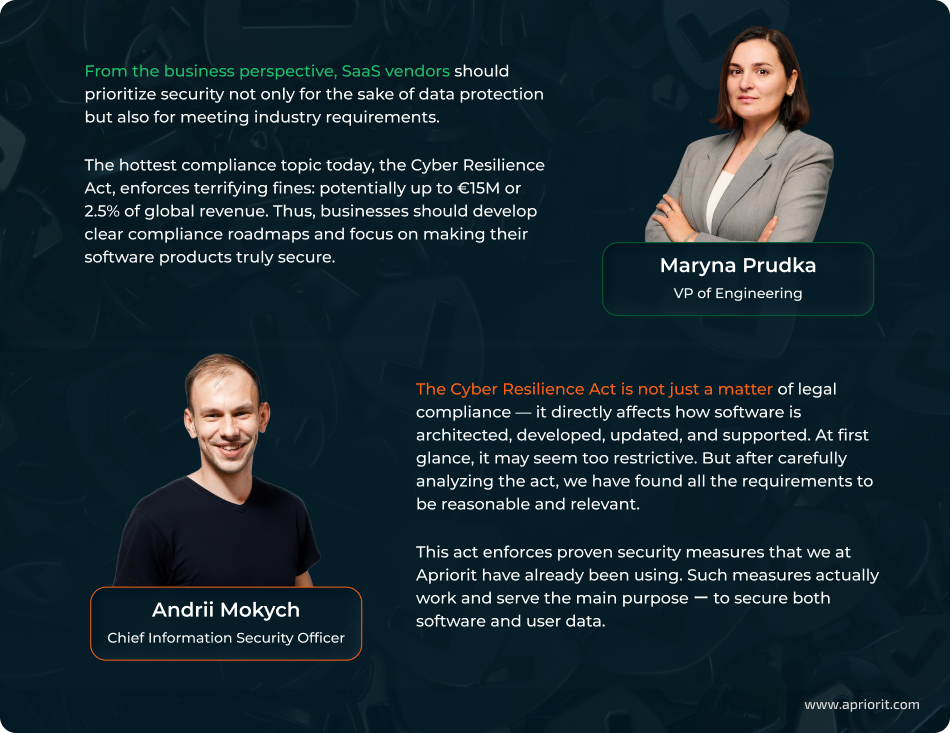
- Prepare for complying with the Cyber Resilience Act (CRA). Though it entered into force on December 10, 2024, its main requirements will only apply starting December 11, 2027. CRA compliance will be mandatory for all hardware and software products with digital elements placed on the EU market.
So, where can you start your security journey? Your team must make sure that SaaS products are resistant to:
- Attacks by malicious actors
- Insider threats
- Unintentional user actions
- Misconfigurations by admins on the customer’s side
- Other threats and risks
In the next section, we take a look at the most common risks SaaS vendors should know about.
Let’s make your SaaS platform secure from day one!
Protect your data, ensure top-notch SaaS performance, and retain your customers. Apriorit will smoothly implement the best cybersecurity practices in your solution.
Top 4 SaaS security risks
The entire idea behind SaaS products is that anyone with access to the internet can access them. Unfortunately, this also applies to malicious actors, who may leverage the availability of a cloud product to try to find weaknesses and compromise its components.
To protect your solution from potential threats, your team must first know what risks to expect.
From Apriorit’s experience developing and maintaining SaaS solutions, we can outline four common risks:
- Broken access control is the most widespread issue in SaaS products. Because of flawed authorization mechanisms, users may have access to information of other users. This can lead to data leaks, corruption, and loss.
- Data injection is the second most common threat to web solutions. It can harm product performance, break defences, and also lead to data leaks.
- Security misconfigurations can be caused by actions of both SaaS providers and customers (for example, admins who deploy third-party solutions within corporate environments). They include incorrect infrastructure configurations, running unnecessary services, lack of password protection, outdated software components, etc.
- Insecure design is a broad and abstract term, yet the issues it causes are quite widespread among SaaS products. An insecure design means that the product’s architecture or business logic creates inherent security weaknesses, such as unprotected storage of credentials or exposure of sensitive user data in admin notifications. Because of this, even correctly written code can result in data exposure, account compromise, or other consequences.
The list of potential threats goes far beyond our top four risks and might include issues like third-party vulnerabilities and API risks. We recommend paying attention to trusted sources that publish relevant information about web application threats, such as the OWASP Top Ten list and the Secure by Design Pledge Goals.
Now, let’s discover how to secure SaaS applications.
How to secure SaaS solutions: 9 best practices from Apriorit’s cybersecurity experts
The main tip Apriorit experts share is to treat vulnerabilities as if they were bugs.
At the end of the day, vulnerabilities are the result of logical errors made by engineers. Though such errors are part of human nature, the final software solution must not include vulnerabilities ー just like it must not include bugs.
So, how can you ensure there are no vulnerabilities in your SaaS product? Here’s a short check-list to give you a general idea:
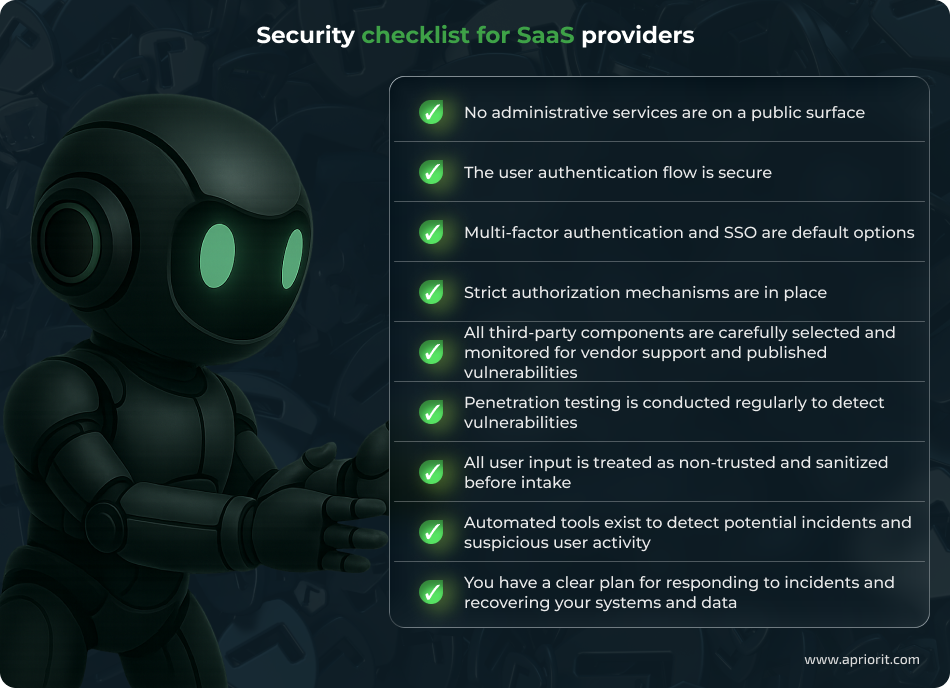
Below, we offer best practices for securing SaaS solutions based on the CISA’s Secure by Design initiative and our own experience delivering protected SaaS products.
1. Reduce the public attack surface
One of the most effective ways to strengthen the security of a SaaS application is to minimize its public attack surface. Simply put, the fewer components are exposed to the internet, the lower the chances of compromise.
Say you have a vulnerable web server, database, or file storage system. If such components aren’t publicly accessible ー meaning no one outside your organization knows they exist, what versions they run, or how they are configured ー the likelihood of an attack drops significantly.
On the contrary, if setups are open for external connections ー even when using secure services like Redis or PostgreSQL ー they are at increased risk for exposure to various threats and hacking techniques.
Andrii Mokych, Chief Information Security Officer
Reducing the attack surface is a practical first step because it limits the scope of potential vulnerabilities. To use this approach in real life, consider the following practices:
- Ensure that only essential services are exposed to the internet. Internal components should remain behind firewalls or private networks.
- Use network segmentation to separate critical systems from public-facing components.
- Apply strict rules for inbound and outbound traffic using security groups, firewalls, and VPNs.
- Continuously monitor which services are publicly accessible and remove any that do not need external connectivity.
This approach should be planned from the earliest development stages, as it essentially minimizes the scope of work. However, even if your product is already live, Apriorit’s cybersecurity engineers can help you close the external perimeter and restrict unnecessary access.
Need help securing and improving your SaaS product?
Build reliable, protected, and high-performing SaaS platforms with our expert developers and cloud architects.
2. Enforce password policies
SaaS products must prevent users from setting simple passwords like 1111.
The basic steps to ensure that users can securely log in to their accounts include the following:
- Enforce strict password creation rules.
- Enable options for single sign-on (SSO) using identity providers like Google and Apple.
- Implement functionality for creating custom password policies in B2B products.
- Integrate password leak detection services that check whether passwords are compromised before allowing users to set them.
If you are a B2B SaaS provider, consider creating opportunities for your customers to manage their workspaces and implementing security functionality within their SaaS environment. This way, your customers can enforce password policies, assign user roles, and analyze audit logs. This can help you win over customers who care about corporate security and maximize security measures as much as they can within their organizations’ environments.
Maryna Prudka, VP of Engineering
3. Configure multi-factor authentication
The problem with single-factor authentication (SFA) is that it basically equals vulnerability. With continuous password leaks, nothing can stop hackers from compromising users with SFA-based logins to SaaS accounts.
In 2024, researchers discovered the biggest credential leak yet, RockYou2024, which exposed a staggering 10 billion passwords. And in 2025, researchers found another leak of 183 million email accounts and passwords, including tens of millions linked to Gmail accounts. With that many passwords revealed, malicious actors have higher chances for successful credential stuffing attacks on various services, including SaaS products.
Therefore, multi-factor authentication (MFA) is a must.
Here are our three main tips when developing or improving existing authentication:
- Your customers should see multi-factor authentication as the default option, not merely as one option to choose from.
- If a user wants to reject MFA, you should obtain clear consent for denying its use, preferably with a text description explaining the importance of MFA for protecting user data.
- Configuring and using MFA for a SaaS account must be easy and straightforward.
Make sure the user authentication flow is secure at every step, from user creation, token lifecycle management, and integrations with SSO providers to password resets, account recovery, and user deletion.
Andrii Mokych, Chief Information Security Officer
4. Deny use of default passwords and configurations
SaaS solutions usually include components provided with default passwords, such as PostgreSQL databases and users.
Why is this bad?
For instance, if there’s no authentication to those components at all, a malicious actor can access one of them, break a component, and get all the information it contains.
Using any default passwords or any default security configurations is not acceptable if you want your solution to be truly secure. Make sure to check stock configurations to see whether a vulnerable password is used.
5. Implement strict authorization mechanisms
The majority of SaaS solutions allow users to handle and store their data. Obviously, SaaS providers must ensure that users can only access their own data and not information handled by others.
However, incidents where one party gains access to information stored in a SaaS solution within another party’s account are quite common.
To prevent such breaches, your team has to implement robust authorization mechanisms.
Apart from multi-factor authentication, which we’ve mentioned above, consider the following practices to enhance your authorization mechanisms:
- Role-based access control to define clear roles and permissions for every user type
- Principle of least privilege to only let users access what they need without granting excessive privileges
- Attribute-based access control to enforce policies based on user attributes like department and location
- Session management and timeout policies to automatically log out of inactive sessions and restrict concurrent logins
- Testing of authorization controls to validate the robustness of your authorization mechanisms by regularly conducting penetration tests and simulating privilege escalation attacks
Authorization must be strict and consistent at every stage. Simply blocking access to the admin panel on the front end is not enough to separate admins from non-admins. Every backend request should be verified: whether the user has permission to access specific data or make changes. There must be a clear, well-defined process enforced throughout ー from development and code reviews to production ー along with log collection to ensure issues can be tracked if something goes wrong.
Andrii Mokych, Chief Information Security Officer
6. Validate user input
From our experience, almost half of the OWASP Top Ten security issues appear in SaaS products because developers treat user input as trusted and harmless.
In reality, user input is a source of numerous vulnerabilities. Attackers can send malicious data that changes system behavior, leading to data exposure, privilege escalation, and account compromise.
That’s why developers must treat all data entering the system as untrusted by default.
Your team should make sure every user input is checked and sanitized before being used in a database, HTML, code, or exec calls. It should then be processed through secure technologies that are designed to handle data safely.
Preventing SQL and other injection types is no longer difficult, especially since there are a variety of development frameworks that already provide user input sanitization and deny injection inputs.
Read also
How to Find the Right Outsourcing SaaS Development Company
Discover Apriorit’s expert insights on selecting a reliable vendor, managing distributed teams, and achieving faster, more cost-effective product delivery.

7. Validate and monitor third-party components
Oftentimes, it’s not your code that is vulnerable.
Many security issues hide in third-party components: vulnerable databases, an outdated version of library dependencies, etc. And if a malicious actor gains access to a vulnerable component, they can harm the entire product.
Here’s what your team should consider doing to prevent risks caused by external components:
- Implement threat intelligence functionality to monitor for detected and published vulnerabilities in different components so your team can quickly update and fix them.
- Make sure that components used in your SaaS product don’t violate your existing compliance requirements and are not subject to sanctions in the country where you operate.
- Create and maintain a software bill of materials (SBOM) to have a comprehensive view of the product’s makeup and streamline component management.
8. Leverage penetration testing to detect vulnerabilities
Many vulnerabilities hide in a solution’s logic. Not only are they hard to detect, but quite often they are rather dangerous.
Tools like Cloudflare and Burp Suite, built-in security tools from cloud providers, and vulnerability scanners like Nessus and OpenVAS mostly help you discover common vulnerabilities. Unfortunately, they can’t find issues that hide in business logic.
To detect hidden security issues, SaaS solutions require explicit pentesting efforts.
Penetration testing helps uncover hidden vulnerabilities and validate security controls by simulating real-world attack techniques. This approach reveals weaknesses that automated tools cannot detect, such as flaws in authentication flows, API misuse, or improper access controls.
Ensure that you run penetration testing activities before major releases, as any significant update or new feature can introduce vulnerabilities. Additionally, consider incorporating regular pentesting as part of a comprehensive risk mitigation strategy.
It’s best to plan testing efforts early, during project planning when defining security requirements. Knowing what you want to protect in the first place, how to do it, and what the criteria are to check whether security requirements are met will help penetration testing specialists do their job perfectly.
Andrii Mokych, Chief Information Security Officer
9. Develop an incident response plan
No matter what security defenses you apply, there are always risks that are hard to predict: a new virus, enhanced malware, advanced social engineering techniques, etc. Therefore, your teams must be ready for any scenario.
A thoughtfully designed incident response plan is key to disaster recovery and business continuity.
If a security incident occurs, your teams must:
- Immediately know that the product was hacked
- Check logging and monitoring records to identify what happened and how
- Limit the area of influence
- Correctly communicate the incident to customers/users
- Proceed with incident mitigation and recovery according to your plan
To minimize the damage from a potential attack, there are some actions your team can already take without waiting for incidents:
- Know what logging is in place, where logs are stored, and their retention period.
- Monitor key logs ー at least antivirus logs ー and keep them for at least one month.
- Divide users between several separate databases.
- Minimize the volume of stored information where possible.
- Anonymize data where possible without harming SaaS performance.
- Structure data.
- Introduce tools for monitoring performance, detecting big database queries, and identifying abnormal activities.
- Plan how users will be notified if different types of incidents occur.
The two cornerstones of managing SaaS security incidents are a clear action plan and a channel of communication with users. These help your teams avoid chaos and even decrease the consequences of an accident.
Andrii Mokych, Chief Information Security Officer
Related project
Developing and Enhancing a Custom SaaS Platform for HR Management
Explore how Apriorit delivered a secure and flexible HR SaaS platform that simplified workforce management, improved analytics, and ensured smooth integration with third-party tools.

Planning a new SaaS solution? Here’s why you should consider a secure SDLC approach
Above, we listed tips that work for all SaaS products: those that are already operating, those in development, and those that are only planned.
But if you’re only about to start creating a SaaS product, there’s a way to cheat and simplify the adoption of all these security tips. For a brand-new SaaS product, consider making it secure from the start.
This is where a secure SDLC comes into play.
Here’s only a small part of what Apriorit development teams do when building SaaS solutions in compliance with secure SDLC principles:
- Integrate security across all software development lifecycle stages, starting with product design
- Incorporate security requirements into system design
- Include proven security controls during the development phase: code reviews focused on vulnerabilities, adherence to security standards, automated tools for detecting vulnerable components, scripts for identifying code-level vulnerabilities, etc.
- Securely handle access keys in CI/CD pipelines
- Strictly limit secrets and production access to authorized personnel only
- Fully isolate the staging environment from production
- Make sure no live customer data ever reaches the development team
- Perform regular data backups with continuous auditing and monitoring in place
- Periodically conduct access reviews
- Check compliance against regulatory requirements and standards
Security controls like authentication, authorization, and framework selection are derived from common risks shared by most web products. However, every solution also carries unique risks based on its nature and the data it processes.
First, your team should identify these risks. Second, you need to prepare for them by incorporating relevant cybersecurity measures during design, development, CI/CD stack selection, and DevOps pipeline setup. As a result, you’ll receive a truly protected SaaS solution.
Andrii Mokych, Chief Information Security Officer
Deliver a SaaS solution that’s secure by design with Apriorit
With 20+ years of experience in software development and cybersecurity, Apriorit is ready to help with projects of any complexity.
From CRMs and payroll management systems to content management and cybersecurity platforms, we build efficient and user-friendly SaaS systems of all sizes and for different industries.
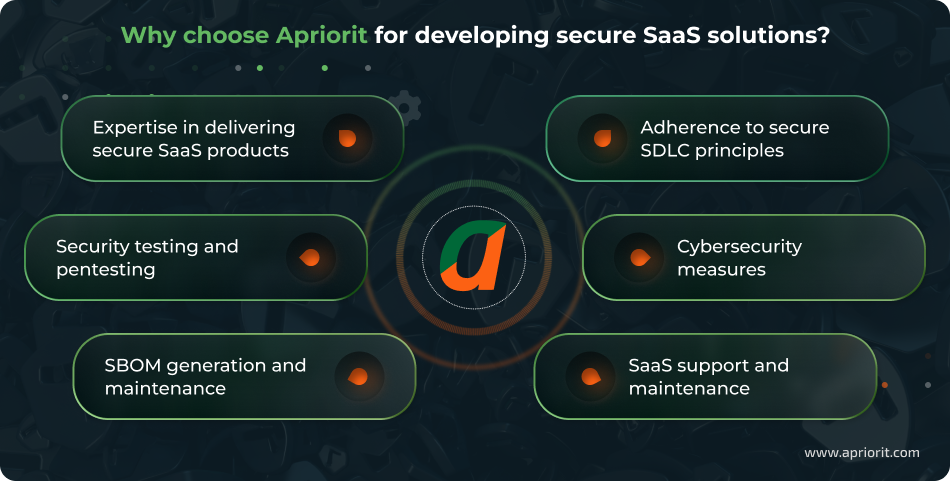
Leverage our expertise to make sure your product:
- Has robust security measures that are planned from early development stages and carefully introduced during development
- Is resilient to attacks and has no vulnerabilities thanks to professional security testing, pentesting services, and thorough code audits
- Protects your company’s intellectual property and user data with proven cybersecurity mechanisms and data encryption
- Includes only secure components thanks to an accurately generated and maintained SBOM
- Keeps working efficiently and stays relevant for decades with professional support and maintenance services
Case 1. A SaaS cybersecurity platform: helping out with new features, security, and compliance
Our client is the vendor of a SaaS cybersecurity platform for detecting and managing vulnerabilities. Their solution is especially popular within highly regulated areas like automotive and healthcare, so SaaS security and compliance are top priorities.
The client asked us to improve their product’s competitiveness, extend its capabilities, improve its cybersecurity posture, and enhance the user experience.
Here’s what we’ve done:
- Enhanced product competitiveness by adding support for more platforms
- Ensured a better user experience by developing new functionality, adding customization options, and improving the UI
- Improved efficiency for the client’s in-house teams by automating internal processes like data analysis
- Enhanced SaaS security and ensured compliance with industry requirements by implementing additional vulnerability detection methods, audit logs, and data analysis mechanisms
Case 2. Migrating a SaaS HR management platform to Angular securely and safely
A past client — for whom Apriorit developed a robust SaaS platform for human resource management some time ago — wanted to migrate their product from AngularJS to Angular.
Our task was to conduct the migration securely and quickly, without rewriting the entire codebase and degrading the user experience.
Here’s what Apriorit engineers did:
- Migrated the software step by step, balancing project speed with stable SaaS performance for users
- Made sure that all existing code functioned the same after migration as before migration
- Thoughtfully updated the technology stack, making sure it would allow for smoothly introducing new features
Case 3. Enhancing a SaaS data management platform with a threefold increase in users
Our client is a US-based SaaS provider that offers a cloud platform for collecting data from monitored devices and desktops and provides features for further data consolidation, analysis, and presentation.
They hired us to improve the SaaS product’s performance, aiming to win more users and improve competitiveness.
Here’s what our client managed to achieve as a result of Apriorit engineers’ work:
- Successfully released new features and improvements within tight deadlines thanks to professionally established CI/CD processes
- Increased the number of active users from 30,000 to 100,000, which became possible due to increased system scalability
- Cut platform maintenance costs by about 40% thanks to an optimized environment setup
Conclusion
Delivering a truly secure SaaS product demands effort at each and every step. Your team must take into account commonly exploited vulnerabilities and threats while also being ready to test systems for flaws in business logic.
From our experience, we know that the best mindset is to focus on complex, systematic measures like risk management and regular penetration testing.
The key is to identify potential risks and threats as early as possible. Then, you’ll have time to determine how to address them early in the design and development stages. With careful security planning and regular audits and testing, your systems will remain secure for much longer.
Whether you’re planning to create a new, reliable SaaS product or enhance your existing solution’s defences, a professional software development vendor like Apriorit can make sure your software and data are protected.
Ready to level up your SaaS security?
Delegate technical tasks to Apriorit’s experts. Let’s implement best practices, adopt a secure SDLC approach, and deliver a product that’s truly secure by design.
FAQ
What is SaaS security?
SaaS security is a broad term, covering cybersecurity measures, practices, tools, and even a mindset focused on protecting Software-as-a-Service products and data against threats and vulnerabilities.
Why is SaaS security important?
Strong SaaS security safeguards sensitive customer and company data, prevents breaches, ensures regulatory compliance, and maintains user/customer trust. This is why adopting secure development practices for SaaS is critical for business continuity and growth.
What are the benefits of SaaS security?
Advanced SaaS security brings advantages such as a reduced risk of data breaches, improved compliance with standards and security regulations, enhanced customer trust, and long-term protection of revenue and reputation.
What are the biggest security threats SaaS companies face today?
Common security threats include broken access control, injection attacks, security misconfiguration, ransomware attacks, insider threats, insecure APIs, and vulnerabilities in third-party components.
How can organizations implement effective SaaS security best practices?
<p>We suggest the following best practices for securing SaaS applications:</p>
<ul class=apriorit-list-markers-green>
<li>Reduce your attack surface</li>
<li>Enforce strong authentication</li>
<li>Validate inputs and dependencies</li>
<li>Implement strict authorization</li>
<li>Adopt a secure SDLC approach</li>
</ul>
What tools should we use to ensure SaaS security?
There’s no list of secure SaaS development tools that are applicable for all projects. However, we can definitely recommend adopting vulnerability scanners, penetration testing frameworks, encryption tools, and monitoring platforms for threat detection.
How often should SaaS vendors conduct security audits?
The general suggestion is to run security audits at least annually. You should also run additional audits after major updates or infrastructure changes, and when new compliance requirements appear.