 Skip to main content


Key takeaways:
- Outsourcing SaaS development helps companies launch products faster, access specialized expertise, and get a professional team without the hiring overhead.
- Choosing the wrong vendor can lead to delays, poor code quality, security issues, unclear responsibilities, and budget overruns.
- A structured selection process — portfolio review, estimates, discovery sessions, and small test tasks — reduces risks and ensures a good fit.
- The right vendor will prioritize security, demonstrate SaaS expertise, communicate transparently, and align with your business goals.
Development speed is vital to the success of SaaS solutions, whether you’re building a new product or responding to urgent tickets from your users.
But speed isn’t the only factor in success. SaaS development demands expertise across multiple roles, from project management and quality assurance to cloud architecture and cybersecurity. Assembling such a team in-house can take six months or longer, while outsourcing can give you a fully staffed team within weeks.
The challenge, however, is that outsourcing comes with its own risks. Choosing the wrong partner can result in missed deadlines, buggy deliverables, misaligned requirements, and budget waste.
In this article, we explore how outsourcing SaaS development can give you instant access to the talent needed to build a robust and scalable SaaS solution. We’ll look at benefits of outsourcing SaaS development, potential pitfalls, and how to evaluate vendors effectively so you can avoid red flags and find the right partner from the start (or for further development of your project).
Contents:
- Why it’s a good idea to outsource SaaS development
- Benefits of outsourcing SaaS development
- Risks of choosing the wrong SaaS outsourcing partner
- A guide to choosing the right fit for your SaaS outsourcing project
- SaaS outsourcing company green flags: a checklist
- Why Apriorit is your ideal SaaS development vendor
- Conclusion
Why it’s a good idea to outsource SaaS development
Outsourcing SaaS development means partnering with an external team of specialists to design, build, and maintain your SaaS product. These external specialists can support your in-house team or take on the full burden of development and management, allowing you to completely focus on business growth, marketing, and sales.
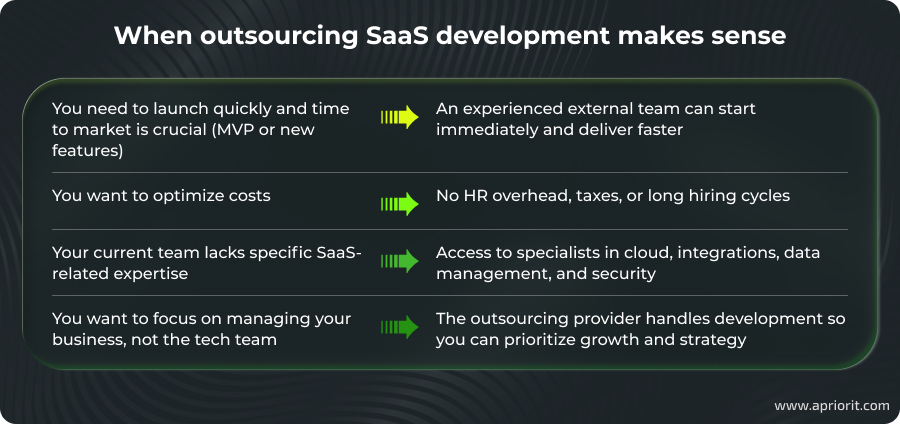
Companies often choose to outsource SaaS projects because of the specific demands these products place on development teams:
- SaaS solutions require wide technical expertise. Even building an MVP with a limited feature set requires a cross-functional team of developers, cloud engineers, QA specialists, and project managers. Outsourcing helps you access all of these roles at once without the long hiring process.
- SaaS products rely on complex infrastructure. They require ongoing support, integration with diverse cloud services, and advanced data management practices. Finding all of these skills in-house is challenging, but outsourcing gives you access to specialized expertise that covers the full stack of SaaS needs.
- SaaS products must evolve continuously. To retain customers, you need to quickly respond to feedback, add new features and integrations, and scale efficiently. Outsourcing makes it easier to expand capacity based on demand so you can deliver updates faster when they’re needed most.
- SaaS systems demand strong security. Because they’re usually integrated with multiple third-party services and handle sensitive user data, it’s critical to follow rigorous security practices during SaaS project development and ensure compliance with industry standards and regulations such as the GDPR, HIPAA, SOC 2, or ISO 27001. Experienced outsourcing companies already have these processes in place, reducing your risk exposure.
Now, let’s look at exactly what outsourcing your SaaS project can bring to your business.
Benefits of outsourcing SaaS development
Outsourcing SaaS development gives businesses flexibility and access to expertise that can be difficult or costly to build in-house. Key benefits include:
- Reduced costs. While a good SaaS development outsourcing company won’t be cheap, you will still be able to avoid expenses related to recruitment, onboarding, paid leave, and payroll taxes. You only pay for the expertise you need, when you need it.
- Easy team scaling. SaaS projects often require different skillsets at different stages. With an outsourcing partner, you can quickly scale your team up or down without the delays and overhead of hiring or downsizing internally.
- Faster delivery. Outsourcing reduces time to market because you get an experienced team that is ready to start immediately. This helps you launch your MVP or new features quickly and stay competitive.
- Lower risk of project failure. An experienced outsourcing partner brings proven expertise from multiple SaaS projects, helping you avoid common mistakes and build a solution that’s competitive in the market while meeting your requirements on time.
- Reliable post-development support. Outsourcing partners can continue maintaining and improving your product after launch. Since the team that built your SaaS solution knows its architecture inside and out, they can resolve issues, quickly implement changes, and effectively manage technical debt to keep your product stable and scalable.
- Long-term stability. A good outsourcing partner will not only deliver features but also ensure the long-term performance, maintenance, and growth of your product through mature processes and quality controls.
By working with an outsourcing team in a different time zone, your team can review tasks during the day and have them completed overnight. With a two-team setup, you can enable 24/7 support — especially crucial in the early days of a product launch.
Ivan, Development Coordinator at Apriorit
While SaaS products benefit immensely from outsourcing, not all outsourcing companies are able to bring you the benefits mentioned above. In the next section, we talk about the risks you might face if you choose the wrong SaaS development vendor.
Thinking about outsourcing your SaaS development?
Let’s discuss how outsourcing can reduce costs, speed up delivery, and set your project on the path to success.
Risks of choosing the wrong SaaS outsourcing partner
Selecting the right outsourcing vendor is one of the most important decisions for your SaaS project. A poor choice can put your product, your budget, and even your business reputation at risk. Below are some of the most common consequences companies face when working with an ill-suited outsourcing partner:
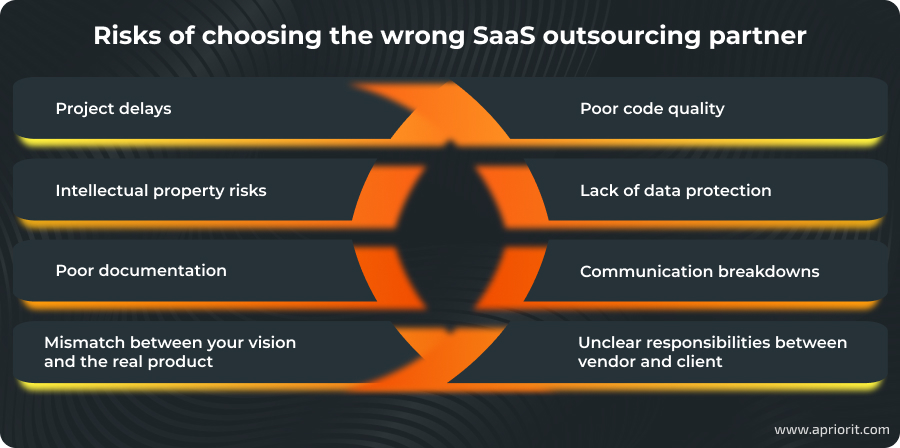
- Mismatch between your vision and the real product. If the vendor doesn’t take your business specifics into account, you may end up with a product that lacks scalability, integrations, or alignment with your actual needs. The most common issue is lack of scalability in the MVP. If your vendor hasn’t anticipated the growth of your SaaS product, it will be expensive to overcome this oversight down the line. In the worst cases, this may result in having to rebuild the solution from scratch.
- Poor code quality. Low-quality code can cause critical bugs, security gaps, and technical debt, all of which are expensive to fix. At best, low-quality code will result in project delays and costly fixes. At worst, it will put your reputation at risk.
- Outdated technologies. Some vendors rely on outdated frameworks to cut costs or speed up delivery. This can cause performance, scalability, and security issues that will make future updates or integrations challenging or even impossible.
- Project delays. Delays can occur for multiple reasons, from poor code quality to your vendor not responding to urgent issues quickly enough. Each delay can harm your business, cause missed opportunities, and even drive customers to your competitors.
- Lack of data protection. Inadequate security practices can result in the exposure of sensitive business and customer data. For SaaS products, where data protection is critical, this can have severe legal and financial consequences.
- Intellectual property risks. If ownership of your code and product deliverables is not clearly defined in the contract, you may face disputes over who controls your intellectual property.
- Going over budget. Hidden costs, poorly defined scopes of work, or unclear estimates can cause expenses to spiral out of control. This can happen if a vendor rushes the estimation stage, doesn’t clarify what’s included in the price, or fails to communicate how changes in scope will affect the budget.
- Communication breakdowns. Misaligned expectations or a lack of visibility into the project’s progress can lead to misunderstandings, missed deadlines, and frustration on both sides. Without consistent updates and transparent reporting, it’s hard to know whether the project is on track or deviating from your goals.
- Poor documentation. Incomplete or outdated documentation can make your product difficult to maintain, scale, or hand over to another team. When crucial details about architecture, integrations, or dependencies are missing, even small updates can become time-consuming and risky. In the worst cases, poor documentation leaves you with a solution that no one — not even your own developers — fully understands how to work with.
- Unclear responsibilities between vendor and client. If it’s not clear who is responsible for what, collaboration can quickly stall. For example, a client may assume the vendor will handle areas like business development, sales, or marketing, while the vendor expects to focus solely on technical delivery. These gaps in expectations can lead to frustration, missed deliverables, and a product that doesn’t fully support the business strategy.
It’s important to focus not just on the initial sticker price but on the total cost of getting the work done. A low-cost team may work slowly, ultimately delaying the project and increasing the overall expenses. You can truly understand how efficient a team is only after working with them for some time.
Ivan, Development Coordinator at Apriorit
With a good outsourcing partner, you don’t have to worry about these potential pitfalls. But how can you find one?
In the next section, we discuss in detail how to find the perfect SaaS development vendor for you and get a high-quality SaaS product on time and within budget.
Related project
Building a Microservices SaaS Solution for Property Management
Explore how we improved the platform design of property management software. Learn how to benefit from replacing a monolithic solution with a flexible SaaS solution based on microservices.

A guide to choosing the right fit for your SaaS outsourcing project
Your sourcing strategy for a reliable vendor depends on your project stage — whether you need to build a SaaS product from scratch or improve your existing MVP or product with additional features.
Let’s start with the vendor selection process for those who are planning to build their first SaaS MVP.
Building a SaaS MVP from scratch
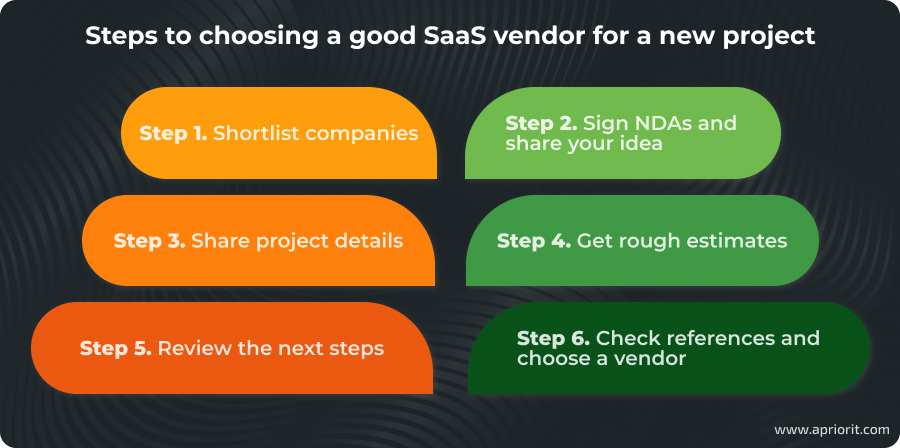
1. Shortlist companies
First, you need to source companies using a simple Google search, resources like Clutch.co, or references from your colleagues or partners. When reviewing outsourcers, pay attention to the following:
- Portfolio: Do they have projects similar to yours?
- Reviews and testimonials: Do they have verified reviews on trusted third-party platforms?
- Technology stack: Can it cover all your technical requirements?
Once you’ve checked for this minimum set of requirements, shortlist several companies and reach out.
2. Sign NDAs and share your idea
Usually, you’ll reach out to a vendor through their website’s contact form and provide details about the project you plan to create.
Before moving to detailed discussions, we recommend signing a mutual non-disclosure agreement (NDA) with each vendor. This protects your intellectual property and gives you the confidence to share sensitive details about your business and product idea.
After signing an NDA, you can share your project information. You can approach a vendor with any level of project readiness:
- A raw idea for your future SaaS product
- A list of high-level features
- A detailed feature set and/or preferred technologies
- Full or partial technical documentation
If you have full documentation, you can jump right to getting detailed estimates from vendors and comparing them. Otherwise, vendors will require more information to give you a proposal. Let’s review your next steps in this case.
3. Share project details during a call
Typically, an outsourcing company will schedule an introductory call to learn more about your project. Information you’ll likely need to share includes:
- Your project goals
- The business context
- High-level features of your SaaS solution (if you don’t have technical documentation)
During this call, pay close attention to the questions the potential service provider asks about your business needs, goals, and future plans. A team that demonstrates genuine interest in your business from the start is more likely to provide estimates and a project vision tailored to your needs rather than a generic solution.
At Apriorit, we usually ask how many users a client expects in the first year of their SaaS product’s operation. This allows us to understand what server configuration will be required so the product can safely scale in the future.
Maryna Prudka, VP of Engineering at Apriorit
We also ask about the preferred programming language or technologies, if any. If the potential client has no preferences, we will recommend a few options that suit the technical requirements.
You can also ask about the software development approaches a vendor uses and why they prefer one approach over another. In particular, check whether they follow an Agile methodology and have a strong CI/CD pipeline. These practices ensure faster iterations, quicker bug fixes, and continuous delivery of new features — all of which are critical for building and scaling SaaS solutions.
4. Get rough estimates
After a vendor gathers basic information about your project, they should provide you with ballpark cost and time estimates. This will give you an idea of how long your project will take and what budget it will require.
Watch out for vendors who promise too precise of estimates without having technical documentation. This may signal that they take a one-size-fits-all approach to all projects and won’t take your specific business needs into consideration.
A rough estimate at Apriorit usually contains this information:
Table 1. Contents of a rough estimate
| Item | Description |
|---|---|
| Realistic price range | An approximate price range that reflects the expected project complexity and scope. |
| Approximate timeline | A high-level development schedule showing how long each stage is likely to take. |
| Project roadmap with key features | Major milestones and core functionality planned for delivery. |
| Suggested technologies and architectural vision | Recommendations on the optimal technology stack, programming languages, architecture, and databases. May also include results of preliminary research (e.g., relevant APIs) and custom recommendations based on your business goals. |
| Advice on next steps | Recommendations on the future direction for platform development depending on business plans and future scale. |
| Recommendation to start with an MVP | A reasoned proposal to begin with a minimum viable product in order to reduce risks and test your concept in real market conditions. |
| Proposed team composition and cooperation model | A description of the recommended team structure and how collaboration will be organized. |
A rough estimate helps you evaluate how a vendor plans to approach your SaaS project, including deliverables, timelines, and costs. Check whether they’ve accounted for scalability, integrations, and long-term maintenance. Also, beware of vague costs, unrealistic deadlines, or unjustified features — these are clear signs of limited SaaS expertise.
Now, let’s talk about cooperation models. Most vendors offer multiple cooperation models depending on how many specialists you need, for how long, and how your whole project is structured and planned.
At Apriorit, we offer three main cooperation models:
- Dedicated team. You get a fully formed team whose attention is 100% dedicated to your project. It’s basically like getting an out-of-the-box in-house team without the hassle of hiring. This is the most common cooperation model for Apriorit’s SaaS development projects, as SaaS products usually require a full team and take time due to their complexity.
- Fixed price. With this model, you pay for a strictly defined scope of work and get the results you expect by the agreed deadline. This cooperation model is rarely used for SaaS due to the complexity and unpredictability of projects, although it’s possible to use fixed price for separate SaaS development services, such as code audits or security assessments.
- Time and materials. Under the time and materials (T&M) model, you pay for the time the development team spends working on your project and the resources used to build it. This model can be applied to a full team or just one specialist. In either case, you’ll pay an hourly rate. In SaaS development, T&M is usually the right choice when the scope isn’t clear from the start or when requirements are expected to evolve — for example, if you’re experimenting with new integrations, building a proof of concept for a feature with uncertain complexity, or iterating based on early user feedback.
These models can be applied flexibly to teams of any size. We can provide a full team that manages itself or allocate just one specialist to join your in-house team, either on a full-time basis or hourly. Project management can also be handled by our side or remain under your direct supervision, depending on your needs.
Compare vendors’ proposals to identify which vendors align with your vision and understand your goals beyond the technical implementation.
Read also
Developing an MVP for SaaS: Technical Insights
Find out how to create a SaaS MVP that balances speed, cost, and scalability while keeping your product vision on track.
5. Review the next steps
A reliable SaaS development vendor won’t just leave you with estimates — they’ll walk you through the logical next steps. These might include carrying out a discovery phase, during which the team creates detailed technical documentation that you can take to any vendor, or proceeding with an MVP to validate your idea in real market conditions before scaling.
A good vendor will explain why a particular step is necessary, how it reduces risks, and what deliverables you’ll get at the end. If a vendor can’t clearly outline the path forward or pushes you straight into full-scale development without validating the product idea, it may be a red flag.
6. Check references and choose a vendor
Just to be sure, you can go the extra mile and ask your vendor for references from previous clients. Speak directly with these clients to learn about the vendor’s strong and weak points, communication practices, and actual outcomes they have delivered. References provide an additional layer of confidence and can validate whether the vendor’s promises hold up in practice.
That’s it! Now all you need to do is negotiate a contract with your vendor, sign it, and start your SaaS development journey.
Up to this point, we’ve focused on the process of choosing a SaaS development outsourcing partner if you’re building your product from scratch. But what if you already have an MVP or even a working SaaS product? Let’s discuss how your process may differ in this case.
Improving an existing SaaS solution
Sometimes, clients come to us with a ready product, an MVP, or even a half-built solution. They may already have an in-house team but need additional help. In such cases, companies usually seek:
- Specific expertise. For example, an AI expert for integrating AI functionality, or a developer in a specific programming language.
- Specialized services. These may include cloud migration or management, code review, or reverse engineering.
- Leadership support. Companies may need a dedicated tech lead to guide and manage their existing development team.
The overall steps for choosing a vendor for an existing product are similar — you’ll still need to shortlist vendors, review portfolios, and check references. However, your strategy will look a little different. Instead of starting with ballpark estimates and discovery sessions, you can validate vendors with small practical tasks and base your decision on their actual performance.
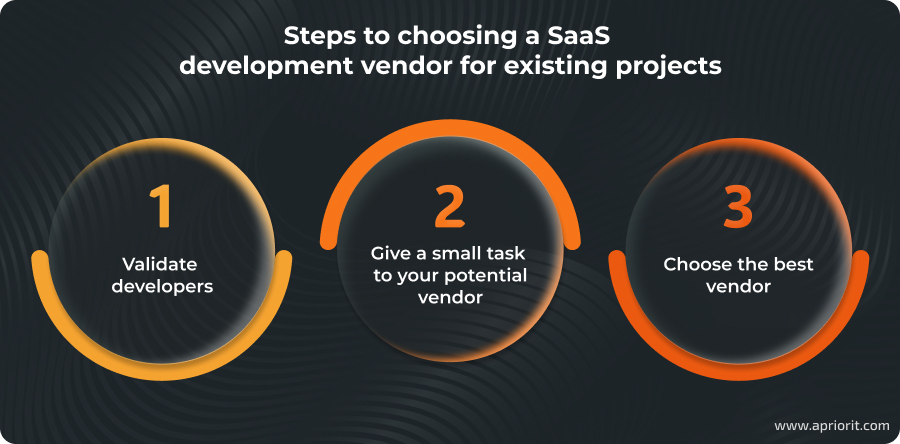
1. Validate developers
Even if a vendor looks good on paper, make sure their developers can meet your technical needs in practice. Run technical interviews to evaluate both technical expertise and soft skills. This will ensure smooth collaboration with your in-house team.
You can also request developer portfolios or CVs to check relevant experience, and you can even assign small test tasks to see how developers approach real-world problems. This extra validation step helps confirm that the people working on your SaaS project are the right fit both technically and culturally.
2. Give a small task to your potential vendor
Rather than handing over your entire product right away, start with one feature, integration, or migration step. This way, you minimize risks and see how a vendor handles real work, from communication and transparency to deliverables and code quality.
If the vendor’s approach doesn’t live up to your expectations, allocate another task to the next vendor on your list and see how they do.
3. Choose the best vendor
Once you’ve tested collaboration on a smaller scale, it will be clear which vendor is the right fit. Reliability, technical excellence, and strong communication are the qualities that will matter most when scaling your SaaS product further.
Now, let’s summarize everything we’ve talked about and discuss what you need to pay attention to when evaluating vendor candidates.
Read also
How to Ensure SaaS Data Security with Curated Database Design
Discover the differences between single- and multi-tenant database structures and how they influence your product’s data safety, performance, and scalability.

SaaS outsourcing company green flags: a checklist
Finding the right outsourcing partner can feel overwhelming, but there are clear signs that a vendor is a strong match for your SaaS project.
Here are some green flags that reflect a vendor’s ability to understand your goals, adapt to your needs, and deliver long-term value. You can check off these qualities when evaluating potential partners.
Credibility and proven experience
- Has verified reviews and references from previous clients on reputable listings like Clutch.co.
- Showcases a portfolio with projects similar to yours, demonstrating relevant SaaS experience.
Strong delivery culture
- Shows flexibility in collaboration, offering different cooperation models, contracts, and approaches to meet your needs.
- Maintains transparent reporting, proactively flagging potential roadblocks instead of hiding problems.
Understands their responsibilities and avoids gaps or unrealistic expectations.
- Follows Agile methodologies to deliver incrementally and adapt to changing requirements.
- Has a strong CI/CD pipeline to ensure frequent, stable releases.
Wide technical expertise
- Offers relevant technical expertise so you don’t have to source additional specialists elsewhere.
- Demonstrates expertise in data management and governance. In SaaS, data management is a big challenge, as many organizations struggle with disconnected data, which hinders the customer experience. A vendor skilled in integration and governance can help avoid this pitfall.
- Has proven experience integrating AI and other modern technologies to enhance SaaS products. AI is the biggest current trend in SaaS according to Gartner, with AI-native SaaS companies scaling 40% faster than their counterparts.
- Leverages AI and automation during development to accelerate delivery and improve quality.
Security-first approach to development
- Follows a secure SDLC (software development lifecycle), embedding security checks and best practices into every stage of development.
- Has proven expertise in meeting compliance requirements relevant to SaaS (e.g., the GDPR, HIPAA, SOC 2).
- Provides regular security testing, including code reviews, vulnerability assessments, and penetration testing.
- Ensures their own compliance with recognized industry standards through ISO certifications and other frameworks.
Alignment with your culture and communication style
- Asks strategic questions early on to understand your business, goals, and future growth, ensuring your MVP is designed for scalability.
- Communicates clearly and consistently, showing genuine interest in your needs rather than offering a one-size-fits-all approach. The vendor can justify offering specific solutions or technologies by tying them to business goals or future growth.
- Aligns culturally with your team: speaks your language, shares similar values, and has a similar communication style. This is especially important if you’re planning to hire just a few specialists and integrate them into your in-house team.
Why Apriorit is your ideal SaaS development vendor
Apriorit has extensive experience creating SaaS MVPs as well as full-scale SaaS solutions, helping clients evolve their products with additional features, integrations, and scalability improvements. Our experience includes a wide variety of SaaS projects across industries, from cybersecurity SaaS platforms to CRM solutions for medical companies.
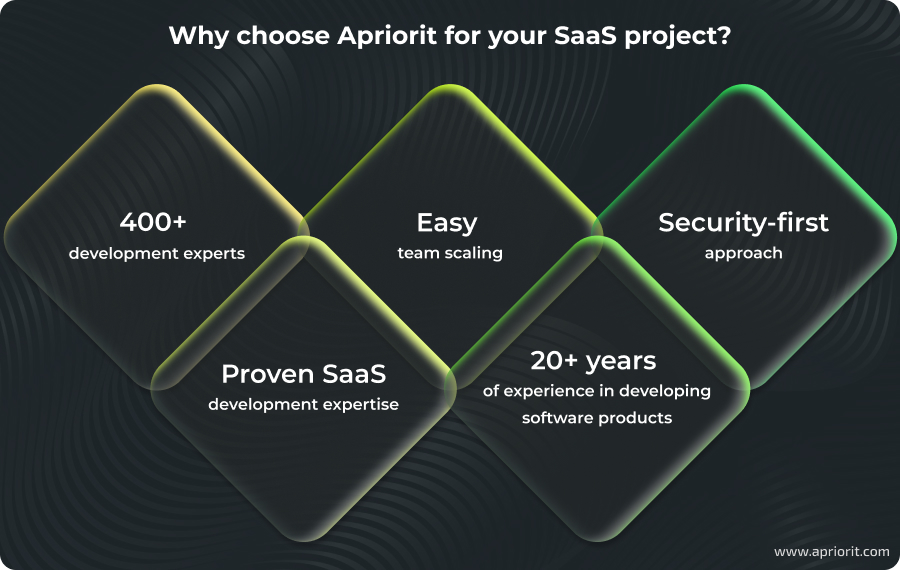
Key reasons why outsourcing secure SaaS development to Apriorit is a good idea:
- Large and diverse technical team. We have 400+ developers and software development specialists covering any technical need in any technology, from complex low-level tasks like kernel and driver development to AI and blockchain integrations. Our team includes web developers, DevOps engineers, security experts, AI engineers, and more, giving you access to all the skills your project might require.
- Flexible team composition. Thanks to our wide pool of talent, we can quickly scale your team up or down depending on your project requirements. For you, this means cost efficiency and adaptability.
- Security-first approach. Apriorit is a cybersecurity-first company, so data protection is woven into every part of our work. We follow a secure SDLC for every project we work on and conduct regular security testing to make sure your SaaS MVP or existing solution is robust against potential threats.
- Proven SaaS development experience. Having delivered multiple SaaS projects, we know the specific challenges involved and how to address them effectively. We rely on Agile methodologies and a strong CI/CD pipeline to deliver results incrementally, adapt quickly to changes, and ensure frequent, stable releases.
- Strong reputation. We consistently receive positive feedback from clients. Some of our partnerships span years, with clients coming back to develop new features or new products. Our longest collaboration has been ongoing for over 20 years. For more evidence of our strong reputation, see our verified reviews on Clutch.
By combining deep technical expertise, flexible teams, and a security-first mindset, Apriorit is positioned to deliver high-quality SaaS products on time and within budget while supporting your product’s continued growth.
Conclusion
Outsourcing SaaS development can be a powerful way to reduce costs, speed up the time to market, and access expertise that may be hard to find in-house. But the success of your project depends heavily on choosing the right partner.
With over 20 years of experience, 400+ engineers, and a security-first approach to software development, Apriorit helps companies design, build, and scale SaaS solutions of any complexity. Our teams cover the full spectrum of expertise — from low-level system programming to advanced cloud, DevOps, and AI engineering — ensuring your product is secure, reliable, and future-ready.
Whether you’re building a new product from scratch or improving an existing SaaS platform, Apriorit will be your trusted partner in creating a solution that grows with your business.
Looking for a reliable SaaS vendor?
Reach out to explore the best approach, timeline, and cooperation model for developing your SaaS product.
FAQ
How can I make sure my outsourcing team delivers high-quality, scalable code?
<p>There are several ways to find out early if code will meet your expectations and scaling needs:</p>
<ol>
<li>Check references and ensure your vendor has a strong portfolio of similar projects.</li>
<li>Ask if your vendor practices regular code reviews, automated testing, and delivery through CI/CD pipelines.</li>
</ol>
<p>During development, make sure your vendor maintains detailed documentation and updates it regularly. As you accept every batch of code, perform acceptance testing to ensure that each new part of your software is built in line with the expectations and requirements outlined in your documentation.</p>
How can I ensure that my product ideas, data, and intellectual property are safe when outsourcing?
<p>To protect your intellectual property (IP) and data, always sign an NDA before you disclose any detailed information about your project or business. Also, carefully review the contract with your vendor to ensure that it contains clauses on IP assignment.</p>
<p>Additionally, make sure that your company maintains ownership of code repositories and cloud infrastructure, limit a vendor’s access to sensitive data, and use secure communication and storage practices.</p>
Can outsourced teams handle long-term scaling and maintenance, not just MVP development?
<p>Yes, many outsourced teams can handle long-term scaling and maintenance, but it depends on their expertise and structure.</p>
<p>Look for partners with experience managing production SaaS platforms, not just building MVPs. Ensure they offer ongoing support models, strong DevOps practices, and clear SLAs for uptime and issue resolution. As your product grows, you may eventually combine outsourced talent with an in-house team for stability and knowledge retention.</p>
When does outsourcing SaaS development make the most sense?
<p>Outsourcing SaaS development is ideal for early-stage validation when you need to quickly check if your idea is viable and can bring results in real market conditions. At this point, you probably don’t want to hire a full-time in-house team.</p>
<p>Often, outsourcing companies can help you quickly strengthen your in-house team if it lacks specific technical expertise. For example, SaaS companies often hire Apriorit’s specialists when they need to add complex integrations or new technologies that require deep and rare technical knowledge.</p>
Can I start with a SaaS MVP and scale with the same outsourcing partner?
<p>Yes, and this is often the best way to grow your product. The outsourcing team that worked on your MVP already knows your product from the inside out, so they don’t need to spend time familiarizing themselves with the code to add new functionality.</p>
<p>Our clients often stay with us after we develop their initial MVPs, as we focus on long-term success and scalability.</p>
Why choose SaaS outsourcing over an in-house SaaS team?
<p>The main reason to choose an outsourcing team over hiring specialists in-house is the ability to get results fast without significant investments in hiring, payroll taxes, benefits, onboarding, and managing full-time employees.</p>
<p>With an outsourcing company, you can easily scale your team up or down depending on your current needs, budget, and market demands. An outsourcing company can also manage your development team if you like, allowing you to focus on business growth, marketing, and sales of your SaaS product.</p>
Have a question?
Ask our expert!

VP of Engineering