



Key takeaways:
- Because the rapid adoption of AI has changed how data is processed and shared, data loss prevention (DLP) solutions are no longer as efficient as they used to be at protecting sensitive information.
- To prevent sensitive information from being exposed through generative AI tools, DLP vendors need to make their products aware of all AI interactions, including with shadow AI.
- AI-aware DLP solutions can inspect interactions with AI applications in real time and apply policies based on contextual information like user access roles, data type, risk score, and application type.
While AI technologies improve productivity, they also introduce new pathways for sensitive data to move beyond traditional security controls. As a result, DLP vendors and businesses building custom data protection capabilities can no longer rely solely on conventional DLP approaches.
AI-aware DLP promises to cover these new pathways. Such extended DLP tools can help expand visibility, classification, and policy enforcement to AI-driven interactions like user prompts and file uploading to copilots.
However, adapting DLP for AI is tricky. Cybersecurity product vendors and businesses with custom DLPs must understand how AI changes data flows, identify emerging risks, and implement controls that can govern both human- and agent-driven activities.
This text will be useful for:
✓ Product leaders developing or modernizing data protection solutions.
✓ Technical leaders working on data protection capabilities for enterprises.
Contents:
- Why do traditional DLP architectures struggle with AI workflows?
- How does AI change DLP requirements?
- What is AI-aware DLP and how does it work?
- Key considerations when developing AI-aware DLP solutions
- 1. Maximize coverage of AI interactions
- 2. Enrich sensitive information detection with context analysis
- 3. Enforce a graduated policy
- 4. Prevent sensitive information disclosure in outputs
- 5. Design for governance, built-in security, and compliance
- How Apriorit can help with AI-aware DLP development
Why do traditional DLP architectures struggle with AI workflows?
Most traditional DLP solutions were designed around predictable transfer points. They can inspect an email attachment before it leaves an organization, monitor files copied to USB drives, or enforce controls on data uploaded to approved cloud services.
AI workflows introduce data channels and processing patterns that many legacy DLP architectures were not designed to observe:
- AI traffic is harder to intercept and inspect. Interactions may use TLS connections, WebSocket or server-sent event streaming, and JSON payloads exchanged through single-page applications. Users can also enter content through a document object model (DOM) or the clipboard rather than transferring a conventional file.
- AI systems transform data instead of simply transferring it. Summarization, paraphrasing, translation, and information extraction can remove the patterns detected by regular expressions, exact data matching, or document fingerprinting while preserving the meaning.
- Data is copied to new data stores. Due to AI workflows, information may be copied into vector databases, RAG indexes, agent memory, and caches. During this process, it may not retain the access controls or sensitivity labels applied to the source.
- User attribution becomes less straightforward. An agent may act on behalf of a user or operate under a non-human identity, making it more difficult to determine who initiated a sensitive data transfer.
- Agent communication can bypass traditional control points. Agent-to-tool and agent-to-agent traffic, including API and Model Context Protocol interactions, may not pass through the endpoint or email gateways monitored by conventional DLP solutions.
- Data exposure can happen in several steps. Sensitive information may be divided across multiple prompts, tool calls, or sessions, preventing controls that inspect isolated interactions from recognizing the complete disclosure.
Let’s explore a few common scenarios:
- A developer pastes proprietary code into a public AI assistant to generate documentation.
- A finance specialist uploads a spreadsheet containing payroll data to an external chatbot for analysis.
- A sales representative uses a SaaS copilot that automatically accesses CRM records and customer communications.
- An AI agent retrieves information from multiple internal systems and passes the results to another tool without direct human involvement.
- A document or web page contains an indirect prompt injection that instructs an AI agent to exfiltrate retrieved data through a tool call, external link, or URL parameter.
- An AI agent has broader access than the user who initiated the task and, acting as a confused deputy, retrieves or discloses information that the user should not be able to access.
In each case, users process and share sensitive data through channels that traditional DLP products weren’t designed to inspect.
How does AI change DLP requirements?
To once again be able to secure critical data from loss or exposure, DLP solutions must adjust to the circumstances AI creates.
Below are a few examples of new requirements that emerge for DLP products:
- Visibility across AI-specific data channels. Advanced cybersecurity products must be able to observe how sensitive information moves through prompts, uploads, responses, copilots, and AI agents. Without visibility into these interactions, security teams may be unable to determine what information is being shared with AI systems and under what conditions.
- Context-aware data classification. AI workflows require a deeper understanding of context and meaning for each piece of content they analyze. Modern DLP solutions increasingly need mechanisms that can evaluate the sensitivity of information and understand relationships between data elements.
- Expanded policy enforcement. Enterprises now use a growing mix of approved AI services, unmanaged AI applications, internal copilots, and autonomous agents. As a result, policies should be updated to take such environments (and the contexts in which they are used) into account.
To meet these new requirements, DLP vendors and enterprise security teams must reconsider their current methods and implement new features. AI-aware DLP has emerged to meet this need.
Empower your data protection with AI awareness!
Get in touch with Apriorit and leverage our cybersecurity expertise to modernize your solution or deliver a new one.
What is AI-aware DLP and how does it work?
AI-aware data loss prevention extends established DLP capabilities to AI-specific interactions and workflows. Its goal is to prevent unauthorized exposure of sensitive information while enabling legitimate business use of AI technology.
AI-aware DLPs don’t replace existing classification engines, policies, and enforcement mechanisms. Instead, such solutions expand their coverage to include:
- SaaS copilots
- Embedded AI features
- Custom AI applications
- AI agents
- Agentic workflows
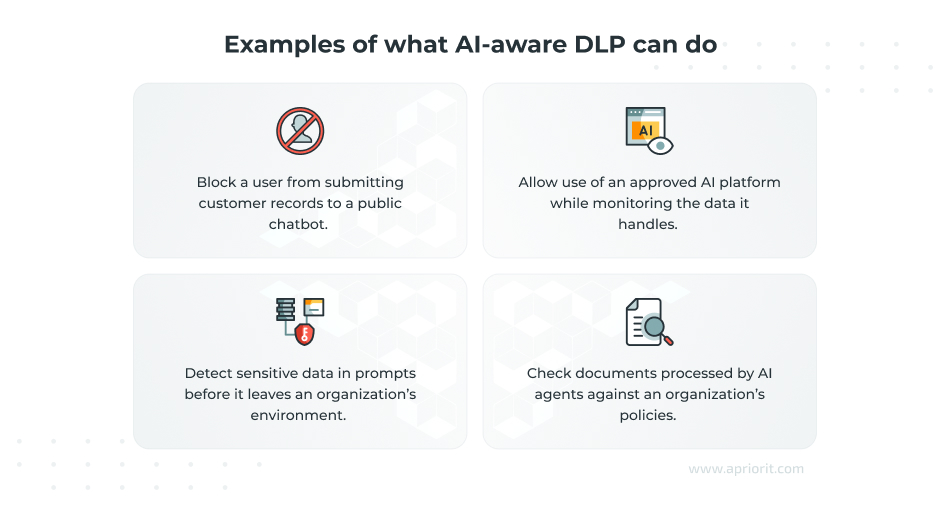
In this way, AI-aware DLPs can access AI prompts and conversations, documents uploaded to AI tools, and AI-generated responses to check for sensitive data leaks.
How does AI-aware DLP work?
AI-aware DLP applies the same core principles as traditional systems (monitor files, emails, network traffic, and endpoints) while also extending visibility, classification, and policy enforcement to AI-related interactions.
Key capabilities of AI-aware DLPs include:
1. Inline prompt inspection. A solution scans prompts before they are sent to an AI provider, detecting sensitive data like personally identifiable information (PII), credentials, source code, and confidential business information.
Different products achieve this visibility in different ways, each with its own coverage and limitations. For example:
- Browser extensions can monitor DOM, paste, and keystroke inputs but may break when an application’s UI changes and may not cover desktop clients or command-line tools.
- Proxies and secure web gateways can inspect network traffic but may face certificate pinning and privacy constraints.
- API gateways cover only managed API traffic.
- Endpoint agents require platform-specific drivers or hooks for Windows, macOS, and Linux.
Inline inspection must balance detection depth against latency. To ensure that, AI-aware DLP solutions can use a two-layer inspection pipeline: a fast synchronous layer based on regex, EDM, document fingerprinting, or lightweight ML models for immediate decisions; and a more advanced semantic or LLM-based layer for ambiguous or higher-risk interactions.
2. Identity and device-context awareness. Depending on the product and its integrations with identity and device management systems, AI-aware DLP may also use contextual signals to enforce adaptive policies. For example: user roles, device and app types, location, and risk levels for different interactions.
3. Sensitive data protection. Some AI-aware DLP and GenAI security controls can redact, mask, tokenize, and even replace sensitive values with placeholders before content reaches the model.
To identify such content, solutions may combine techniques such as:
- Exact data matching (EDM) and index document matching (IDM) / document fingerprinting for known data.
- Embedding-based similarity for documents that are semantically similar.
- Named entity recognition (NER), ML-based classifiers, secrets detection, and code-similarity analysis for source code.
- Small local models or LLM-as-classifier for unstructured content.
The specific detection techniques available depend on the product architecture and integrations used.
4. Bidirectional inspection. AI-aware DLP can inspect both user inputs and model responses and can block, replace, or sanitize sensitive output before it reaches the user.
Read also
Discover and Protect Sensitive Data Using Artificial Intelligence
Improve the efficiency of sensitive data discovery processes and support compliance efforts at scale. See how modern AI-enabled approaches can help your organization gain better control.

Key considerations when developing AI-aware DLP solutions
Adding AI awareness doesn’t necessarily mean rebuilding a DLP product.
Existing classification engines, policy frameworks, and enforcement mechanisms remain the foundation. However, your team should extend data protection capabilities to handle the less predictable and increasingly autonomous nature of AI workflows.
The key is to determine where the current architecture needs broader coverage, richer decision context, and new enforcement points.
Below, we list key considerations from our experience that can help product and technical teams implement AI awareness in DLPs.
1. Maximize coverage of AI interactions
Start with the most obvious, yet the most important step: Identify as many AI interactions as possible across managed environments.
Make sure your solution will be able to collect telemetry from all supported and managed locations where employees and systems interact with AI technologies, including:
- Prompts submitted to AI applications.
- Files uploaded to AI tools.
- AI-generated responses.
- API calls to LLMs.
- Embedded copilots within enterprise platforms.
- Custom AI agents, chatbots, and skills.
- Agentic systems that exchange data with external tools and services.
- Model Context Protocol (MCP) connections and tool interactions, where supported.
Plus, pay special attention to shadow AI discovery. This term covers the use or deployment of AI applications, models, accounts, APIs, embedded AI capabilities, agents, or related services without appropriate IT or security visibility, approval, or governance. It can include entirely unsanctioned tools as well as unapproved accounts, features, integrations, or agents operating within otherwise approved platforms.
To implement such visibility, your team can use endpoint agents, browser extensions, secure web gateways, API integrations, cloud access security brokers (CASBs), and native integrations with enterprise AI platforms.
2. Enrich sensitive information detection with context analysis
Once an interaction with AI services is detected, an AI-aware DLP solution must correctly evaluate whether the information being exchanged is sensitive.
Using only predefined patterns (such as credit card numbers, customer identifiers, and regulatory keywords) is often insufficient to identify all sensitive information, particularly unstructured or organization-specific content. The reason is that some proprietary assets like organization-specific intellectual property, product designs, or research data may lack the structured patterns that traditional classifiers rely on.
AI-aware DLP solutions should enrich interactions with contextual information whenever such context is available. This helps with both accurately identifying sensitive data and evaluating the risk score of each interaction. For example, uploading source code to an approved internal copilot may represent a lower risk than uploading the same content to a personal account in a public AI chatbot.
To sum up, make sure your future AI-aware DLP can:
Answer questions like: | Use additional methods like: | Supplement each interaction with contextual information like: |
❓What type of information is being shared? ❓ Where did that information originate? ❓ Is it confidential, regulated, or proprietary? ❓ Which user is performing the action? ❓ Which AI application is involved? | 🔦Contextual and semantic content analysis 🔦 Document and data lineage tracking 🔦 Cross-channel correlation 🔦 Context-aware policy evaluation 🔦 Custom classifiers trained on organization-specific content | ✅User identity and role ✅ Device ✅ Application type ✅ Account type (corporate or personal) ✅ Location and network context ✅ Sensitivity labels associated with source content |
Note: Context can also include agent identity, permissions, and intended actions. An AI agent retrieving customer records to complete an approved workflow may require different controls than an agent accessing the same information before sending it to an external tool or service. As organizations adopt agentic systems, DLP policies need to evaluate not only who is handling data but also which agent is involved, what it is authorized to access, and what actions it intends to perform.
Unlike human users, agents can’t be coached or warned. As a result, AI-aware DLP may need to:
- Enforce machine-readable deny responses.
- Require step-up authorization with a human in the loop.
- Apply rate, scope, or volume limits.
- Restrict access to specific tools and resources.
- Trigger a kill switch when risky behavior is detected.
Related project
Improving Research Efficiency and Privacy: Corporate AI Chatbot Development for a Consulting Firm
Explore how a custom AI solution helped our client streamline access to research data and improve the efficiency of knowledge retrieval. Find out how Apriorit delivered an AI-powered system tailored to specific business needs and strict security requirements.

3. Enforce a graduated policy
Once the handling of sensitive data has been identified and a risk level has been determined, a system can take action.
Modern AI-aware DLP solutions should provide several response options. For example, apart from allowing or blocking an interaction, the system can also warn a user, provide coaching guidance, redact sensitive information, or request additional approval.
Response type | Action options | Scenario example | Business benefit |
Allow | ❕ Proceed without interruption for low-risk interactions. | A user submits non-sensitive information to an approved AI app operating within established policies. | Support AI adoption for legitimate use cases without degrading the user experience. |
Warn | ❕ Display a warning before data is shared when an interaction presents a potential risk. | A user attempts to run a prompt including the organization’s name within an external AI app. The system shows a warning and doesn’t allow the user to press enter. | Increase security awareness while giving users an opportunity to reconsider their actions. |
Coach | ❕ Explain applicable security policies. ❕ Recommend approved AI tools. ❕ Suggest removing sensitive information from prompts. ❕ Provide instructions for handling regulated data. | A user attempts to automate a routine task using an external AI app. The system doesn’t allow for submitting the prompt without redacting it first (e.g. removing the company name) and explains how the original prompt violates policies. | Build long-term security awareness and reduce repeated policy violations. |
Route | ❕ Redirect a user toward approved alternatives. | A user attempts to send a customer report into a non-approved AI tool. The system automatically redirects the request to an internally managed AI agent. | Allow a user to complete their tasks while maintaining compliance with organizational policies. |
Block | ❕ Block a user in case of high-risk activities. | A user attempts to attach a customer report with PII into an external AI chatbot. | Avoid data leaks along with reputational, legal, and financial losses. |
4. Prevent sensitive information disclosure in outputs
An important difference between AI-aware and traditional DLP is that the protection workflow can operate in both directions.
Say that a corporate AI assistant retrieving information from internal knowledge bases pulls up personal customer data that the requesting employee doesn’t have access to. In such cases, AI-aware DLP can also inspect the generated responses to detect and prevent sensitive information from being disclosed to such an employee.
Note: Access to internal grounding data should first be governed by identity management, source-system permissions, least privilege, connector controls, and internal security policies. Output inspection only provides an additional defense layer against data leakage rather than a substitute for methods mentioned above.
What your DLP team can do is inspect generated responses before they are presented to users, particularly in applications that access sensitive enterprise data (where possible). For example, your team can insert an output guardrail or response inspection layer between the model (or agent) and the UI, as well as make the application wait for the verdict before rendering anything.
However, output inspection comes with tradeoffs. Modern LLM applications often stream responses token by token, so making users wait for a final verdict can significantly worsen the user experience. Depending on security and latency requirements, development teams can choose between several approaches:
- Full buffering allows for inspecting the entire response before displaying it to the user. It provides the strongest protection but is very slow.
- Chunk- or sentence-level inspection buffering inspects streamed content in smaller portions using a sliding window. It improves responsiveness while maintaining some level of control.
- Pre-generation validation inspects retrieved context and source data before the model generates a response. It reduces the risk of sensitive information appearing in the output.
- Streaming with post-generation controls prioritizes responsiveness and intervenes only after suspicious content is detected. It improves the UX but carries a higher risk, as users most likely have already seen the exposed data.
When designing AI-aware DLP capabilities, you should also consider the following:
- Apply data classification and sensitivity labels consistently across AI-accessible repositories.
- Review how AI applications and agents retrieve, process, and expose enterprise data.
- Use techniques such as sanitization, tokenization, and redaction when sensitive information should not be shared with AI systems.
- Align controls with established AI security and risk management frameworks, such as the NIST AI risk management framework and OWASP recommendations for sensitive information disclosure risks.
5. Design for governance, built-in security, and compliance
DLP solutions are expected to support regulatory requirements, internal governance policies, and audit processes. With AI-enabled environments, this means that businesses need visibility into how sensitive data is classified, accessed, processed, and shared. Without appropriate governance controls, organizations may struggle to demonstrate compliance or investigate AI-related security incidents.
For many development teams, the goal is to ensure that AI-related controls align with established security and risk management practices while implementing those AI-related controls, not sometime later. This approach can help reduce technical debt, simplify audits, and support evolving regulatory expectations around AI and data protection.
Here’s what your team can do to align product development with compliance and security expectations:
- Make AI activity auditable. Record prompts, file uploads, agent actions, tool calls, policy decisions, and enforcement outcomes to support investigations and compliance reporting. At the same time, avoid turning your DLP into another repository of sensitive information. Apply appropriate protections to audit data, including redaction or masking of sensitive content, encryption, and strict access controls.
- Govern AI agents, tools, and integrations. Define which agents, copilots, MCP servers, and external AI services are approved, what data they can access, and which actions require additional authorization.
- Apply least-privilege access across AI workflows. Limit agent permissions, tool access, and data exposure to only what is required for each task.
- Extend classification and policy controls to data that AI can access. Make sure that sensitivity labels, retention requirements, and governance policies remain enforceable when information is handled via AI systems.
- Evaluate AI-specific regulatory and risk management requirements early. Align product design with applicable AI governance, data protection, and industry compliance regulations before introducing new AI capabilities.
Read also
How to Secure Agentic AI During Development: Turning a Digital Insider into a Useful Tool
Prepare your organization for the security challenges of agentic AI. Discover practical guidance for protecting AI agents, integrations, and connected enterprise environments.

How Apriorit can help with AI-aware DLP development
At Apriorit, we combine 20+ years of experience in software development and cybersecurity engineering with proven skills in building successful AI projects.
Our tech experts will gladly help you accelerate AI awareness implementation and reduce technical risks when:
✓ Delivering new data protection functionality with support for AI-specific workflows.
✓ Extending existing cybersecurity products with capabilities for monitoring and protecting sensitive data in AI tools.
Here are a few examples of what else we can do for you:
- Develop AI tools for cybersecurity. Leverage our skills to build custom AI/ML tools for sensitive data discovery and classification. You can also request secure AI solutions like custom copilots, RAG systems, AI assistants, and enterprise AI applications.
- Strengthen your overall security posture. Protect your product or corporate infrastructure while adopting AI technologies. Apriorit provides expertise in application security, cloud security, identity and access management, data protection, and regulatory compliance.
- Integrate products with AI and enterprise ecosystems. Request custom APIs and integrations development to connect DLP products with AI/ML services, cloud platforms, enterprise applications, and security infrastructure.
- Consult on AI implementation and security. Assess AI-related data protection risks, evaluate existing security controls, and help define architectures and policies. Our tech experts will answer all your questions to help you align your product with desired business goals and relevant requirements.
Last but not least, at Apriorit, we apply secure SDLC practices throughout design, development, testing, delivery, and maintenance. We are ready to help you establish security-first development by incorporating security requirements at each stage of the project.
Introduce AI awareness into your DLP solution!
Reach out to start modernizing your existing DLP product with AI-aware capabilities or build a new advanced solution from scratch.
FAQ
How is AI-aware DLP different from traditional DLP?
Traditional DLP primarily focuses on monitoring channels like email, cloud storage, endpoints, and web traffic. AI-aware DLP expands protection to AI-specific interactions, including prompts, LLM APIs, embedded copilots, AI agents, and agentic workflows.
Why do organizations need AI-aware data loss prevention?
AI-aware DLP helps organizations maintain visibility and control over AI-related interactions and data flows. The most common examples of new security blind spots are employees who increasingly use AI tools to analyze data, generate content, and automate business processes. This way sensitive information can be exposed through prompts, uploads, AI-generated responses, and autonomous workflows.
How does AI-aware DLP protect sensitive data?
It protects sensitive information by combining visibility, classification, and policy enforcement across AI-enabled workflows. AI-aware DLP can help organizations monitor data shared with AI applications, identify sensitive content, evaluate risk based on context, and apply appropriate controls.
What capabilities should I prioritize when modernizing DLP for AI?
<p>While priorities vary by product and use case, DLP vendors and enterprise security teams typically focus on extending visibility to AI interactions, discovering unmanaged AI applications, improving classification accuracy for unstructured content, and supporting AI-specific policy enforcement.</p>
<p>Additional areas often include governance for AI agents and tool integrations, AI-assisted data discovery and classification, graduated policy models, and compliance controls. Together, these capabilities can help organizations adapt existing DLP architectures to evolving AI-related risks without rebuilding them from scratch.</p>
Can you add AI-aware capabilities without rebuilding an existing DLP product?
<p>In many cases, yes. Existing DLP investments remain valuable because core capabilities such as classification engines, policy frameworks, reporting systems, and enforcement mechanisms are still relevant in AI environments.</p>
<p>Rather than replacing these components, organizations can often extend them to cover AI-specific interaction channels, including prompts, file uploads, copilots, AI applications, and agentic workflows. This approach can reduce complexity while preserving previous investments in data protection technologies.</p>



