


Key takeaways:
- IoT devices are an integral part of many automotive systems: they collect, process, and transmit data needed for navigation, predictive maintenance, and driver monitoring.
- Each IoT use case relies on its own combination of sensors, controllers, and connectivity modules, and often on integrations with external systems.
- Developing software for automotive IoT-powered systems comes with security, integration, data normalization, energy consumption, and other challenges that require specialized domain expertise.
IoT devices and software are the basis of a connected vehicle. They enable almost all of the vehicle’s smart features, from GPS navigation and on-board entertainment to assisted driving and self-driving.
However, to use IoT capabilities efficiently, software engineering teams must take into account numerous hardware limitations, requirements for specific use cases, and industry regulations on vehicle security and safety.
As a TISAX-certified company that frequently works with automotive software development projects, we’ll share:
- How IoT-powered connectivity works in a vehicle.
- Typical use cases for IoT in automotive.
- How to overcome some of the key challenges of developing software for automotive IoT.
This article will be useful for automotive technology leaders who want to build or modernize IoT-powered features and are looking for relevant engineering experience.
Contents:
How automotive IoT connectivity works
Automotive IoT is an ecosystem of in-vehicle sensors, controllers, connectivity devices, networks, and software platforms. It allows vehicles to collect, process, and exchange data with other devices and services. IoT solutions enable connected and smart services in modern vehicles such as remote diagnostics, navigation, charging management, and V2X communication.
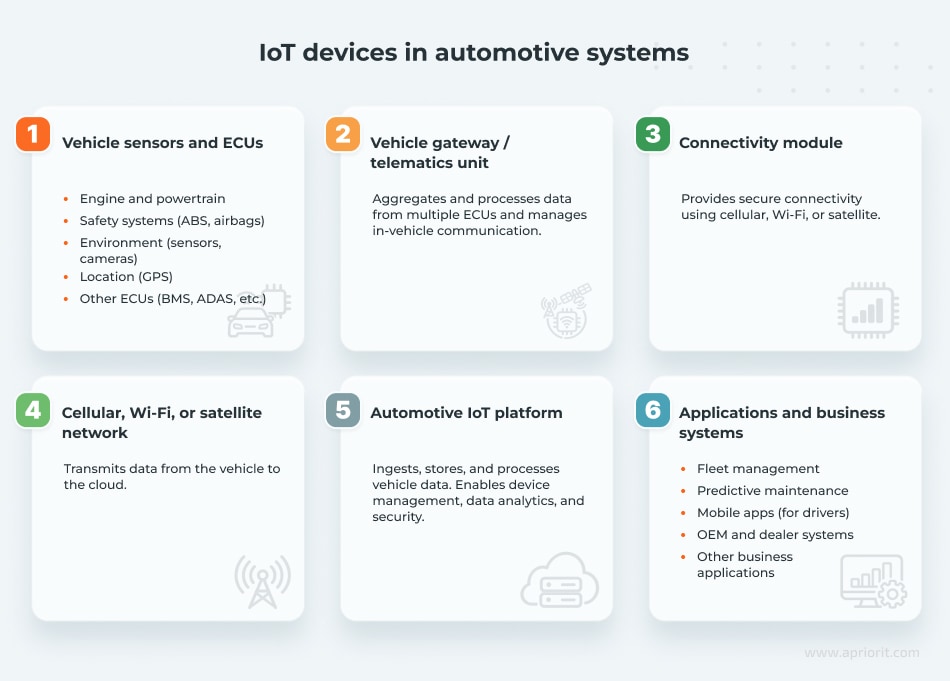
IoT devices are usually responsible for ingesting, processing, and sending data to cloud automotive IoT platforms. They typically perform the following tasks:
- Data collection. A connected vehicle is packed with sensors and perception devices: cameras, radar, LiDAR, ultrasonic sensors, GNSS receivers, etc. They collect data about the vehicle’s environment, internal mechanisms, and driver and passengers. This raw data can be processed locally or sent to an external database or service.
- Local processing. Devices and IoT systems like domain controllers, zonal controllers, telematics control units (TCUs), and central vehicle gateways can read signals and do basic processing. Typically, this includes decoding signals, filtering and aggregating data, adding timestamps, and buffering records while connectivity is unavailable. Local processing can also include edge AI tasks.
- Authenticate. The central vehicle gateway or TCU can work with hardware security modules or secure elements to protect encryption keys and prove the identity of the vehicle or ECU.
- Normalize and interpret. Vehicle gateways and domain controllers can decode CAN frames, map proprietary signals to a common signal model, convert units, and validate values before sending them to a cloud service.
- Transmit. TCUs with 4G/5G modems, Wi-Fi and Bluetooth modules, satellite modems, and C-V2X/DSRC units send collected telemetry to cloud platforms. These devices also receive remote commands and updates, as well as communicate with vehicles or road infrastructure.
Having issues with your in-vehicle IoT systems?
Apriorit’s automotive development experts are here to help.
Key use cases for IoT in the automotive industry
IoT solutions power many automotive software systems that depend on reliable, accurate, and in some cases real-time data from a vehicle.
Let’s look at some of the most common use cases and examples of using IoT in the automotive industry.
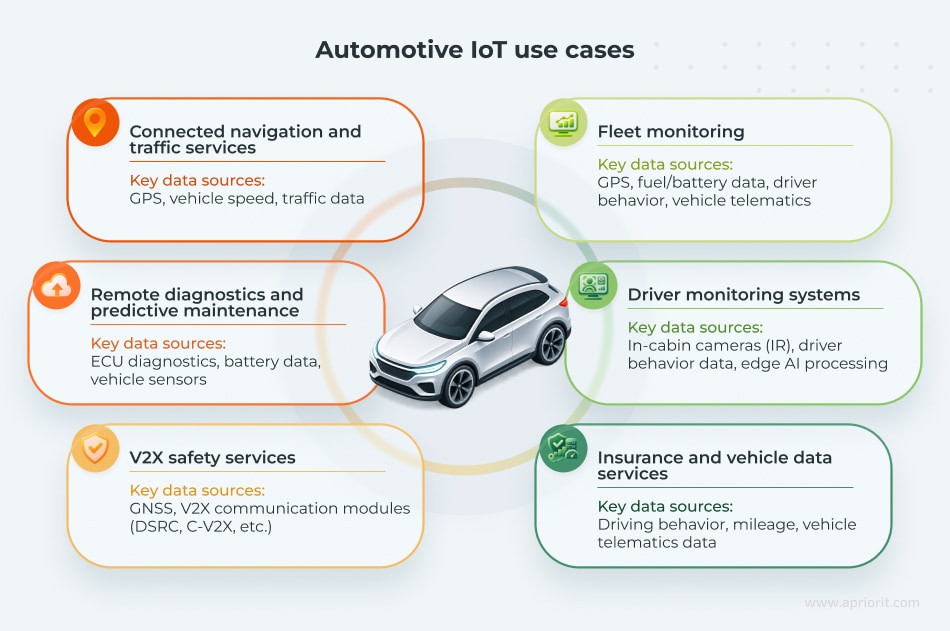
Connected navigation and traffic services
Use case: Providing drivers with more relevant info on chance events like accidents, road closures, weather conditions, and available parking and charging stations.
Instead of relying only on a preloaded map, connected navigation systems analyze data like vehicle location, speed, direction, information on other vehicles, road infrastructure signals, etc.
IoT devices and solutions involved: GNSS receivers, in-vehicle navigation software, mapping and traffic APIs, and sometimes roadside infrastructure.
Impact: Products like TomTom Traffic process anonymized car data from millions of navigation devices, in-dash systems, and applications. According to TomTom, traffic-aware routing can reduce commuting times by up to 20%, while more accurate traffic information can improve estimated arrival times by up to 15%.
Remote diagnostics and predictive maintenance
Use case: Allowing manufacturers, dealerships, and fleet operators to monitor vehicle health without waiting for scheduled maintenance or a driver’s report. Remote diagnostics and predictive maintenance systems pair vehicle telemetry with data from service records, warranty systems, spare parts inventories, and other automotive systems. Their analysis can notify drivers and technicians on developing failures and hidden patterns.
For electric vehicles, the same architecture can support battery and charging management by monitoring key charge, health, and energy consumption metrics.
IoT devices and solutions involved: ECUs and sensors that collect diagnostic trouble codes and measurements such as battery voltage, temperature, pressure, fluid levels, mileage, and component performance; vehicle gateway or TCU to filter and transmit this information.
Impact: Automotive manufacturers like Volvo can provide a connected services platform that provides fleets with real-time data from onboard telematics and diagnostic systems. The Volvo Connect portal gives operators access to vehicle status, performance, fuel efficiency, maintenance, and safety information. Drivers can use the Volvo app to remotely check the status of fuel, oil, coolant, washer fluid, lighting, and cab temperature.
Read also
Predictive Maintenance in the Automotive Industry: Benefits and Challenges
Discover how predictive maintenance systems use sensor data, analytics, and connected technologies to detect issues early and optimize service schedules.
Fleet monitoring
Use case: Tracking vehicle locations, reviewing routes, monitoring fuel or energy consumption, identifying excessive idling, and responding to breakdowns. Fleet monitoring systems consolidate IoT data from multiple commercial vehicles into a single, usually cloud-based platform.
IoT devices and solutions involved: A fleet monitoring system may collect GNSS coordinates, odometer readings, engine parameters, battery status, cargo conditions, and events such as harsh braking or rapid acceleration. On top of that, a fleet platform usually needs to integrate with dispatching, route planning, maintenance, fuel management, and enterprise resource planning systems.
Impact: Reduction of idle time and unplanned downtime. The 2024 Teletrac Navman Telematics Survey found that 96% of fleet operation professionals reported achieving savings through telematics. In addition, 47% said they were integrating AI tools into their technology stacks to automate and simplify fleet management processes.
V2X safety services
Use case: Exchange of safety information with other vehicles, road infrastructure, and network services. It relies on frequent standardized messages between all communication participants. They exchange information such as position, speed, direction, acceleration, and vehicle status.
IoT devices and solutions involved: On-board units (OBUs) in vehicles, roadside units (RSUs) at intersections and work zones, multi-constellation GNSS receivers for positioning and timing, and hardware security modules (HSMs) or secure elements for certificate storage and message signing.
Impact: The US Department of Transportation demonstrated the potential effect of individual V2X applications in 2024. Its evaluation snapshot reports that V2X-based digital alerts used near Indiana interstate work zones reduced hard braking events by 80%. V2X signal priority for school buses in Fulton County, Georgia, reduced stops by 40% and overall travel time by 13%.
Driver monitoring systems
Use case: Detecting signs of distraction, drowsiness, or reduced engagement, and preventing road incidents. For example, a driver assistance system can use a near-infrared camera to determine whether the driver is looking at the road. If the driver remains distracted, the system can issue visual, audible, or haptic warnings.
This is one of the few IoT use cases in the automotive industry where data processing usually happens inside the vehicle because alerts must be generated quickly and captured video data may be sensitive. Edge AI models can interpret sensor input and send only selected events or system health data to a back end.
IoT devices and solutions involved: An in-cabin infrared camera, infrared lights that help it work at night, and a processing unit that detects where the driver is looking and whether they appear tired or distracted.
Impact: Driver monitoring alerts can reduce drowsiness events by more than 60% in workplace driving studies, although there’s currently no research to confirm the effect on crash rates.
Driver monitoring has also become a compliance requirement: since July 7, 2026, all new passenger cars and vans in the EU must include an advanced driver distraction warning system.
Insurance and vehicle data services
Use case: Using mileage and real driving behavior data to estimate an individual vehicle’s risk exposure rather than calculating premiums only from aggregated risk factors. Automotive IoT data can support usage-based insurance and other services that depend on verified information about vehicle operation.
IoT devices and solutions involved: Plug-in OBD devices, built-in vehicle telematics systems, installed “black boxes” that can record mileage, location, speed, acceleration, braking, and cornering.
Impact: Berg Insight estimated that Europe and North America had approximately 34 million active insurance telematics policies in 2024. According to SambaSafety’s Telematics Report, 72% of surveyed commercial fleets reported fewer crashes and claims after combining telematics with driver training, while one in four reported lower insurance premiums.
Read also
The Future of ADAS Development: Your Roadmap to Prioritizing Product Features
Evaluate where ADAS innovation is heading before making long-term product decisions. Learn what advancements are likely to influence automotive development in the coming years.

Challenges and solutions of using IoT in connected vehicles
There are several key limitations that make software development for automotive IoT challenging. They include:
Computing. Many IoT components, especially sensors, TCUs, and aftermarket devices, have limited computing power, memory, and energy capacity. They are too small to fit and power hardware components that can run complex calculations or store data. Limited computing power makes developers carefully choose and implement only must-have features.
- Compliance. Automotive software development is heavily regulated by ISO 26262, ISO 24089, ISO 21434, ASPICE, the GDPR, and other laws, standards, and frameworks that describe how developers must treat a vehicle’s safety and security.
- Cybersecurity. Automotive IoT devices collect sensitive data about a vehicle’s drivers and passengers: locations, typical routes, personal preferences, credentials for integrated navigation and media services. This data should be protected with encryption, authentication, anonymization, and other mechanisms.
- Maintenance. Even though OTA updates are becoming more common for vehicles, they are still limited in what can be updated, how often a vehicle will connect to a stable network, and whether an update is secure.
As automotive software developers, we have seen how these limitations, requirements, and challenges impact real projects. The good news is that with enough experience and foresight, you can plan around them to deliver secure software.
Here are some of the most common challenges we’ve seen in automotive projects and ways they can be solved:
Table 1. The key challenges of automotive IoT software development
Challenge | How it complicates development | How to tackle it |
Standardizing fragmented vehicle data | – OEMs and vehicle models expose different signals, units, naming conventions, and CAN message formats. – Data format inconsistencies make telemetry difficult to interpret. | – Introduce a normalization layer in the gateway or cloud platform. – Use established models where suitable, such as COVESA Vehicle Signal Specification. |
Ensuring stable connectivity | – Lost connections can interrupt telemetry, remote commands, or update downloads. – Continuously transmitting raw data increases bandwidth and cloud costs. | – Design for intermittent connectivity and resumable transfers. – Prioritize safety- or service-critical messages, or aggregate other data at the edge. – Use multiple communication channels where possible. |
Integrating vehicles with external systems | – External and legacy systems may use incompatible APIs, proprietary protocols, or outdated data formats. – Replacing them may be costly or disruptive, while direct integration increases technical debt and maintenance effort. | – Use an anti-corruption layer with protocol adapters, schema transformation, and API gateways. – Decouple systems through queues or event-driven integration. – Apply the Strangler pattern for modernization. |
Securing IoT communication | – Communication modes and connections to external services expand the attack surface. – Compromised credentials or commands may expose sensitive data or access. | – Use authentication, encrypted communication, least-privilege access, and secure key storage. – Segment external components from safety-critical in-vehicle networks. – Add threat analysis, vulnerability monitoring, and security testing to the SDLC. |
Building support and maintenance systems | – Connected vehicles must remain operational while cybersecurity threats change. – Diagnosing failures is difficult when logs are incomplete or distributed. | – Add remote diagnostics, structured logging, fleet observability, software inventories, and update status monitoring. – For OTA updates, use signed packages, compatibility checks, staged rollouts, recovery mechanisms, and rollback. |
Managing energy consumption in connected EVs | – IoT elements and on-board systems consume energy even when the vehicle is parked. – Frequent communication when the vehicle is parked can drain the low-voltage battery. | – Define sleep states and wake-up conditions for sensors, ECUs, gateways, and modems. – Batch non-urgent transmissions. – Coordinate connectivity with the battery management system and schedule demanding tasks while charging. |
Implementing regulatory and functional safety requirements | – Teams must maintain traceability and evidence across requirements, architecture, implementation, and post-production changes. – Compliance responsibilities extend across OEMs, suppliers, cloud providers, and software vendors. | – Identify applicable standards and regulations during requirements and architecture design rather than after implementation. – Document changes during development and support. – Build pipelines for risk analysis and compliance monitoring. |
In practice, each of these challenges comes with its own nuances and unique solutions. Detecting them before you start hands-on development and planning your SDLC around them will help you deliver your project within deadlines and ensure code security and reliability.
Developing automotive IoT software with Apriorit
Apriorit is a TISAX-certified software development company whose experience with automotive projects ranges from building AI-based customer support apps to auditing the security of connected vehicle communications.
Our experts have diverse experience with automotive-specific tasks and in development areas like:
- Embedded and IoT engineering. We’re comfortable working at a low level. Whether you need custom firmware for your IoT devices, integrations with legacy systems, or maintenance and OTA updates, our team is ready to deliver.
- Connectivity and telematics development. Our engineers design systems that connect different types of devices and ensure consistent, secure, and structured data exchange. We also build data collection pipelines that collect all the telematics your automotive services need.
- Cybersecurity-focused development. Our development approach is based on a secure SDLC, which keeps your software safe at any stage of development. Our team also has 20+ years of experience in securing sensitive data to ensure your solution is protected post-launch.
- Full-cycle automotive development. Apriorit provides every type of specialist your project may need, from project managers to embedded engineers and QA specialists. With quick onboarding and AI-assisted development workflows, we can start making a difference in your project in two weeks.
Build your automotive software using our expertise!
Our engineers are ready to tackle all of your project’s development challenges.
FAQ
What is automotive IoT?
<p>Automotive IoT refers to the technologies that connect vehicles to cloud platforms, mobile apps, fleet systems, and other infrastructure. Vehicles use sensors and communication modules to collect and share data about their location, condition, performance, and surroundings.</p>
<p>This connectivity supports services such as remote diagnostics, predictive maintenance, fleet tracking, over-the-air software updates, and usage-based insurance.</p>
Why does security matter in automotive IoT?
<p>Connected vehicles exchange sensitive data and may allow remote access to certain functions. Using an unsecure connection, attackers could steal driver or vehicle data, disrupt fleet operations, install unauthorized software, or gain access to vehicle systems.</p>
<p>Security measures must cover the whole automotive system. That includes in-vehicle networks, telematics devices, cloud infrastructure, APIs, mobile apps, and over-the-air updates.</p>
What is the difference between automotive IoT and a connected vehicle?
<p>A connected vehicle can communicate with external systems through cellular networks, Wi-Fi, Bluetooth, satellite, or vehicle-to-everything technology.</p>
<p>Automotive IoT is the larger ecosystem that makes this communication useful. It includes connected vehicles, sensors, data processing tools, mobile apps, fleet management systems, and roadside infrastructure.</p>
Which types of IoT devices are used in vehicles?
<p>Modern vehicles use many connected devices and components. The exact set depends on the features a vehicle and systems around it support. Typically, a vehicle includes:</p>
<ul>
<li>Cameras, radar, LiDAR, and ultrasonic sensors</li>
<li>Tire pressure and temperature sensors</li>
<li>Accelerometers and gyroscopes</li>
<li>Battery management systems</li>
<li>Cellular, Wi-Fi, Bluetooth, and V2X modules</li>
<li>In-vehicle gateways</li>
<li>Infotainment systems</li>
<li>Aftermarket OBD-II tracking devices</li>
<li>Edge computing units that process data inside the vehicle</li>
</ul>
Have a question?
Ask our expert!

VP of Innovation and Technology, Canada Branch Director