


Embedded finance is the integration of a financial product or service into the customer journey of another digital product or platform. This technology can be applied to different services and features, from payments and lending to insurance and financial accounts.
For software companies, embedded finance can create new opportunities to improve customer experiences and expand product capabilities.
This article explores the core concepts, examples, benefits, risks, and implementation considerations behind embedded finance.
Contents:
- What is embedded finance?
- Embedded finance vs. BaaS vs. open banking
- Where is embedded finance used?
- How does embedded finance work?
- What types of embedded finance exist?
- Popular examples of embedded finance
- What benefits does embedded finance offer to software product companies?
- What risks and challenges should companies consider before implementing embedded finance?
- How can Apriorit help with embedded finance integrations?
What is embedded finance?
Embedded finance is the integration of a financial product or service into the customer journey of another digital product or platform. This technology allows users to access capabilities such as payments, financing, accounts, insurance, or investment services without moving to a separate financial application.
A company operating the platform with embedded finance may provide the financial service itself where legally permitted. However, embedded finance commonly involves one or more authorized or regulated financial partners.
Technology and infrastructure providers can also support integration, processing, onboarding, recordkeeping, and other parts of the service. The exact arrangement depends on the financial product, the parties’ roles, and the jurisdictions involved.
Embedded finance vs. BaaS vs. open banking
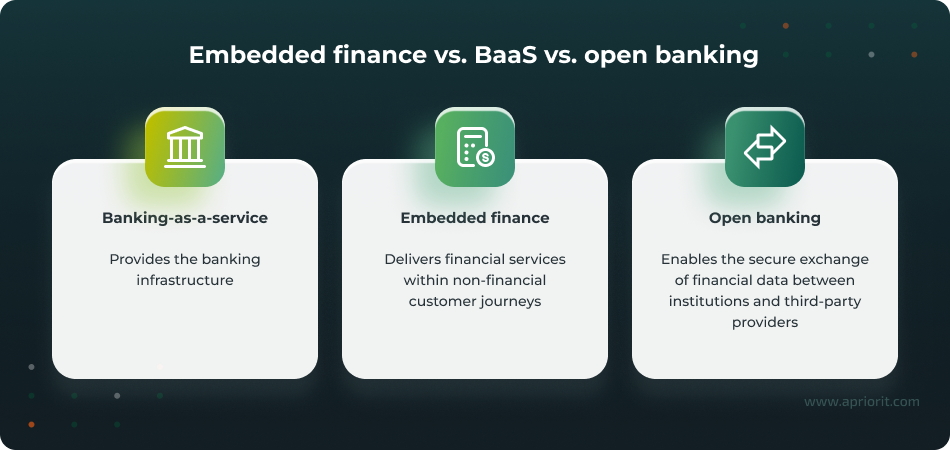
The terms embedded finance, banking-as-a-service (BaaS), and open banking are sometimes used interchangeably. However, they refer to different layers of the financial ecosystem.
Let’s look at the difference between embedded finance, BaaS, and open banking:
- Banking-as-a-service (BaaS) is the infrastructure layer that enables non-bank companies to offer financial products by connecting to licensed banking services through APIs. In other words, BaaS provides the regulated banking capabilities that businesses can build on without becoming banks themselves.
- Embedded finance is the customer-facing result of BaaS infrastructure. It refers to financial services integrated directly into non-financial platforms, allowing users to access features (payments, lending, insurance, banking services) without leaving the app or website they are already using.
- Open banking is a layer of secure data sharing that allows banks to share account and transaction data with authorized third parties via standardized APIs and customer consent. FinTech service providers use open banking to build products like personal finance tools, account aggregation services, and alternative lending solutions.
Where is embedded finance used?
Embedded finance helps businesses retain customers by providing seamless digital experience, as users can complete payments, insurance purchases, and other financial activities without leaving the platform they are already using.
Embedded finance examples
Product types | Embedded finance use case |
E-commerce solutions | ✅ Integrated checkout ✅ Digital payments |
SaaS platforms | ✅ Invoice payments ✅ Subscription billing ✅ Customer financing |
Online marketplaces | ✅ Automated seller payouts ✅ Merchant accounts |
Travel systems | ✅ In-app payments ✅ Insurance ✅ Financing options |
B2B platforms | ✅ Embedded lending ✅ Trade finance ✅ Payment solutions |
How does embedded finance work?
Embedded finance works by combining a customer-facing platform with one or more financial and technology providers. Users access financial services within the application they already use, while the financial functionality is delivered behind the scenes through partnerships and integrations.
A typical embedded finance arrangement involves several participants such as:
- The embedded platform that provides user experience and controls the customer journey.
- A financial provider who supplies the underlying financial service where authorization or regulation is required.
- Technology or infrastructure providers who may support onboarding, transaction processing, account management, orchestration, or system integrations.
Additional partners may participate depending on the product, service model, and regulatory requirements.
The systems used by these parties often exchange information via APIs and other integration methods.
What types of embedded finance exist?
In real life, categories of embedded finance overlap. Their legal treatment depends on the product structure, the activities each party performs, and the jurisdictions involved.
For example, a financial account may be structured as a bank deposit or an electronic-money product, with different protections and provider roles. A card may provide access to an account while also functioning as a payment instrument. Similarly, merchant financing can include loans and credit lines as well as products that aren’t legally treated as loans in every jurisdiction.
The table below shows how the most common types of embedded finance products are grouped:
Type | What it provides | Examples |
Embedded payments and payouts | ✅ Payment acceptance ✅ Checkout ✅ Transfers ✅ Payouts integrated into another product | ⚪ In-app checkout ⚪ Marketplace seller payouts ⚪ Invoice payments |
Embedded credit and financing | ✅ Access to credit or other financing within a customer or business workflow | ⚪ Buy now, pay later ⚪ Credit lines ⚪ Seller financing ⚪ Merchant cash advances |
Embedded accounts and cards | ✅ Accounts or stored-value products ✅ Money movement ✅ Card-based access to funds | ⚪ Business spending accounts ⚪ Virtual cards ⚪ Earnings-linked debit cards |
Embedded insurance | ✅ Insurance offered in the context of another purchase or activity | ⚪ Travel insurance presented during booking ⚪ Protection offered with a product purchase |
Embedded investing services | ✅ Access to investment or wealth-management functionality within another application | ⚪ Brokerage access ⚪ Portfolio tools ⚪ Investment features |
Popular examples of embedded finance
The following examples show how leading digital platforms integrate financial services directly into their existing customer journeys, making transactions more convenient while creating additional value for users and businesses alike.
- Uber offers embedded payouts through the Uber Pro Card for drivers and couriers.
- Shopify provides Shopify Balance for businesses to receive payouts, manage cash flow, transfer funds, and make purchases.
- Amazon Lending allows marketplace sellers to access financing offers directly within Seller Central.
- Airbnb enables eligible guests to use buy now, pay later (BNPL) options at checkout via Klarna.
- Tesla embeds insurance directly into the vehicle ownership experience.
What benefits does embedded finance offer to software product companies?
Embedded finance can help software product companies extend their products with financial capabilities that support existing customer workflows.
By embedding financial products directly into their apps and software, companies can reduce customer drop-offs, achieve higher conversion rates, improve customer satisfaction, and receive new revenue from additional services.
The key benefits of embedded finance include:
- Improved customer journey. Users are able to access payments, financing, accounts, or other financial services without moving to a separate provider’s product. This can reduce context switching, although verification, disclosures, and other required steps may remain.
- Additional revenue opportunities. A company may earn fees, receive a share of financial product revenue, or support more activity within its core product. The available model depends on the service, the agreements between participating companies, and applicable regulations.
- Stronger engagement and retention. A useful financial capability may give customers more reasons to complete related workflows within the same product. However, retention depends on the feature solving a relevant problem and working reliably.
- Product differentiation. Embedded finance can help a software company address needs that its core functionality alone doesn’t cover. For example, a marketplace may combine commerce tools with seller payouts or financing, while a software-as-a-service platform may add invoice payments or expense cards.
Note: The results of integrating embedded finance technologies in your project depend on the service’s relevance, reliability, commercial model, and regulatory structure. The benefits listed above are potential outcomes rather than automatic effects.
What risks and challenges should companies consider before implementing embedded finance?
Businesses should carefully evaluate embedded finance integration before acting on it. Key risks and challenges include:
- Security and data exposure. Embedded finance can distribute personal and financial data across the platform, financial providers, and infrastructure partners. Teams need to account for authentication and authorization weaknesses, data leakage, fraud, compromised partners, insecure webhooks or file transfers, privileged access, and coordinated incident response.
- Regulatory and compliance complexity. Applicable obligations depend on the financial service, each party’s activities and role, the customer and transaction type, and the jurisdictions involved. Payments, credit, accounts, insurance, and investment functionality can fall under different regulatory regimes. Working with an authorized provider doesn’t automatically remove the platform from the regulatory perimeter or transfer every compliance obligation to the partner.
- Third-party dependencies. The service may depend on external providers for processing, financial guardrails, recordkeeping, onboarding, compliance tooling, underwriting, or servicing. Provider outages, interface changes, control failures, or relationship termination can affect the platform’s customer-facing functionality.
- Integration and operational complexity. Multi-provider arrangements require teams to coordinate data formats, system records, transaction states, retries, exception workflows, reconciliation, and monitoring. These requirements can continue after launch as providers and their interfaces evolve.
- Unclear ownership of customer outcomes. Different organizations may handle onboarding, transaction processing, account servicing, complaints, refunds, or disputes. Contracts should allocate these responsibilities clearly, but contractual allocation alone doesn’t remove each regulated party’s legal obligations.
- Business continuity and exit risk. Product teams need to consider how the service will operate during partner outages and how customer records, transactions, and support responsibilities will be handled if a provider relationship ends. Provider oversight, contingency planning, and exit arrangements must therefore be part of the product’s operating model.
How can Apriorit help with embedded finance integrations?
Apriorit is ready to help your product teams integrate embedded finance technologies into your product securely and efficiently.
Whether you need to connect third-party services, develop custom APIs, modernize legacy components, or coordinate multiple providers within one software ecosystem, our engineers can design and implement the integrations your solution requires.
Here’s what we offer:
- Secure API development and integration
- FinTech development services
- Security-first engineering approach
- Support for compliance efforts
Planning to add financial capabilities to your product?
Partner with Apriorit to build secure, reliable integrations that connect your platform with the financial services your customers need.



