



Key takeaways:
- While AUTOSAR isn’t a regulatory requirement or licensing authority, OEMs expect Tier 1 suppliers, embedded software companies, and other vendors to follow its standards.
- The biggest challenges of AUTOSAR adoption are rarely just technical — they are organizational, procedural, and strategic.
- Successful AUTOSAR implementation is much more likely when teams invest early in architectural decisions, disciplined workflows, and cybersecurity measures.
As vehicle software becomes more complex and interconnected, automotive companies face growing pressure to deliver systems that are scalable, interoperable, and compliant with industry expectations.
At the same time, the increasing complexity of software-defined vehicles and the need to coordinate multiple electronic control units introduce new operational and security challenges.
These factors significantly expand the attack surface, enabling new potential vectors for cyber attacks. Consequently, there is a growing need to prioritize cybersecurity by design, enforce strict isolation between system components, and ensure secure execution environments across the entire vehicle platform.
AUTOSAR has emerged as a de facto standard for addressing these challenges. However, adopting it in practice is far from straightforward.
In this article, we explore:
- What AUTOSAR-based development really means in practice
- Common pitfalls companies encounter during adoption
- Best practices that help engineering teams successfully implement AUTOSAR-based systems
Contents:
What is AUTOSAR?
Automotive Open System Architecture (AUTOSAR) is a global development partnership of leading automotive OEMs, Tier 1 suppliers, semiconductor vendors, and software development companies. Its mission is to define and maintain a standardized software framework and open electrical/electronic (E/E) system architecture for automotive systems.
AUTOSAR standards (often referred to as platforms) provide a layered software architecture, standardized APIs, and predefined software modules. These allow automotive teams to integrate ECUs and hardware from multiple suppliers and keep their software portable, reusable, and hardware‑independent across vehicle programs.

What is AUTOSAR-based development?
Technically speaking, AUTOSAR standards aren’t regulations or formal certification schemes, as AUTOSAR isn’t a governmental or standards body.
In this article, AUTOSAR-based development refers to aligning your software architecture, interfaces, middleware behavior, and development processes with AUTOSAR specifications and interoperability requirements.
In practice, this means building automotive software so that it can integrate predictably with OEM and supplier ecosystems that are already AUTOSAR‑based.
Classic AUTOSAR vs Adaptive AUTOSAR
Classic and Adaptive AUTOSAR are complementary platforms. They are designed to co‑exist within the same vehicle, each serving different performance, safety, and lifecycle requirements in modern E/E architectures.
| Classic AUTOSAR | Adaptive AUTOSAR | |
|---|---|---|
| What it is | Standardized software for deeply embedded, deterministic ECUs with strict real‑time and safety requirements | Standardized platform for high‑performance computing ECUs requiring dynamic behavior and scalability |
| Best fit | Time‑critical, safety‑determined control systems | Compute‑intensive, scalable, updateable vehicle software |
| Use cases | ⵔ Powertrain ⵔ Chassis ⵔ Body control ⵔ Airbags ⵔ Braking | ⵔ ADAS / autonomous driving ⵔ Infotainment ⵔ Centralized compute ⵔ SDV domains |
| Operating system (OS) | OSEK‑derived real‑time OS or bare‑metal RTOS | POSIX-compliant OSs (often Linux-based in practice) |
| Update capabilities | Limited; updates typically require reflashing entire ECU software | Supports incremental updates and enables OTA-capable architectures |
Need reliable automotive software developers?
Leverage our deep experience in AUTOSAR, embedded systems, and SDV development to accelerate delivery and reduce risks in your automotive projects!
How can your business benefit from AUTOSAR alignment?
Instead of treating AUTOSAR as just a set of technical recommendations, many OEMs, Tier 1 companies, semiconductor manufactures, software suppliers, and tool suppliers approach it as a strategic operating model for vehicle software delivery.
Key business advantages include:
✓ Lower integration cost through structured reuse
Software components can be reused without AUTOSAR, but AUTOSAR offers a shared architectural framework that makes reuse consistent, portable, and vendor-agnostic. Components developed within its standardized interfaces and configuration models are easier to transfer between ECUs, vehicle variants, and even OEM programs. This also helps to reduce reintegration and revalidation effort.
✓ Faster time to market thanks to standardized tooling and workflows
AUTOSAR ecosystems rely on mature configuration and specialized tools that automate large parts of Basic Software (BSW) configuration, runtime environment (RTE) generation, and interface mapping. This shortens development cycles and reduces manual integration work, which is especially valuable when working on multi‑ECU programs.
✓ Market access and supplier qualification
While AUTOSAR compliance is not mandatory, many OEMs expect or require it in requests for quotation (RFQs). If your organization is a Tier 1 supplier or embedded software vendor, AUTOSAR expertise is a baseline qualification; lacking it can be a deal‑breaker.
✓ Streamlined safety and security certification efforts
AUTOSAR platforms are designed to support ISO 26262 and ISO/SAE 21434 compliance (though using platforms does not automatically guarantee compliance). Relying on standardized, widely accepted middleware and development concepts helps your teams establish proper security and accelerate certification.
✓ Architectural scalability across vehicle and software lines and variants
AUTOSAR enables OEMs to scale software across platforms by separating application logic from hardware specifics. This means the same application component can run on different ECUs or hardware platforms with minimal changes because hardware-specific details are handled by the underlying AUTOSAR stack rather than the application itself. This is especially important for organizations managing multiple vehicle lines, automotive software components, and regional configurations over long product lifecycles.
Related project
Auditing the Security of a Connected Vehicle Communication System
Find out how partnering with Apriorit helped a client to uncover hidden security gaps in their vehicle communication system, strengthen defenses, and build a future-ready automotive solution.

What makes automotive software AUTOSAR-compliant?
At Apriorit, we suggest approaching AUTOSAR alignment as a layered concept.
Let’s explore the key layers and what they mean for businesses:

1. Architectural conformance
At its core, AUTOSAR defines a common way to structure automotive software.
Instead of every supplier inventing their own ECU architecture, AUTOSAR enforces unified components such as:
- AUTOSAR XML (ARXML) ー A standardized description format that defines software components, interfaces, system topology, and configuration data. ARXML acts as the contract between tools, teams, and suppliers.
- Basic Software (BSW) configuration ー A configuration of AUTOSAR’s standardized middleware and services layer, ensuring consistent behavior across ECUs.
- Runtime Environment (RTE) ー The middleware layer that connects application software components with BSW and hardware, based on configuration and system descriptions.
Such an architectural conformance allows different suppliers to build software that integrates predictably.
2. Process alignment with ASPICE
Automotive SPICE (ASPICE) is a maturity model that assesses the maturity of development processes for electronic and software-based systems.
By defining how development is performed, ASPICE enforces requirement traceability, controlled integration, defined testing strategies, change control, and so on.
AUTOSAR doesn’t mandate ASPICE. However, OEMs typically expect vendors to follow it because in real-life projects, ASPICE is what makes AUTOSAR-based development reliable and scalable.
3. Functional safety enablement
AUTOSAR features support functional safety but don’t replace the ISO 26262 safety lifecycle. The platform supplies mechanisms like deterministic timing, partitioning, watchdog integration, and error reporting that safety engineers use to achieve automotive safety integrity level (ASIL) goals.
Achieving ISO 26262 compliance for a safety‑relevant function still requires hazard analysis, ASIL assignment, safety requirements, and more.
Note: For functions where correct performance in intended conditions is critical, your team should pay attention to ensuring the safety of the intended functionality (SOTIF) according to ISO 21448. AUTOSAR provides tools and interfaces that make meeting ISO 26262/SOTIF feasible, but the normative work comes from the safety processes and artifacts you produce.
4. Cybersecurity and regulatory readiness
Modern AUTOSAR platforms can help your teams provide secure communication, update management, and diagnostic control, helping organizations align with automotive cybersecurity expectations.
However, in parallel, your team should also consider compliance with ISO/SAE 21434. This requires a lifecycle approach that includes threat analysis, risk assessment, vulnerability management, and more.
Additionally, you might need to consider UNECE WP.29 regulations that impose legal requirements in many jurisdictions for UNECE contracting parties:
- UN Regulation No. 155 — Cyber security and cyber security management system
- UN Regulation No. 156 — Software update and software update management system
These regulations tie into AUTOSAR alignment by demanding demonstrable processes and capabilities that your automotive software must support.
5. Validated toolsets
AUTOSAR‑based development typically relies on established tool ecosystems, where tool interoperability and correct usage matter as much as source code itself. Tool qualification and controlled toolchains help ensure that the artifacts claimed to be AUTOSAR‑compliant are actually correct and reproducible, which is important for safety cases and supplier audits.
Projects typically apply MISRA C/C++ and AUTOSAR C++14 guidelines to AUTOSAR Classic code, and they qualify compilers, code generators, and model‑based tools that produce ARXML or generated sources.
OEM expectations regarding AUTOSAR alignment vary by customer, project type, and other details. Let’s summarize the most common and typical indicators of AUTOSAR‑compliant delivery:
| What OEMs usually look for as signs of compliant delivery: |
|---|
| ✅ Documented and versioned ARXML baseline |
| ✅ Clear variant and configuration management strategy |
| ✅ Evidence supporting ASIL allocation or decomposition, where applicable |
| ✅ Test coverage and integration validation reports aligned with project scope |
| ✅ Results of conformance testing results, audit trails, and tool qualification analysis |
4 challenges of AUTOSAR adoption
AUTOSAR adoption is rarely straightforward.
Many organizations underestimate the technical, organizational, and transformation costs involved, especially when moving beyond pilot projects into series production and multi‑supplier programs. But knowing what pitfalls to expect can help you set realistic expectations and avoid expensive mid‑program corrections.
Automotive developers typically face these challenges:
1. Technical complexity and ecosystem fragmentation
AUTOSAR introduces a high level of architectural and configuration complexity. BSW configuration alone may involve hundreds of parameters, often managed through vendor‑specific tools like Vector DaVinci or EB tresos. These toolchains evolve quickly, and feature parity across vendors is not guaranteed.
ARXML file management may also become a pain point, as different teams generate, modify, and exchange configuration artifacts that must remain version‑compatible and consistent. Integration issues often emerge not from application code but from subtle mismatches across configurations, tool versions, or platform assumptions.
2. Migration from legacy architectures
The real cost of migrating from proprietary or non‑AUTOSAR stacks is not rewriting code but rethinking architecture, tooling, processes, and team workflows.
Partial migration is possible but introduces its own risks. Hybrid environments — where AUTOSAR and legacy components coexist — often require complex adapters and compromise architectural clarity.
Teams must decide carefully when to:
- Migrate existing code
- Wrap legacy components
- Redesign functionality entirely
Getting this decision wrong can lock programs into fragile architectures that are difficult to evolve.
3. Organizational and supplier coordination challenges
AUTOSAR operates within a multi‑tier supply chain, where OEMs, Tier 1s, Tier 2s, and IP vendors all contribute software and configuration artifacts.
This raises difficult governance questions:
- Who owns the AUTOSAR configuration baseline?
- Who is responsible for integration validation?
- How are changes reviewed, approved, and propagated?
Without clear ownership, AUTOSAR programs can suffer from configuration drift, duplicated effort, and late‑stage integration failures. Such a mismatch can occur even when individual suppliers are technically proficient.
4. The AUTOSAR talent gap
Successful AUTOSAR implementation requires knowledge and skills in AUTOSAR specifications, tooling behavior, integration patterns, and OEM‑specific expectations. This level of competence typically takes years to build internally.
Organizations must make explicit trade‑offs between:
- Investing in long‑term internal training
- Hiring scarce AUTOSAR specialists
- Partnering with external teams that bring established expertise
Each option has cost and scalability implications, and many program delays can be traced back to underestimating this skills gap.
Read also
Getting In-Vehicle Infotainment Software Development Right: Features and Practical Advice from Tech Experts
Discover how to build robust in-vehicle infotainment systems that meet modern user expectations and automotive standards. Learn strategies to improve performance and scalability.

Best practices for successful AUTOSAR implementation
Successfully implementing AUTOSAR requires more than conforming to specifications. For most automotive organizations, the real challenge lies in managing architectural complexity, coordinating multi-supplier ecosystems, and ensuring long-term scalability.
As a company with practical experience developing secure and compliant automotive software, we’ve gathered five best practices to help your team reduce implementation risks while aligning AUTOSAR adoption with business goals.
1. Start with a clear architecture and platform strategy
Early architectural misalignment may significantly increase system complexity and reduce reuse across platforms. Before development begins, your teams should make explicit decisions about which AUTOSAR platform to use and where each fits within the vehicle architecture.
A well-defined AUTOSAR architecture strategy should:
- Clarify the roles of Classic and Adaptive AUTOSAR within the same vehicle platform
- Define boundaries between application software, middleware, and hardware abstraction
- Establish how ECUs interact across domains (powertrain, advanced driver assistance systems (ADAS), infotainment, etc.)
It’s also crucial to plan for scalability: how new features, variants, or ECUs will be added over time without breaking the overall architecture. This includes designing modular software components, maintaining stable interfaces, and minimizing cross-component dependencies.
2. Pay attention to configuration management
AUTOSAR development is heavily configuration-driven. Artifacts such as ARXML files, BSW configurations, and RTE mappings become critical integration contracts across teams and suppliers. Because of that, configuration integrity directly governs runtime behavior and system interoperability.
Make sure your team establishes:
- A centralized and versioned AUTOSAR configuration baseline
- Strict ownership and change control processes
- Automated validation checks for configuration consistency
3. Invest early in timing and performance analysis
Deterministic behavior is a cornerstone of AUTOSAR-based systems, especially for safety-critical ECUs. However, timing issues often emerge late (such as during integration or validation), which is when they are the most expensive to fix.
To avoid expensive fixes, implement the AUTOSAR Timing Analysis framework. It emphasizes:
- Early modeling of task scheduling and communication timing
- Analysis of worst-case execution times
- Validation of end-to-end latency across software components
Ignoring timing constraints at early stages can lead to missed deadlines, degraded system reliability, and failure to meet functional safety requirements. In multicore and high-performance ECUs, this becomes even more critical due to complex task distribution and resource contention.
4. Use model-based development and automation
Given the complexity of AUTOSAR configuration and code generation, manual processes scale poorly. Model-based development tools and automated workflows help teams maintain consistency and reduce human error.
Best practices include:
- Using modeling tools like MATLAB and Simulink to generate AUTOSAR-compliant components
- Automating RTE generation, code integration, and validation pipelines
- Applying coding standards such as MISRA alongside AUTOSAR guidelines
5. Integrate cybersecurity from the beginning
AUTOSAR itself doesn’t guarantee security by default. Your team must include software engineers with cybersecurity expertise to make sure the final product is truly protected.
Best practice is to integrate:
- Functional safety artifacts like hazard analysis and ASIL decomposition into AUTOSAR design decisions
- Cybersecurity requirements like secure communication, diagnostics, and update handling
- Continuous traceability between requirements, implementation, and validation
- Proven cybersecurity processes like secure architecture reviews, threat modeling, and secure configuration of communication and diagnostics
Late‑stage security retrofits are particularly expensive in AUTOSAR systems, as they often impact configuration, interfaces, and update mechanisms. Proactive security integration reduces redesign risk and supports alignment with ISO/SAE 21434 expectations.
Read also
Automotive HMI Design and Development: Building Safe, Scalable, High-Performance Cockpits
Learn how to create intuitive and responsive interfaces that enhance user satisfaction while meeting strict industry standards and requirements.
How Apriorit can help you with secure automotive software development
Our team is ready to assist you with projects of any complexity by providing professional vehicle software development services. We help automotive companies address AUTOSAR challenges with a practical, results-driven approach to embedded and vehicle software development.
As a TISAX-certified company, Apriorit uses proven ways to ensure advanced cybersecurity measures in your automotive solution and help you validate the security posture of suppliers and service providers.
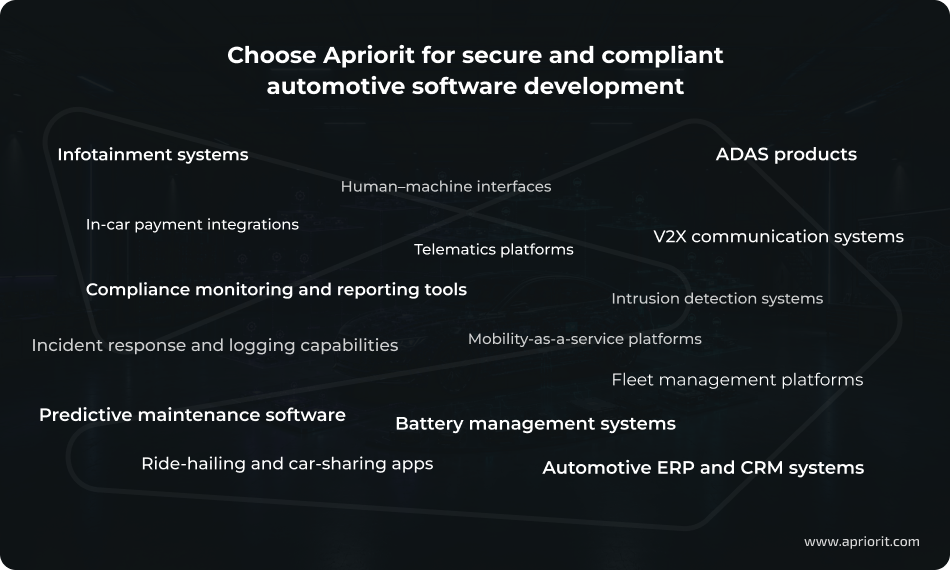
By partnering with Apriorit, you get:
- Deep automotive and embedded engineering expertise. Work with engineers who have proven experience in developing AUTOSAR-based solutions and generating high-quality software bills of materials (SBOMs).
- Adherence to industry standards and regulations. Be sure your project is developed according to all key recommendations, guidelines, and requirements: NIST, AUTOSAR, ISO 26262, ISO/SAE 21434, MISRA C, ASPICE, GDPR, etc.
- Low-level and system programming capabilities. Leverage our strong background in kernel, driver, and resource-constrained environments for reliable ECU development.
- Focus on cybersecurity. Receive a product that’s developed by following secure SDLC practices at every stage. At Apriorit, we align development workflows with the best protection strategies to ensure resilient automotive software.
- Testing and audit services. Level up your project protection with professional software code audit and penetration testing services from an independent party.
- Legacy modernization and advanced reverse engineering. Analyze software and hardware that’s undocumented or damaged, recover lost functionality, and modernize legacy systems.
- Expertise in cross-platform and high-performance systems. Receive efficient solutions for both constrained ECUs and high-performance computing platforms.
- End-to-end support across the product lifecycle. Get the full spectrum of services, from architecture design and custom AUTOSAR development to integration, modernization, and long-term evolution.
Entrust your automotive project to security experts!
Let Apriorit build you secure, reliable, and future-ready automotive software. Our teams combine deep technical expertise with a solid knowledge of AUTOSAR-driven development.
FAQ
Is AUTOSAR compliance mandatory for automotive software?
<p>No, AUTOSAR compliance isn’t legally mandated.</p>
<p>There’s no formal certification required to claim AUTOSAR compliance in automotive systems. However, in practice, many OEMs and Tier 1 suppliers expect AUTOSAR alignment as part of their technical requirements, especially in RFQs and long-term platform development programs.</p>
Can AUTOSAR be used together with non-AUTOSAR software components?
Yes, AUTOSAR-based systems frequently coexist with non-AUTOSAR components, especially in real-world vehicle architectures and during gradual migration from legacy platforms. This is typically achieved using wrappers, adapters, or dedicated integration layers that bridge different interfaces and communication models.
What tools are commonly used in AUTOSAR development?
<p>AUTOSAR development relies on specialized toolchains for configuration, code generation, and validation. Common examples include:</p>
<ul class=apriorit-list-markers-green>
<li>Vector DaVinci</li>
<li>Elektrobit EB tresos</li>
<li>ETAS ISOLAR</li>
<li>MATLAB</li>
<li>Simulink</li>
</ul>
Does AUTOSAR limit software customization or innovation?
<p>No, it doesn’t prevent customization or innovation.</p>
<p>AUTOSAR in automotive standardizes architecture and interfaces, which may seem restrictive at first. However, it simply defines how software components should interact within a shared framework. In practice, AUTOSAR enables innovation at the application level while reducing integration overhead.</p>
Is AUTOSAR relevant for software-defined vehicle development?
<p>Yes, AUTOSAR plays a key role in software-defined vehicle (SDV) architectures. Classic AUTOSAR continues to support safety-critical, real-time ECUs, while Adaptive AUTOSAR is designed for high-performance, service-oriented systems with dynamic behavior and <a href=cybersecurity-risks-of-ota-automotive>OTA update capabilities<a>.</p>
What are the risks of poor AUTOSAR implementation?
<p>Poor AUTOSAR implementation can lead to significant technical and business risks. These include:</p>
<ul class=apriorit-list-markers-green>
<li>Integration failures across ECUs and suppliers</li>
<li>Inconsistent configurations</li>
<li>Performance and timing issues</li>
<li>Increased effort during validation and certification</li>
</ul>
<p>At scale, these problems lead to delayed releases, higher development costs, reduced system reliability, and difficulty evolving the software architecture.</p>